2 Mil vs 3 Mil Packing Tape: Which to Choose
You need tape today, the pack station is low, and you're staring at rolls labeled 1.9 mil, 2.0 mil, 2.6 mil and 3.1 mil. The higher number looks like the safer buy, but that shortcut is where bad seals and wasted spend start.
This guide breaks down 2 mil vs 3 mil packing tape in terms you can use at the bench. You will learn what the mil label really measures, how to match tape to carton weight and climate, and when a thicker roll pays for itself.
Table of Contents
- Why Tape Thickness Confuses Buyers
- What the Mil Number Actually Means
- 2 Mil vs 3 Mil Tape Compared Side by Side
- How to Match Tape to Carton Weight and Climate
- A Simple Process for Choosing Your Tape
- When Thicker Tape Saves Money
- Shop Packing Tape in Stock
- Frequently Asked Questions About Tape Thickness
Why Tape Thickness Confuses Buyers
A buyer sees a case marked 3 mil, assumes it is the heavy duty answer, and orders a pallet. A week later, flaps lift on recycled cartons in a cold dock area. The tape was thick enough. The adhesive was wrong for the surface and the temperature, and nobody checked anything past the number on the label.
That pattern shows up constantly in purchasing. Two rolls can both say 3 mil and behave differently, because the mil figure does not always measure the same thing on every spec sheet. Backing material changes the result. So does how the tape gets applied at the bench.
What a Failed Seal Actually Costs You
A popped seam rarely stops at retaping one box. Your crew repacks, replaces damaged goods, and sometimes pays to reship the order. The customer waits longer than they should. Those costs stack fast, which is why this choice deserves more than a glance at the label.
The question isn't which number is bigger. It's which tape holds your carton, on your box surface, in your building's conditions.
Thickness works as a starting filter when you browse the full packing tape category. It cannot be the only one. The decision rule that holds up at the bench weighs carton weight, box surface, and climate together, with adhesive and backing sitting on top of that baseline.
What the Mil Number Actually Means
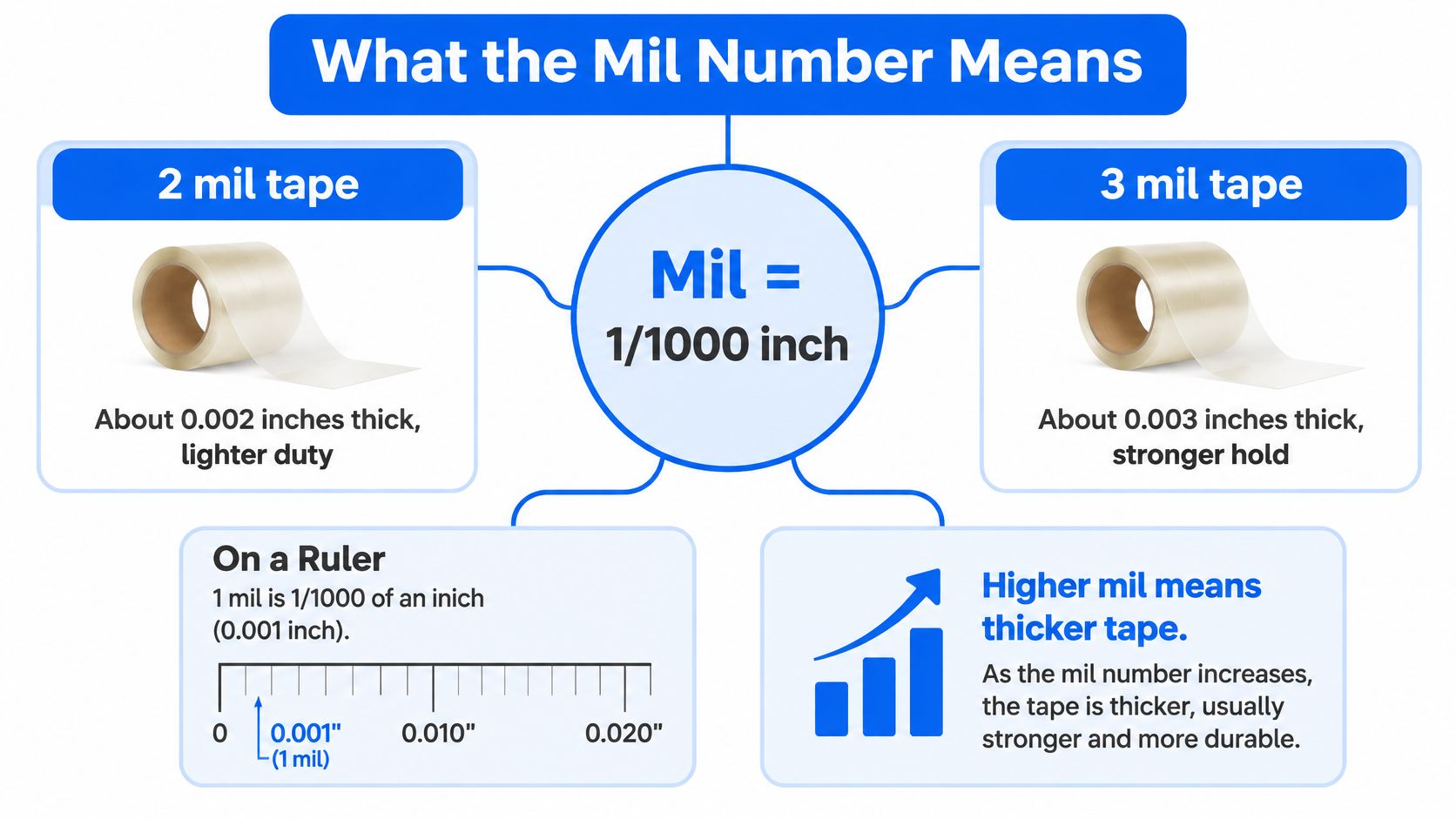
A mil is one thousandth of an inch. So 2 mil tape is about 0.002 inches (0.0508 mm) thick, and 3 mil tape is about 0.003 inches (0.0762 mm) thick, a difference of 0.001 inch, per Grainger's 3 mil packaging tape listing. That same listing reflects the point that thickness alone doesn't settle performance, since adhesive chemistry and backing matter too.
The quick visual below shows the scale difference between the two grades.
Film Thickness Versus Total Thickness
This is the detail most buyers miss. The number on a carton often covers the total thickness, which includes the backing film and the adhesive layer together. A tape sold around 3 mil may sit between 2.6 and 3.1 mil total once both layers are counted, so check the product spec instead of assuming an exact figure.
When you open a spec sheet, look for three values.
- Total thickness: backing plus adhesive, measured in mils.
- Tensile strength: how much pulling force the tape resists before breaking.
- Adhesion: how well it grips a test surface, usually steel.
Reading the 1.6 to 3.1 Mil Range
You'll see labels like 1.6, 1.9, 2.0, 2.6, and 3.1 mil on the market. Lower numbers suit light, clean cartons. Mid range numbers around 2.0 mil cover routine shipping. Higher numbers add material margin for heavier or rougher work. Treat those labels as sorting shortcuts, then confirm with the full spec before you commit to a case quantity.
2 Mil vs 3 Mil Tape Compared Side by Side
Put a 2 mil roll next to a 3 mil roll and the difference is easy to state. The thicker tape carries 50% more nominal thickness, based on measurements taken under the ASTM D3652 thickness test method. Sealing strength doesn't scale the same way. Tensile results depend on the backing polymer and the adhesive formula, so the extra mil buys material margin rather than a proportional jump in holding power. Keep that gap in mind as you read the table.
2 Mil vs 3 Mil Packing Tape at a Glance
| Specification | 2 Mil Tape | 3 Mil Tape |
|---|---|---|
| Nominal thickness | About 0.002 inches | About 0.003 inches |
| Duty class | Medium duty | Heavy duty |
| Typical carton load | Routine cartons, moderate weight | Heavier cartons, rough handling |
| Best surface | Clean, new corrugated | Recycled or dusty corrugated |
| Common use | Everyday e commerce and office shipping | Dense goods, long transit, cold areas |
What Published Test Data Shows
Manufacturer data shows why the label alone misleads. One 2 mil film construction reaches 3.0 mil total thickness once adhesive is counted, with 32 pounds per inch tensile strength and 150% elongation at break, according to Intertape's premium packing tape data sheet. That same document shows thinner and thicker grades don't move in a clean, proportional line.
Read that again, because it changes how you order. A roll sold as "2 mil" can measure 3.0 mil on a test gauge. Two tapes at the same mil rating can pull different tensile numbers. That spread comes from different backing films and adhesive coats, not sloppy labeling. You can see this spread when you compare standard packing tape options next to heavier grades.
How to Use This Comparison
Shortlist with the table, then pull the full data sheets for the exact rolls you're considering. Check tensile strength, adhesion, and total thickness together, in that order. A supplier who can't give you those three numbers is asking you to buy blind.
How to Match Tape to Carton Weight and Climate
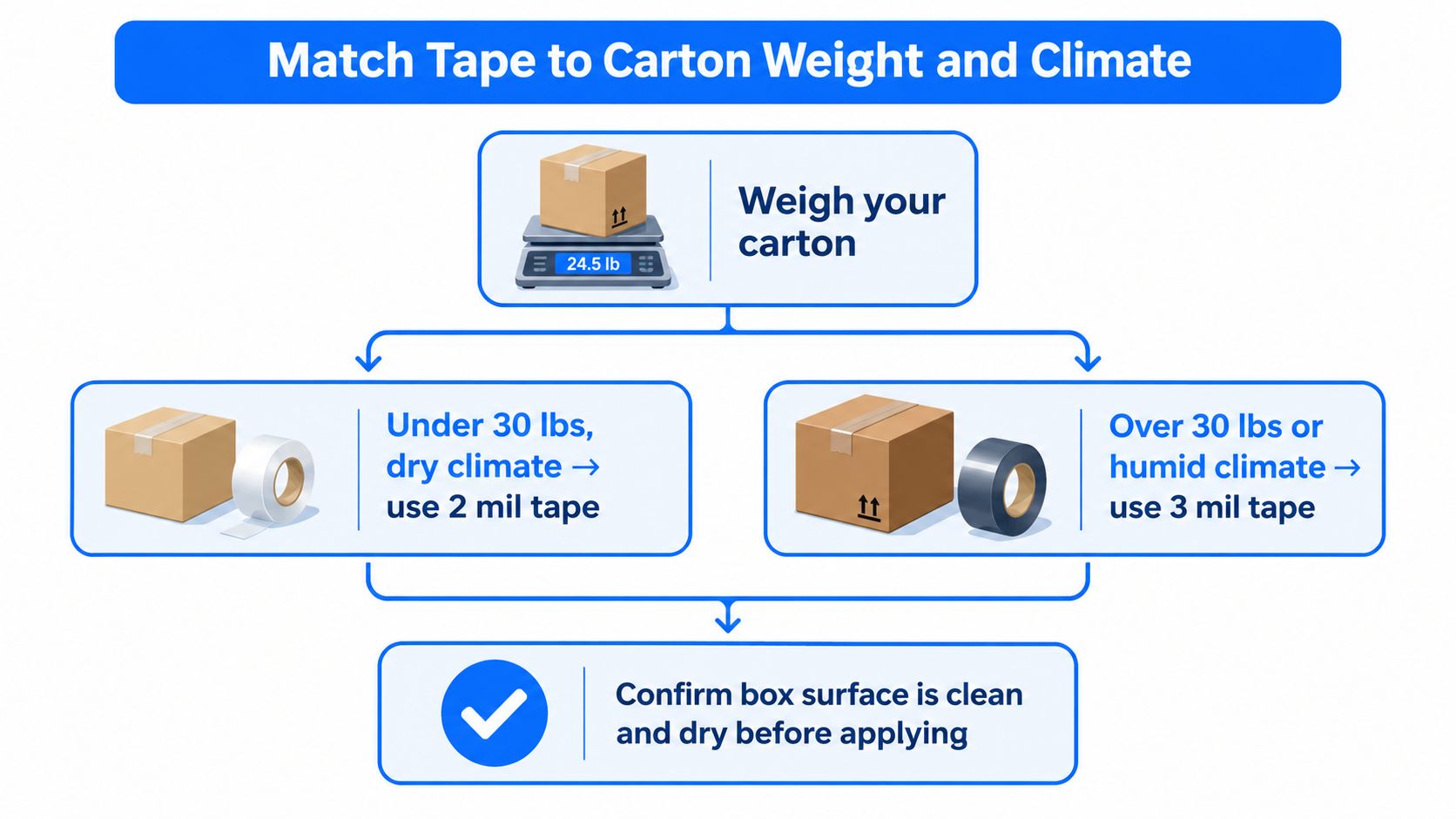
Start with weight, because it's the variable you can measure today. Routine cartons do fine on 2 mil tape. Once a carton goes over 30 lb, or the box uses recycled content, or the shipment sits in a cold room, move up to a 3 mil grade and confirm the spec supports it.
Use this flow to sort your cartons before you order.
Surface and Temperature Change Everything
Recycled corrugated has shorter fibers and a rougher, dustier face. Adhesive has less to grab. Cold air makes many adhesives stiffer, so a tape that seals well at room temperature can flag open in an unheated trailer. If your cartons pass through cold storage, look at cold temperature packing tape built for those conditions instead of forcing a standard grade to work.
Published selection guidance separates loads in a similar way. The tesa tape selection chart places low load work at a maximum of 15 kg and medium load work at a maximum of 30 kg, with standard service listed at 0 to 35 degrees C. That gives you a neutral frame for sorting your own cartons.
The video below shows proper application, which matters as much as tape choice.
Practical rule: A thicker tape still fails on contaminated flaps or with a mismatched adhesive. Clean the surface, press the tape down firmly, and test before you scale up.
Validate your pick with a controlled test. Seal sample cartons, store them at your real temperature, and check the seams after handling. That half hour of testing beats guessing across a pallet order.
A Simple Process for Choosing Your Tape
I've watched buyers order 3 mil tape for every carton on the dock because the heavier label felt safer. It sealed fine. A lighter grade would have done the same job on their light boxes at a lower cost per roll. Thickness only earns its price when weight, surface, and climate call for it.
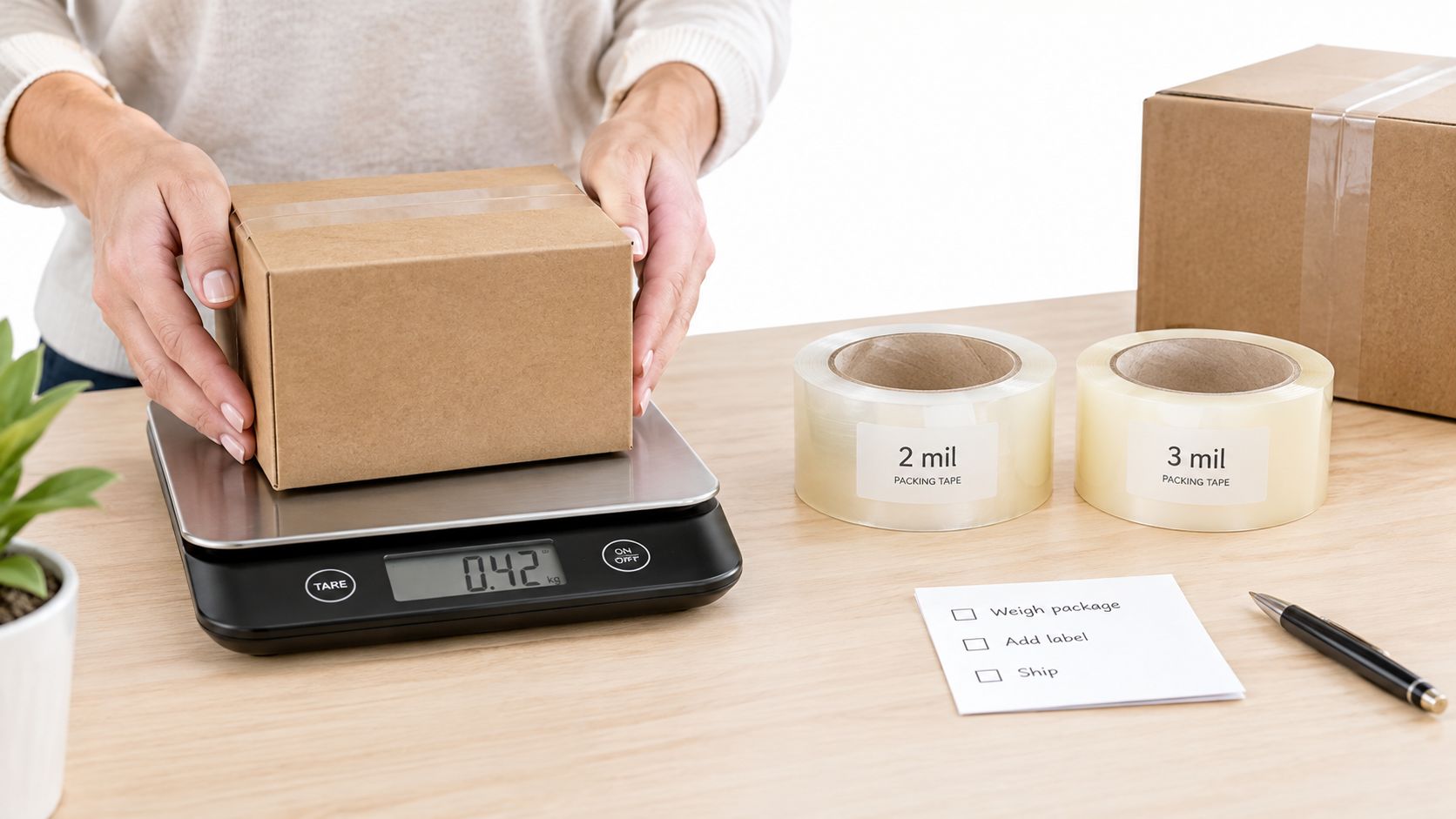
Work through these checks in order:
- Weigh a packed sample carton. Use the heaviest version you ship, not an empty box.
- Check the box surface. New board seals easier than recycled or dusty board.
- Note the environment. Cold rooms, hot trailers, and long storage all stress adhesive.
- Read the full spec sheet. Total thickness includes the adhesive layer, and two tapes at the same mil rating can hold very different loads. Compare tensile strength and adhesion numbers together.
- Pick the width. 2 inch tape suits most cartons. 3 inch tape suits heavy cartons and boxes over 24 inches wide.
Don't Skip the Box Itself
Tape can't rescue a weak or undersized carton. If flaps bulge or corners crush, upgrade the board grade before you blame the seal. The guide on 32 ECT vs 44 ECT boxes helps you match box strength to load weight.
For a clean look on retail cartons, many shippers pair this process with a crystal clear packing tape. Run the same weight and surface checks first, then choose the finish.
When Thicker Tape Saves Money
Thicker tape costs more per roll. That premium only makes sense when it removes a bigger cost somewhere else. Think in terms of cost per sealed carton, not cost per roll.
Where 3 Mil Earns Its Keep
- Cartons over 30 lb: One strip of 3 mil replaces two strips of a lighter grade, which saves tape and labor at the bench.
- Recycled content boxes: The extra adhesive mass helps on rough, fibrous surfaces where thin tape lifts at the edges.
- Cold rooms and winter shipping: A heavier grade gives you margin when adhesive performance drops in low temperatures.
- Rough conveyor handling: Thicker film resists puncture and nicking that can start a tear across the seam.
Where 2 Mil Is the Smarter Buy
Clean, lightweight cartons in a climate controlled building rarely need more than 2 mil. Paying for 3 mil there adds cost without reducing failures. You'll also run through rolls faster, since thicker tape means fewer yards per roll of the same diameter.
Buy thickness where failure risk is real. Everywhere else, you're just paying for plastic you don't need.
If you're ordering at scale, work through the math in the packing tape bulk buying guide. It covers how case and pallet quantities change your per carton cost, and price breaks by the case or pallet can narrow the gap between grades.
Shop Packing Tape in Stock
You know your carton weight, surface, and climate. Now match that profile to a product. The packing tape category covers clear, tan, and quiet unwind options alongside hand held and table top dispensers.
For routine shipping, start with the standard grades and match the mil rating to your carton weight, as covered earlier. For shelf ready or retail cartons where looks matter, a crystal clear grade keeps graphics and barcodes readable under the seal. Whatever you pick, check total thickness on the spec sheet. Two tapes can carry the same mil label and still split it differently between backing and adhesive.
If your operation is reviewing the full packaging line, it helps to see how tape fits into broader packaging solutions from plant to shelf. Tape is one link in a longer chain, and carton, void fill, and labeling choices all interact.
Material Handling USA, based in Salt Lake City since 1997, stocks 58,000 plus SKUs and ships nationwide with volume pricing. Call a product specialist at 1-800-326-4403, Mon to Fri 8am to 5pm MT, for pallet quantities, custom sizes, or a quote on project size orders.
Frequently Asked Questions About Tape Thickness
Is 3 mil tape really 3 mil thick? Often it's 2.6 to 3.1 mil in total thickness, counting backing and adhesive. Check the product spec for the exact figure.
Does thicker tape always mean stronger tape? No. Per 3M box sealing tape data, Tape 313 at 2.55 mil total thickness posts 35 lb/in tensile strength, while Tape 353 at 1.9 mil total thickness posts 25 lb/in tensile strength but higher adhesion. Thickness and strength don't move in lockstep.
What width should you use? 2 inch tape covers most cartons. Use 3 inch tape for heavy loads and boxes wider than 24 inches.
When should you step up from 2 mil to 3 mil? When cartons exceed 30 lb, boxes use recycled content, shipments pass through cold rooms, or you want one strip to replace two.
Can one tape grade handle every carton? Rarely. Most operations stock a standard 2 mil tape for routine work and a 3 mil tape for heavy or difficult cartons.
How do you validate a new tape before a big order? Seal sample cartons, store them at your actual temperature, handle them roughly, and inspect every seam before you commit.
Shop 2 mil and 3 mil tape, dispensers, and the cartons to match at Material Handling USA, with volume pricing and price breaks by the case or pallet on in stock packaging supplies. If you're unsure which grade fits your carton weights and climate, call 1-800-326-4403, Mon to Fri 8am to 5pm MT, and a product specialist will help you spec the right roll before you order.