Pallet Covers 2 Mil vs 4 Mil: Which Thickness to Buy
Are you buying a thicker pallet cover to solve a real failure point, or just because thicker sounds safer? A heavy cover can still tear over an exposed nail, while a lighter cover can work well on a smooth, stable indoor load.
The decision on pallet covers 2 mil vs 4 mil starts with what touches the film, where the pallet sits, and how often workers move it. Match the cover to those hazards, then compare cost per protected pallet, not just cost per cover.
Table of Contents
- Pallet Cover Thickness at a Glance
- 2 Mil vs 4 Mil on the Criteria That Matter
- How to Choose a Cover in Five Steps
- Gusset Sizes for 48x40 and 48x48 Pallets
- Top Sheets vs Full Pallet Covers
- UVI Treated Covers for Outdoor Storage
- Frequently Asked Questions About Pallet Cover Thickness
- Confirm Roll Counts and Shop Pallet Covers in Stock
Pallet Cover Thickness at a Glance
Gauge is a starting point, not a strength guarantee. The micrometer values below are direct conversions at 25.4 micrometers per mil.
| Thickness | Micrometers (approx.) | Typical fit |
|---|---|---|
| 1.5 mil | 38.1 | Light dust on short indoor holds |
| 2 mil | 50.8 | Indoor dust and incidental moisture under stretch wrap, short storage |
| 3 mil | 76.2 | Loads with some edge contact or moderate handling |
| 4 mil | 101.6 | Yard storage, sharp corners, reused covers, sun exposure with UVI treated film |
A mil is one-thousandth of an inch, so a 2 mil cover is about 0.002 inch thick and a 4 mil cover is about 0.004 inch thick, as explained in Interplas's film guidance. Doubling the gauge doubles the film, not the usable protection.
Resin type, film construction, extrusion quality, seams, additives, and dimensions all shape how a cover performs. Fit matters as much as gauge: a tight cover concentrates stress at corners, and a loose cover can snag during handling.
Compare specifications, not just labels
When you compare products, request:
- Material identification: LDPE, LLDPE, HDPE, or the stated blend.
- Thickness tolerance: How closely the film holds its advertised gauge.
- Strength results: Tensile and impact data in machine and transverse directions, plus available puncture and tear results.
- Construction details: Seam design and dimensions that match your loaded pallet.
Two covers with the same mil rating can perform very differently. If test information is limited and the load carries real risk, request the missing data and trial a heavier option before committing to bulk quantities.
The bin liners and pallet covers category lets you compare cover options alongside other packing and shipping bags. Weigh each option by cost per protected pallet, and the thinnest cover that survives your worst handling day usually wins.
2 Mil vs 4 Mil on the Criteria That Matter
| Hazard or factor | 2 mil | 4 mil |
|---|---|---|
| Indoor dust and moisture | Good fit for short storage | Works, but often more than the job needs |
| Sharp carton corners or protruding parts | Higher puncture risk | Larger material margin |
| Forklift movement and tear risk | Higher risk during rough handling | Larger margin for repeated handling |
| Outdoor wind and sun | Not the first choice, specify UVI for sun | Better margin, add UVI for sun exposure |
| Reuse across shipments | Better starting point for single use | Better candidate for reuse, inspect each time |
| Material cost per cover | Generally lower | Generally higher |
| Cost per protected pallet | Favorable when failures stay low | Favorable when avoided failures offset added film |
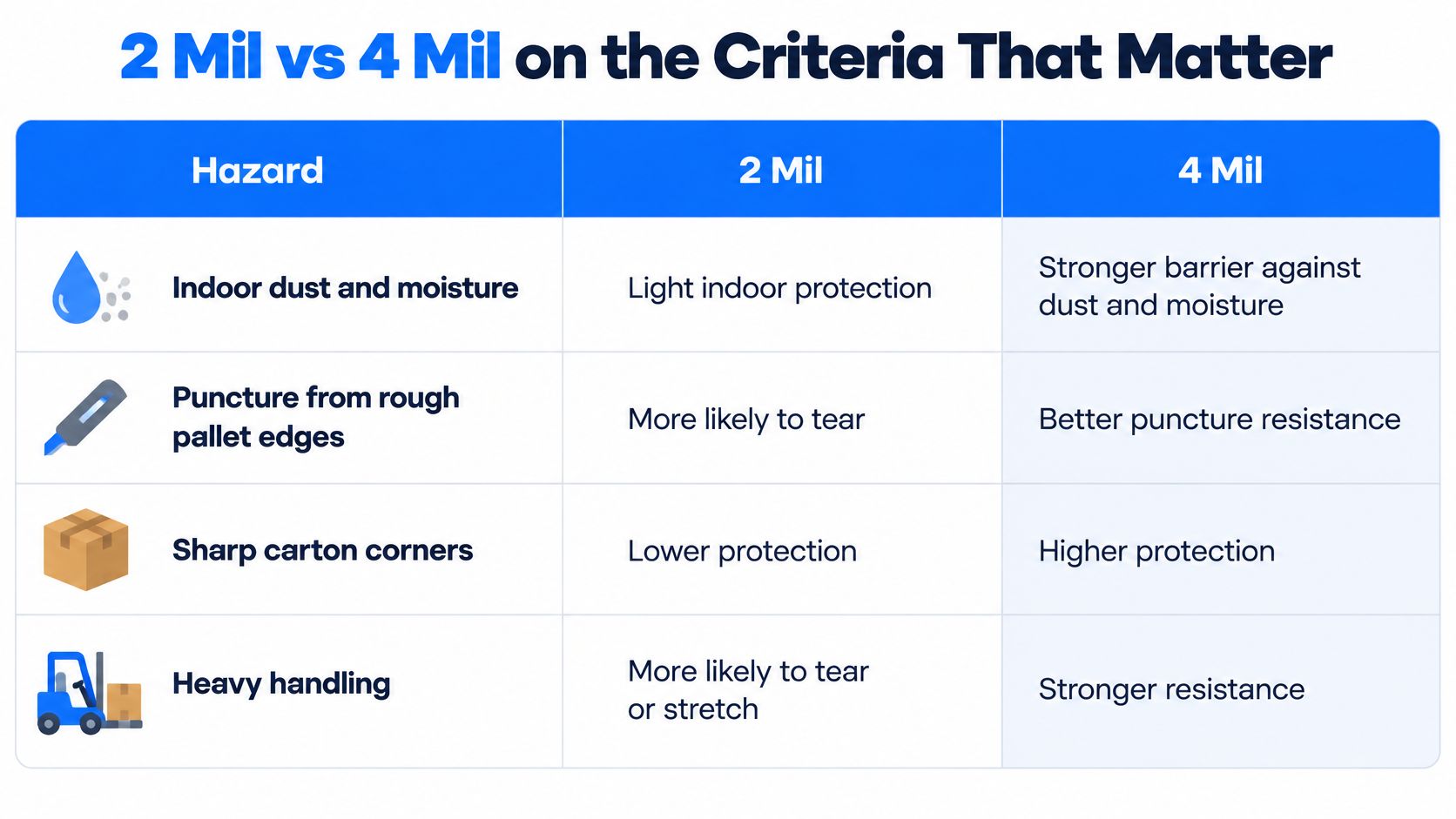
Puncture and handling damage usually deserve more attention than the purchase difference. A protruding part can push through the film, while a small snag can start a tear that grows when workers remove or reposition the cover.
Don't use heavier film as a substitute for fixing the pallet. Remove exposed fasteners, replace damaged deck boards, and protect hard corners before testing either thickness. Otherwise, you're paying for extra material while leaving the cause of failure in place.
A 2 mil cover wins on price per cover for stable indoor loads. A 4 mil cover wins when an avoided tear or puncture costs more than the added film.
Count the work after a failure
Include replacement covers, repacking labor, product inspection, cleanup, and damaged goods in your comparison. Divide those costs, together with cover spending, by the pallets that reached their destination adequately protected.
Say a smooth boxed load stays indoors until loading. Extra film may add little value. A load with exposed metal corners and repeated dock transfers presents a different problem, even if both loads use the same pallet footprint.
Our poly bag mil thickness guide provides more gauge-selection guidance. Whichever thickness you choose, size it correctly and test it on the actual load.
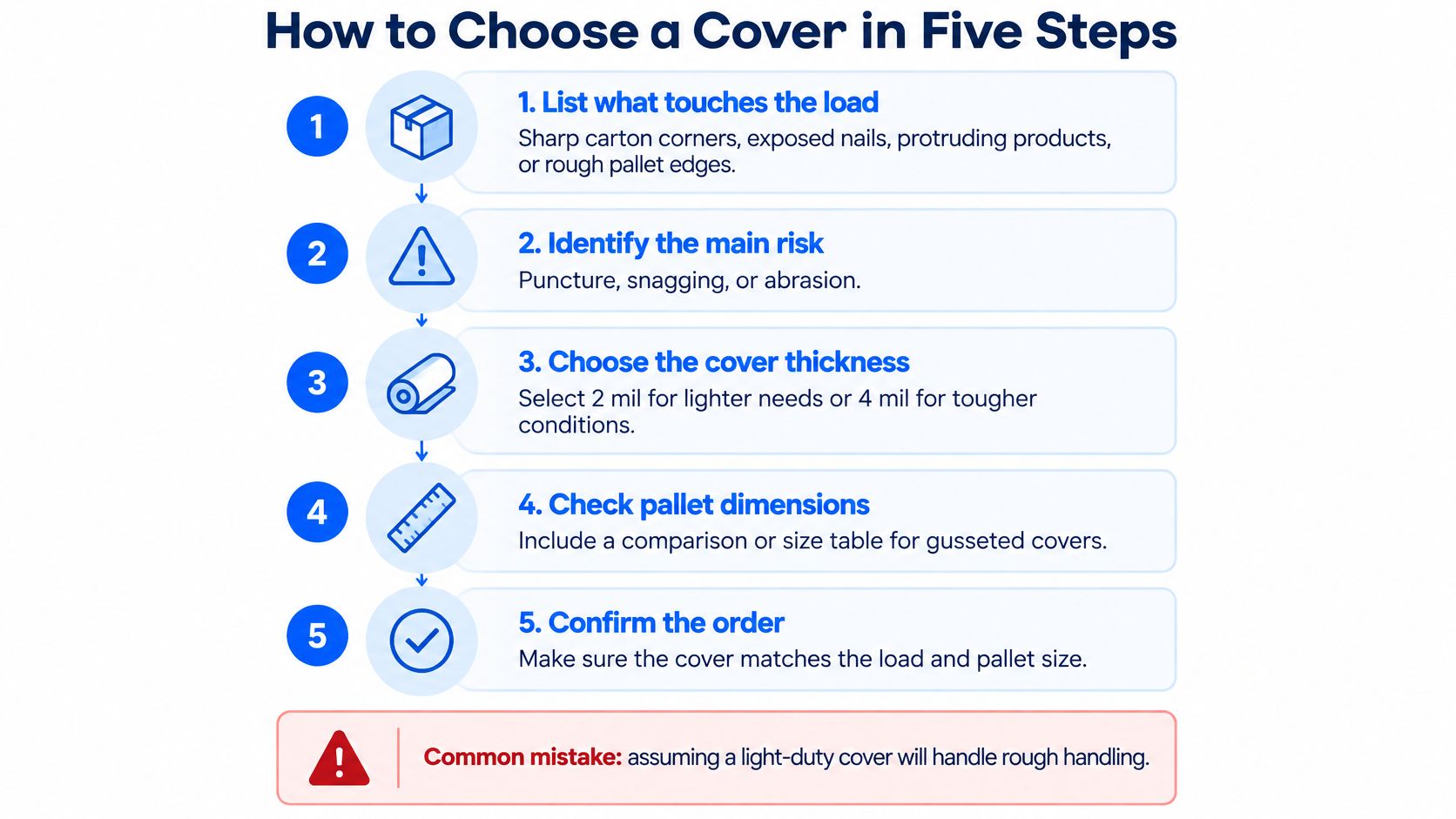
How to Choose a Cover in Five Steps
-
List what touches the film. Check carton corners, exposed nails, protruding products, and rough pallet edges. Don't assume a neat-looking stack has no puncture points.
-
Measure the complete load. Use a tape measure to record its widest footprint and loaded height, including overhang. Note whether it sits indoors, under a dock canopy, or outside, rather than ordering from the pallet label alone.
-
Identify the main exposure. Separate dust protection from splash, abrasion, repeated forklift moves, wind, and sun. Outdoor staging still counts as sun exposure even when the final storage location is indoors.
-
Choose a trial thickness. Use the lookup table, then check the product's material and construction. Don't make the mil label your only acceptance test.
-
Run a representative trial. Apply the cover, move the pallet through its normal route, and inspect corners, seams, and snag points. Record replacement material and labor so you can compare total protection cost.
A cover protects surfaces, but it doesn't replace load containment. Use stretch wrap for pallet containment to help keep the stack together, and follow our stretch wrap buying guide when choosing the wrapping system.
Our buying guides and planning tools help you compare the complete packaging setup, rather than treating each consumable as a separate purchase.
Gusset Sizes for 48x40 and 48x48 Pallets
| Pallet footprint | Side gusset | Height |
|---|---|---|
| 48 x 40 in | 42 to 44 in starting range | Loaded height plus tuck allowance |
| 48 x 48 in | 50 to 52 in starting range | Loaded height plus tuck allowance |
These are sizing-practice starting ranges, not a manufacturer's fit guarantee. Allow roughly 2 to 4 inches beyond the footprint for width and gusset, then verify the selected product's stated load fit.
A gusseted cover is listed as width x side gusset x length or height. Using that starting rule, both pallet footprints call for a cover width of roughly 50 to 52 inches. The side gusset follows the shorter footprint dimension, while height must reach over the loaded stack and leave enough material to tuck.
Read the complete dimension string
A published Interplas LDPE pallet-cover listing identifies a 48 x 42 x 48-inch, 2 mil cover, with a 48-inch width, 42-inch side gusset, 48-inch height, and nominal thickness of 0.002 inch. Those dimensions describe the cover, not a guaranteed loaded-pallet footprint.
That distinction matters when cartons bulge or hang beyond the deck. Measure the load's widest point, and don't assume a cover labeled 48 x 40 will fit a 48 x 48 pallet.
Fit check: The cover should slide over the corners without being stretched tight, while leaving no loose skirt that can catch in handling equipment.
Keep final shipping dimensions separate from cover dimensions. When planning freight, Supply Automate's shipping estimates for e-commerce brands can support budgeting, but use your actual packed shipment measurements.
Top Sheets vs Full Pallet Covers
A pallet top sheet covers the upper face only: dust settling from rafters, light debris, and incidental moisture from above. A full pallet cover wraps the top and runs down the faces, so weigh that format when carton edges, film tails, labels, or loose product are exposed during staging and forklift moves.
| Option | What it covers | Best fit |
|---|---|---|
| Pallet top sheet | Upper surface | Stable loads with flat tops and overhead exposure |
| Full pallet cover | Top and sides | Loads needing protection around exposed faces |
| Gusseted full cover | Top and sides, with expanding side folds | Rectangular loads needing room around corners |
Choose by protected surface, then cost per protected pallet. A top sheet has the lower piece price, but if abrasion or side splash damages one exposed case, the saved cents turn into rework. A full cover costs more per cover; it can still be the cheaper protected-pallet outcome when side faces see conveyors, dock doors, or repeated handling.
When listings separate formats, compare top sheet and full cover listings by the surfaces they protect and the stated load fit. If a catalog keeps a separate page such as pallet top sheeting, judge it against full covers on those terms; otherwise compare formats inside bin liners and pallet covers and shop the listing that states your load size.
Use a top sheet when stretch film, corner boards, or existing side containment already handles the faces and the remaining hazard is overhead. Use a full cover when exposed sides matter, especially during staging or repeated movement. Neither format should be treated as a sealed enclosure unless the product and application provide one.
Load dimensions control the fit
The Interplas pallet-cover catalog lists a 48 x 40 x 100-inch cover for a 48 x 36 x 80-inch load, and a 48 x 48 x 96-inch cover for a 46 x 46 x 68-inch load. These examples show why the nominal cover dimensions aren't interchangeable with load dimensions.
Before ordering, verify width, gusset, height, applicable load size, and covers per roll. Check the current specification, not just the category name or product photo.
UVI Treated Covers for Outdoor Storage
Specify UVI treatment when the load sits in sun. Sunlight can degrade plain polyethylene, so outdoor selection needs more than a thicker gauge.
A UVI treated cover helps resist sun damage to the film. It doesn't automatically make the package waterproof, windproof, or heatproof, and it doesn't guarantee protection against condensation inside the cover.
For yard storage, a 4 mil UVI treated cover is a practical starting choice. Confirm that the listing states the treatment rather than assuming every heavy cover includes it.
Check the outdoor setup
- UV specification: Look for stated treatment, exposure limits, and any listed outdoor-use rating.
- Seams and corners: Reject damaged seams and protect concentrated contact points.
- Gusset fit: Avoid a stretched fit or excess loose film that wind can lift.
- Securement: Choose a suitable strap or tie-down method without cutting into the cover.
- Inspection: Check after storms, handling, and long storage holds.
Don't assign a service life from thickness alone. This guide doesn't claim a UV duration, so use the selected product's exposure limits and inspect for tears, brittle areas, and thin spots.
When selecting pallet covers for outdoor storage, confirm both the gauge and UVI treatment. If the listing doesn't establish outdoor suitability, get that detail resolved before placing a volume order.
Frequently Asked Questions About Pallet Cover Thickness
When is 2 mil enough?
Use it for short indoor storage, dust and incidental moisture protection, and shipping under stretch wrap when the load has smooth contact surfaces.
When do you need 4 mil?
Start there for sharp-cornered loads, yard storage, frequent handling, or planned reuse. Fix exposed nails and rough edges first.
Do you need UVI treatment?
Yes, when the cover sits in sun. Check the product's stated outdoor exposure limits rather than assuming thickness supplies UV protection.
How do you size a gusseted cover?
Measure the loaded footprint, allow fitting clearance, and add enough height for the intended tuck. Use the sizing table as a starting point, then confirm the manufacturer's load-fit specification.
What's the difference between a top sheet and a full cover?
A top sheet covers the upper surface. A full cover reaches down the sides, making it the better choice when side exposure matters.
How many covers come in a roll?
Check the specific size and model. Roll quantity isn't determined by thickness or pallet footprint, and case quantity may describe a different ordering unit.
Do you still need stretch wrap?
Yes, if your load requires film containment. A loose pallet cover isn't designed to hold an unstable stack together.
Confirm Roll Counts and Shop Pallet Covers in Stock
A cover spec is complete only when purchasing can reorder it without measuring the load again. Set replenishment from pallets covered per month divided by covers per roll, round up to whole rolls, then add a buffer for the damage rate, demand swings and lead time you see at the dock.
The buying number is cost per protected pallet. A cheaper 2 mil cover that tears on one sharp corner costs more than a 4 mil cover that survives the route, while a heavier cover used on smooth cartons is money spent on hazards the load does not have.
Make the SKU reorder-safe
Keep these fields in one item record:
- Gauge and material: chosen thickness and stated polyethylene type.
- Dimensions: finished width, gusset and height after the intended tuck.
- Outdoor requirements: UVI treatment when sun exposure applies.
- Pack quantity: covers per roll, rolls per case and covers per case.
- Companion supplies: stretch wrap, corner protection and securement where needed.
Order from bin liners and pallet covers in stock, and put stretch wrap for load containment on the same ticket when containment is part of the spec. For recurring volume, compare volume pricing by the case or pallet rather than chasing a lower price per cover.
Material Handling USA has supplied industrial products since 1997 and lists 58,000+ in-stock SKUs with nationwide shipping. For project-size requirements, use Request a Quote instead of stretching a stock SKU beyond its intended role.
File the accepted spec after the first clean run: product, size, pack unit, route and failure points checked. That record keeps repeat orders from drifting into a lookalike cover.
Material Handling USA offers pallet covers, packing and shipping bags, and related packaging supplies with volume pricing. Visit Material Handling USA to shop online, or call a product specialist at 1-800-326-4403 for pallet quantities, custom sizes, or a quote on project-size orders.