Poly Mailers vs Bubble Mailers: A Smart Buyer's Guide
You're probably staring at two stacks of mailers and one growing line of orders, trying to keep damage down without bloating postage. That's the poly mailers vs bubble mailers decision, and it's not a style preference. It's a shipping-cost choice tied to product risk, pack speed, and what the carrier will charge for the finished package.
If you ship soft goods, poly usually wins. If you ship items that scratch, dent, or crack, bubble usually wins. The right answer comes from the SKU, not the category name, and the wrong choice can cost you in returns, reships, and avoidable postage.
| Criterion | Poly Mailer | Bubble Mailer |
|---|---|---|
| Weight | Lighter and lower profile | Heavier and thicker |
| Protection level | Moisture, dust, tear, and abrasion resistance, with little cushioning | Better shock and minor-crush protection from the air-bubble layer |
| Water resistance | Strong for soft goods and documents | Strong, but construction adds bulk |
| Typical sizes | Commonly sized for apparel, textiles, and flat goods, check the product spec | Commonly sized for small fragile items, check the product spec |
| Print options | Good for branding and custom messaging | Also printable, but thickness can change pack-out |
| Best use | Apparel, textiles, printed goods, documents | Cosmetics, small electronics, books, jewelry, and other impact-sensitive items |
Table of Contents
- The Box-Store Problem Every Ecommerce Buyer Faces
- Comparing Poly Mailers and Bubble Mailers Side by Side
- How to Choose the Right Mailer in 5 Steps
- Best Products for Poly Mailers and Best Products for Bubble Mailers
- Poly Vs Bubble at Total Cost, Not Just Price
- Recommendation Matrix and Where to Shop
- Poly Mailer Questions Ecommerce Buyers Ask
- Shop In-Stock Mailers or Call a Specialist
The Box-Store Problem Every Ecommerce Buyer Faces

The mistake starts before the order leaves the packing table. A SKU gets handed a package that is too large, too heavy, or too protective for what is inside, and the result is wasted material, slower packout, and higher postage than the item deserves. That is the break-even test that matters: packaging cost, damage risk, dimensional-weight postage, and returns, all judged at the SKU level.
A poly mailer is a flexible polyethylene envelope built to keep out moisture, dust, tearing, and abrasion while adding very little bulk. USPS standards require plastic mailing bags to use at least 2-mil polyethylene for easy loads up to 5 pounds and 4-mil polyethylene for easy loads up to 10 pounds. That makes poly mailers a clean fit for apparel, textiles, documents, and other non-fragile products. If a soft good needs a tougher outer skin, tear-resistant poly mailers are the right place to look.
A bubble mailer adds an internal air-filled cushioning layer. That layer helps absorb light impact and reduces minor crushing, which is why it belongs on products that can scuff, dent, or crack. The tradeoff is thickness, and thickness can push a parcel into a higher billed size when USPS dimensional weight applies.
A bubble mailer also changes the pack-out decision. It gives you protection without a box, but it still asks for more space than a flat poly bag. For a low-value soft item, that extra bulk usually makes no sense. For a small item with a hard shell, finish, or edge, it is the safer call.
Neither mailer replaces a corrugated box for fragile freight. USPS expects mailpieces to survive normal handling without breakage or deterioration, and fragile items still need cushioning, restraint, and sometimes a rigid outer package. That line is the one to respect.
Comparing Poly Mailers and Bubble Mailers Side by Side
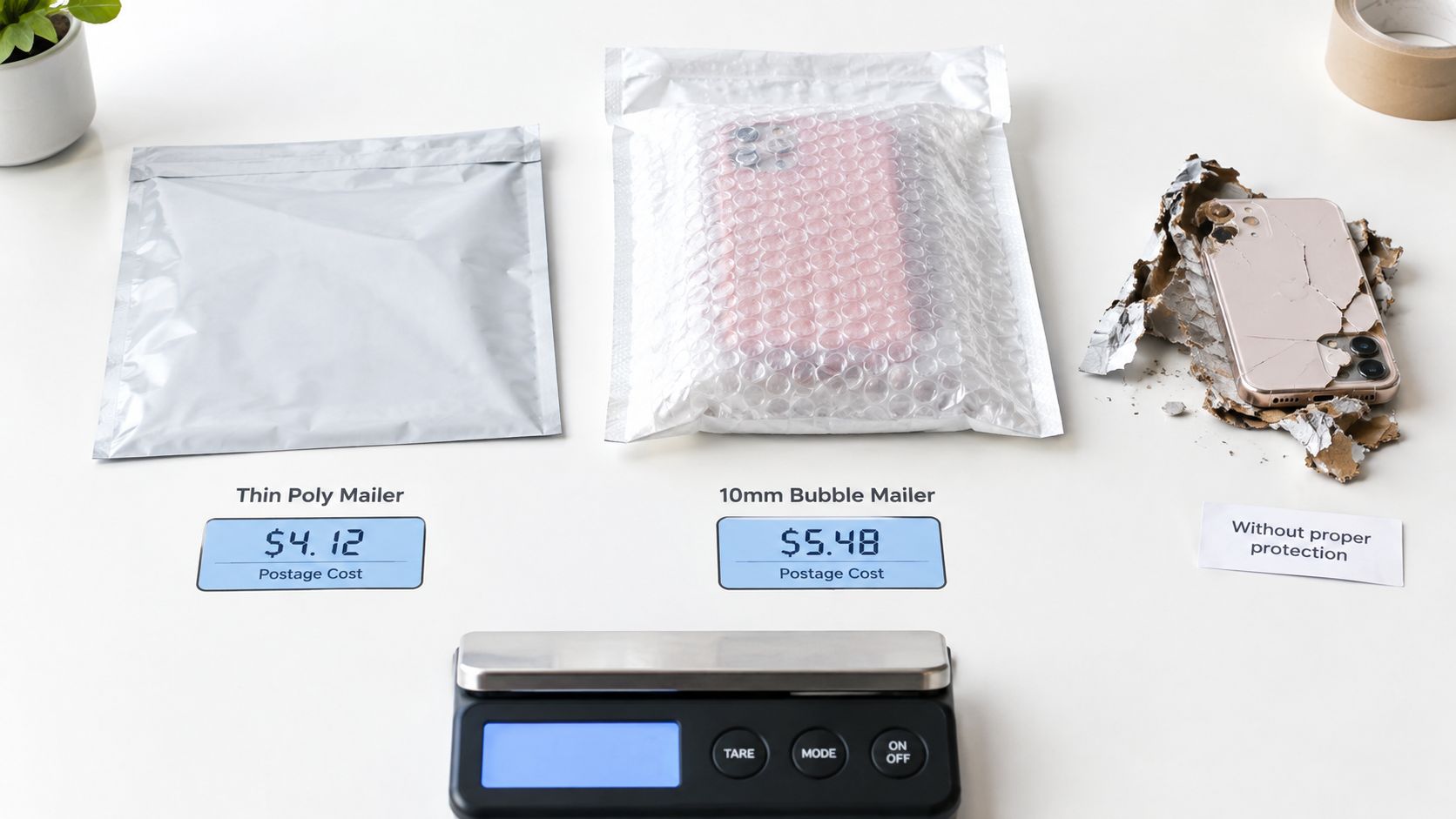
The actual choice is not brand preference. It is whether the SKU can survive the trip in a thin sleeve or needs built-in cushion to avoid damage, returns, and re-shipments.
What changes at the pack station
USPS applies dimensional-weight pricing to packages over 1 cubic foot, 1,728 cubic inches, using length × width × height ÷ 139 and charging the greater of actual or dimensional weight. A thicker mailer can raise postage even when the item inside is light. Poly mailers usually keep outside dimensions tighter, while bubble mailers add thickness and can push a parcel into a higher billed size. Use the USPS postage verification rules to check your pack test against current carrier math.
That is the break-even test fulfillment teams should run at the SKU level. If the item is soft, durable, and already protected by its own structure, poly usually keeps shipping cost down without creating avoidable risk. If the item can scuff, chip, crush, or show wear at the corners, the extra cushion in a bubble mailer often pays for itself by cutting damage and returns.
Recycling is less straightforward. The state of plastics recycling overview shows that recycling access for plastic film is still limited, so confirm the recovery route for your specific mailer resin instead of trusting the label. Bubble mailers add another wrinkle when mixed materials are bonded together, because sorting gets harder once paper, film, and cushioning are combined.
The buying lens that matters
| Criterion | Poly Mailer | Bubble Mailer |
|---|---|---|
| Protection | Limited cushioning, good surface defense | Better impact attenuation |
| Shipping efficiency | Usually best | Usually lower because of added thickness |
| Soft goods | Strong fit | Usually overbuilt |
| Fragile goods | Weak fit | Better fit |
| Recycling path | Simpler when single-material | More complicated when mixed-material |
Use the table as a reorder filter, not a slogan. If your goods are flexible, durable, and not easily marked, poly mailers usually give you the better total cost. If the item can chip, crush, or scuff, choose the bubble mailer and accept the higher pack-out cost.
How to Choose the Right Mailer in 5 Steps
-
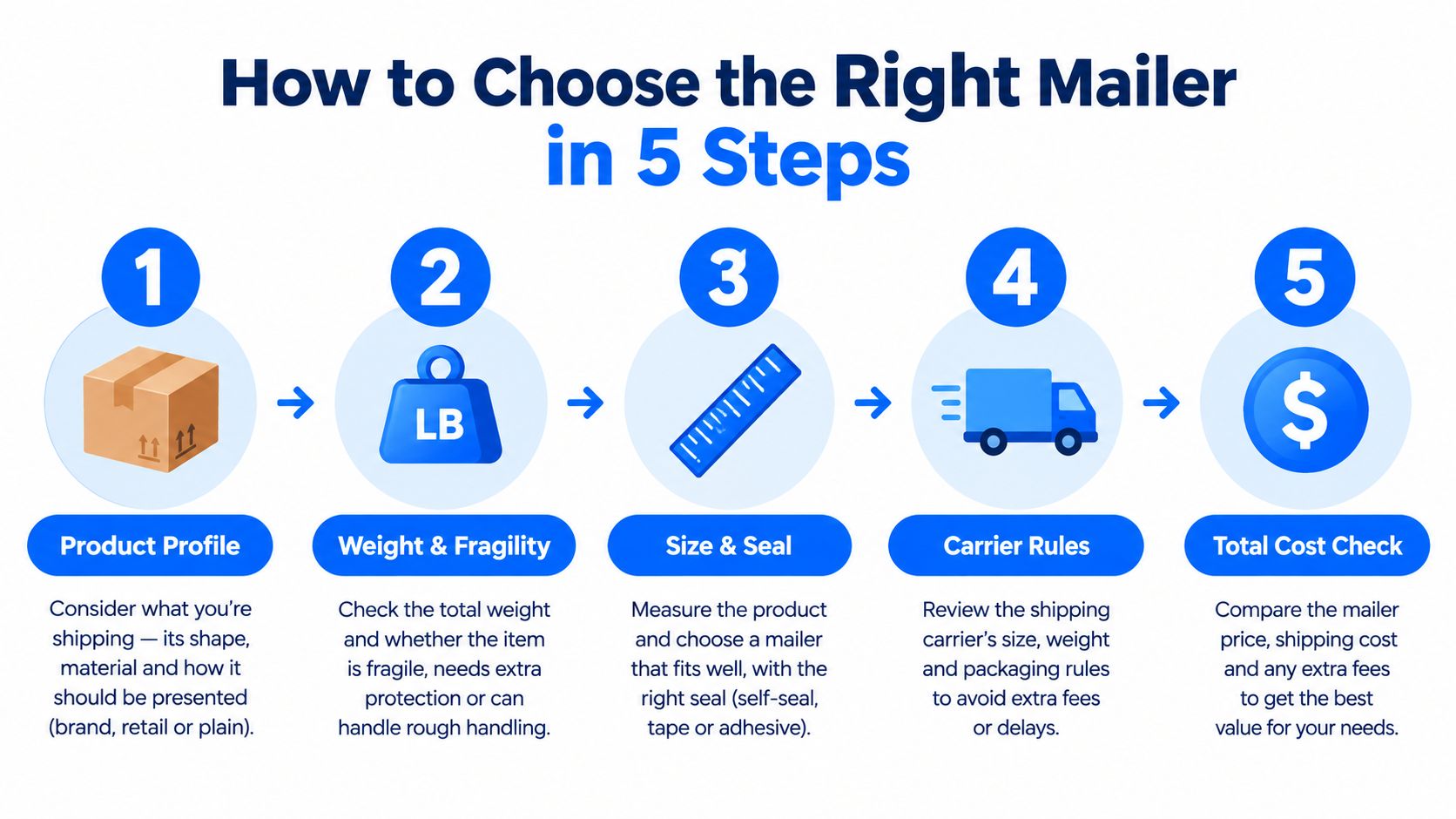
Profile the product first. Soft goods and printed materials lean poly. Hard parts, coated items, and anything that can scuff lean bubble.
-
Check weight and fragility together. A light item can still break if it has a rigid corner or fragile finish. Don't let low weight trick you into picking the wrong format.
-
Match the packed size to the mailer. Measure the item after wrapping or folding, then confirm the seal closes flat without stretching the seams.
-
Run it against carrier rules. USPS parcel limits, dimensional weight, and shape rules can change the actual cost. A thicker mailer can be the right protective choice and still cost more to send.
-
Test the total cost, not the unit cost. Compare mailer cost, postage, damage, and returns across a small shipment sample before you reorder in volume.
Start with the product, not the packaging. If you choose the mailer first, you'll fix the shipment around the bag instead of the bag around the product.
For shipments that ride near carrier thresholds, the final packed thickness matters more than the product weight on its own. A mailer that looks cheap at the purchase order level can become expensive once you add postage and damage handling.
Best Products for Poly Mailers and Best Products for Bubble Mailers
A 12 oz cotton tee ships cleanly in a 10x13 poly mailer, and the tare stays low, so you do not pay for padding you do not need. That same mailer is the wrong call for a hardcover book, because the spine can scuff in transit and the corners take abuse. For that kind of SKU, use a padded option from the bubble mailers category.
The break-even test is simple at the SKU level. If a mailer protects the item, keeps the pack flat, and avoids a return, it wins even if the unit price is higher. If it adds bulk without reducing damage, it loses.
Use poly mailers for flexible goods that ship flat and tolerate compression, like apparel, textiles, printed inserts, and documents. Use bubble mailers for hard or semi-fragile items that need surface protection, such as cosmetics in rigid containers, small electronics, jewelry, and compact home goods. Glass, ceramics, and high-value electronics still belong in a corrugated box with internal protection, because a mailer does not add enough structure for those products.
Keep the decision tied to the product, the pack-out, and the likely damage cost. That is the difference between a cheap-looking mailer and a cheap shipment.
Poly Vs Bubble at Total Cost, Not Just Price
The cheapest mailer on paper is not always the cheapest shipment in practice. A bubble mailer can save money if it prevents enough damage, reshipments, or customer complaints to offset the extra material and postage.
Vendor specs for padded mailers often list polyethylene outer film with bubble padding in the 2 to 4 mm range, with thicker padding reserved for more delicate goods. Other product sheets compare standard poly mailers with bubble mailers using different film gauges and cushioning depth, along with flat-drop results that vary by package design. Treat those figures as vendor-specific, not universal limits.
SKU by SKU, the break-even test is simple. Compare the added bubble-mailer cost, any dimensional-weight postage change, and the value of avoided damage across a real pack sample. If the padded option prevents enough returns or replacement labor, it wins even when the unit price looks higher.
A third-party ecommerce test found that 12% of tested products arrived damaged and 6% of packages showed damage, with problems tied to transit, pre-shipment handling, and inadequate protection webtonic.io. That kind of loss rate can erase a small packaging saving fast.
The right question is not which mailer costs less. It is which mailer delivers the lowest total cost per order after postage, damage, and returns.
Recommendation Matrix and Where to Shop
Recommendation matrix
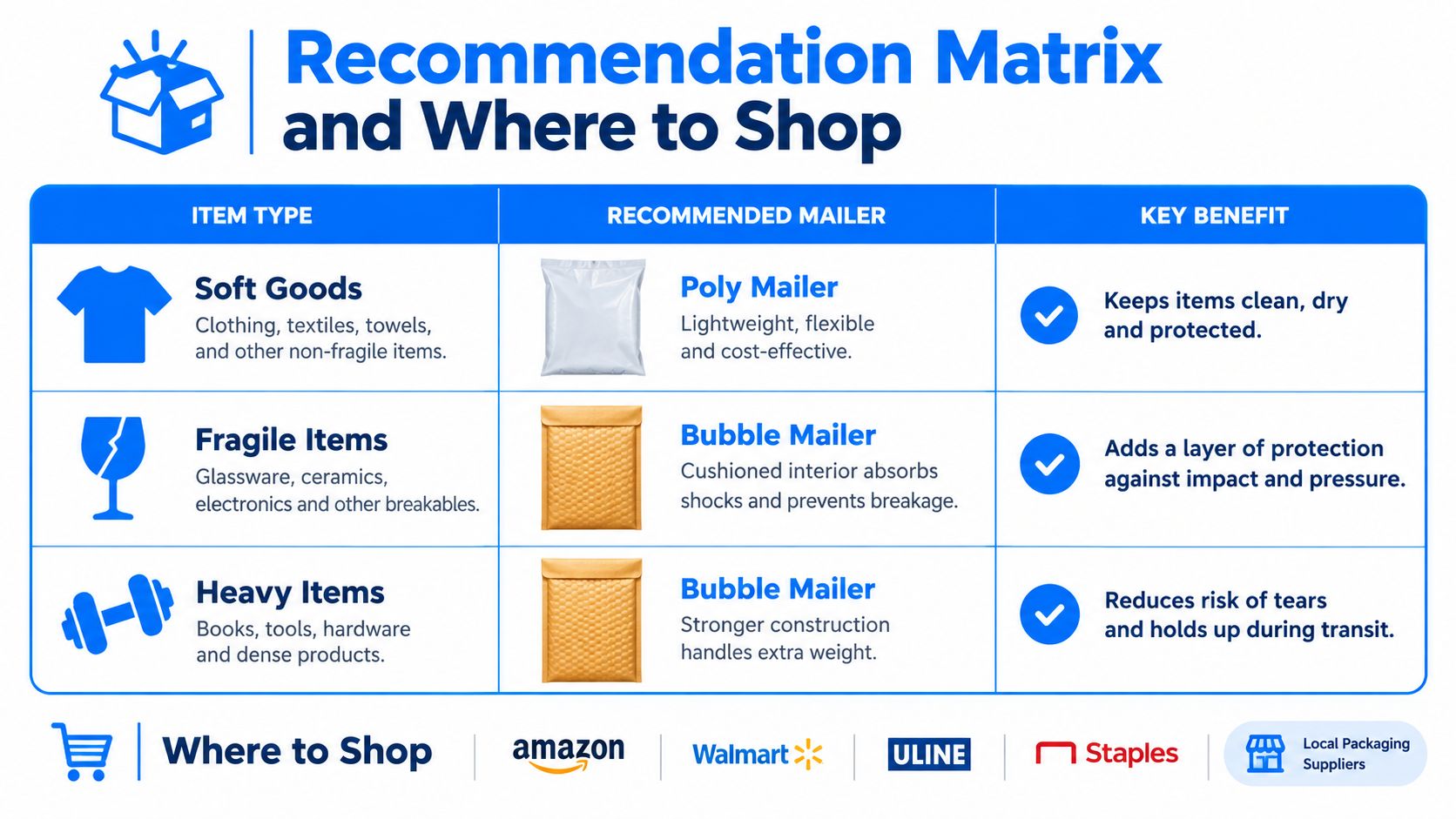
- Soft goods, apparel, textiles, printed items, use poly mailers when the package stays thin and the contents do not need cushioning.
- Fragile or scratch-prone items, use bubble mailers when surface protection matters more than minimizing packout bulk.
- Packed thickness over 3/4 in, rigid corners, or items that need bracing, move to a corrugated box even if the product is light. Weight does not override shape.
Shop the shipping mailers hub if you are standardizing packaging by SKU and want to compare in-stock options in one place.
Dual peel-and-seal strips make returns easier, and recyclable mailer options can also fit into the same workflow. Keep the mailer for the SKUs it can protect, and stop forcing it onto items that need a box.
Poly Mailer Questions Ecommerce Buyers Ask
When is a bubble mailer worth the extra cost?
Use it when damage risk is real. If the product can dent, crack, or show cosmetic wear from light impact, the extra cushion usually pays for itself in fewer returns.
How do I size a mailer correctly?
Measure the packed item, not the loose product. Check that the finished package stays within the carrier's minimum size and dimensional-weight rules for the service you plan to use.
Are poly mailers usually curbside recyclable?
No, not usually. Flexible film often needs a special drop-off route, and local access is limited, so check local rules before you count on recycling.
What do dual peel-and-seal strips do?
They make returns easier. One strip seals the outbound shipment, and the second strip gives the customer a clean way to reseal the package for return.
What gauge should I order for soft goods?
Start with the product spec and match the load to the application. USPS standards point to 2-mil for easy loads up to 5 pounds and 4-mil for easy loads up to 10 pounds.
When should I stop using a mailer and switch to a box?
Switch when the product is fragile, heavy, rigid, or easily crushed. If the item needs internal bracing or corner protection, a mailer is the wrong container.
Do bubble mailers always cost more overall?
Not always. If the added cushion prevents even a modest amount of damage or reshipping, the total cost can be lower than a cheaper flat mailer that fails in transit.
Shop In-Stock Mailers or Call a Specialist
Browse the shipping mailers category to compare poly and bubble formats in stock. If you need pallet quantities, custom sizes, or a quote on project size orders, call a product specialist at 1-800-326-4403, Monday to Friday, 8am to 5pm MT. Volume pricing and price breaks by the case or pallet are available when your order size justifies it.
Material Handling USA keeps in-stock mailers, shipping supplies, and volume order support in one place, so you can match the packaging to the SKU instead of guessing. If you need help choosing between poly mailers and bubble mailers for your own pack line, visit Material Handling USA and use the mailer categories to build a cleaner, cheaper shipping workflow.