Reclosable Bag Sizes for Parts: A Complete Buyer Chart
Stock reclosable bag sizes for parts include 2x2, 2x3, 3x4, 3x5, 4x6, 5x8, 6x9, 8x10, 9x12, 10x12, and 12x15 inches. Choose by the packed part envelope plus closure clearance, not just the number on the label.
You're at the maintenance bench with a bracket that won't clear the zipper, or a handful of screws sliding around in an oversized bag. The right choice lets your crew load, identify, close, and reopen the kit without fighting the packaging.
Table of Contents
- Why the Right Size Matters for Parts and Kits
- Stock Size Chart for Reclosable Parts Bags
- Measuring the Bag by Usable Inside Dimensions
- 2 Mil vs 4 Mil Reclosable Bags
- White Block Write On Bags and Hang Hole Options
- Anti Static Bags for Electronics and ESD Sensitive Parts
- How to Choose the Right Reclosable Bag in Five Steps
- Shop in Stock Reclosable Bags and FAQ
- Are Reclosable Parts Bags Sold by the Case?
- Can You Get Volume Pricing or Custom Sizes?
- Are Hang Holes Available in Every Gauge?
- What Marker Should You Use on White Block Bags?
- Is a Pink Bag Enough for Shipping Electronics?
- Can You Recycle Used Parts Bags?
- Do State Packaging Rules Affect Purchasing?
- What If a Bag Arrives Out of Spec?
Why the Right Size Matters for Parts and Kits
A bag can accept a part and still be wrong for the job. Push a threaded fitting into a tight bag and the threads can drag against the film. Drop a small screw into a large bag and the picker has more empty plastic to handle before finding the contents.
Fit means more than length and width. You also need room for the part's thickness, the full kit quantity, and the way employees insert and remove it. A mixed fastener kit doesn't pack like a flat terminal strip, even when their longest dimensions match.
The useful size is the smallest bag your crew can fill, close, label, handle, and reopen without damaging the contents or seal.
Match the Bag to the Bench
Think about the actual work rather than the empty bag. A maintenance kit may return to a drawer after each repair. A production hardware bag may be opened once and discarded. Those jobs don't necessarily need the same film.
- Loading: Check whether the opening accepts the widest part without stretching.
- Identification: Keep part numbers readable and the contents visible.
- Handling: Consider sharp edges, weight, repeated opening, and storage conditions.
Avoid treating a familiar size as a universal answer. A bag that works for washers may fail for a bulky connector. Approve the packed kit, then record the size, gauge, and options so purchasing can replenish the same specification.
Stock Size Chart for Reclosable Parts Bags
A label such as 3x5 names a nominal size, not the space available to load a part. Use the chart to shortlist bags by the part or kit going inside, then check the listed dimensions and features in the reclosable parts bag category. The contents below are starting examples; screw length, connector shape, and kit quantity affect fit.
Common Reclosable Bag Sizes for Parts
| Size (W x L), inches | Typical Contents | Common Kit or Use |
|---|---|---|
| 2x2 | A small screw, washers, tiny spacers | Individual hardware identification |
| 2x3 | Short machine screws, nuts, small fuses | Small repair packets |
| 3x4 | Washers, terminals, compact connectors | Electrical or fastener picks |
| 3x5 | Longer screws, small fittings | Narrow hardware kits |
| 4x6 | Mixed fasteners, compact replacement parts | General maintenance kits |
| 5x8 | Fittings, brackets, grouped connectors | Bulkier repair packets |
| 6x9 | Terminal strips, replacement components | Service kits with several items |
| 8x10 | Larger brackets, small assemblies | Assembly support kits |
| 9x12 | Grouped components, wider hardware bundles | Multi-part maintenance kits |
| 10x12 | Broad replacement parts, organized hardware sets | Larger kit packets |
| 12x15 | Small assemblies, bulky multi-piece kits | Consolidated replacement kits |
When two sizes both clear the packed envelope, choose the smaller one. Excess film can slow picking and make part numbers harder to read through the bag. A tight opening is a separate problem: extra length does not provide more width for loading.
For mixed kits, lay out every component that travels together, including any instruction sheet or identification card. A trial with only the easiest part can miss the space the full kit needs.
Check the Larger Formats Carefully
Under the military specification discussed below, dimensional tolerances can widen as bag area increases. That matters when a larger format has to fit a fixed drawer or picking location.
Check the product's stated dimensions and tolerance. Commercial bags should not be assumed to follow a military standard. For a large purchase, approve a loaded sample before releasing the order.
Measuring the Bag by Usable Inside Dimensions
Usable inside dimensions describe the space the part can occupy, not the outside edges of the film. Measure the sample flat, then check it loaded.
The MIL-DTL-117 bag specification defines width between the inside edges of the side seams and length from the inside bottom seam or fold to the opening, with these length and width tolerances.
| One-side bag area | Allowable dimensional tolerance |
|---|---|
| Up to 25 in² | -1/16 to +1/8 inch |
| 26 to 200 in² | -1/8 to +1/4 inch |
| 201 to 500 in² | -1/4 to +3/8 inch |
| 501 in² or more | -1/4 to +1/2 inch |
These bands are not an automatic promise for commercial zip bags. Your purchase specification must identify the applicable tolerance and clarify whether the stated length excludes the zipper header.
Use the measurement sequence below to separate outside size from usable space.
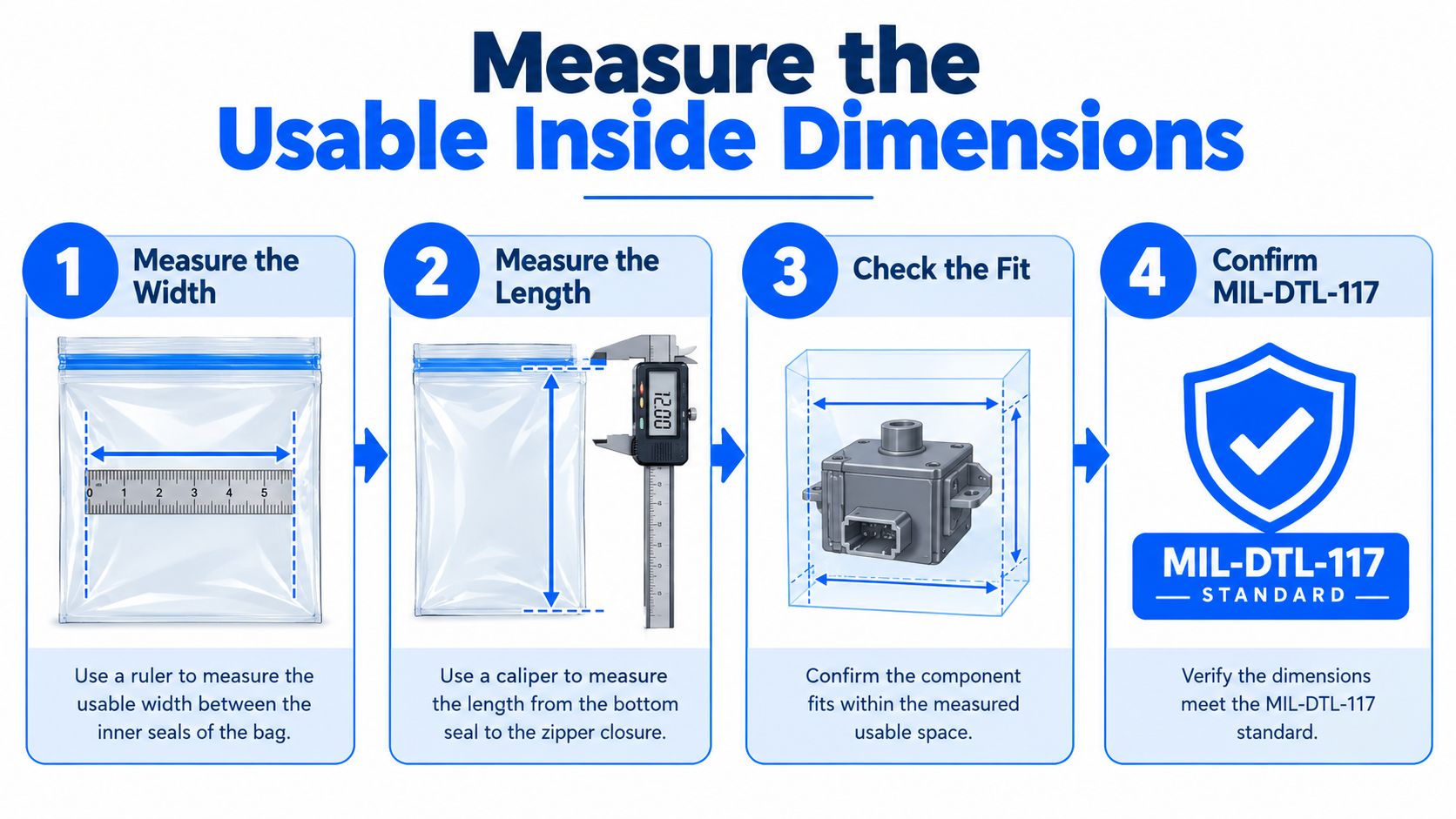
Approve the Loaded Sample
Measure the widest and longest points of the packed bundle, including its depth. Leave insertion room beside it and enough space above it for the zipper to close without tension.
As a trial allowance, start with roughly half an inch beside each side of the bundle and roughly an inch below the zipper. These aren't standard tolerances or guaranteed sizing rules. Adjust them through sample loading, especially for bulky fittings.
Approval check: The zipper should close with normal finger pressure, not while someone compresses the contents or pulls the film tight.
Record usable width, usable length, thickness, closure type, and whether you checked the bag empty or loaded.
2 Mil vs 4 Mil Reclosable Bags
Choose 2 mil for light, smooth parts and short kitting cycles. Choose 4 mil when metal fasteners, sharp edges, frequent reopening, or months of bin storage make the lighter sample unsuitable.
The comparison below gives you a starting point for a hands-on trial.
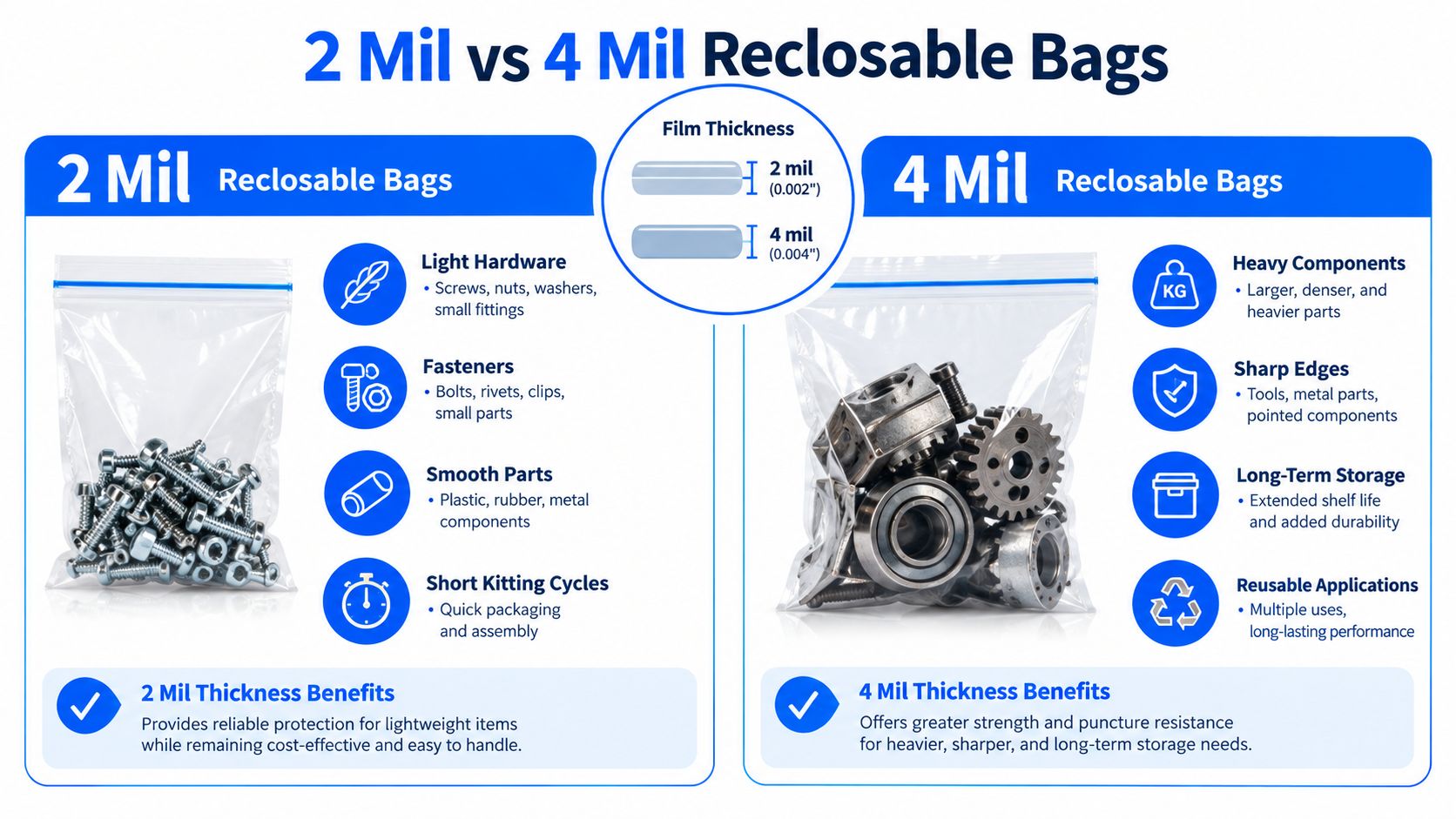
| Selection factor | 2 mil starting point | 4 mil starting point |
|---|---|---|
| Part surface | Smooth, light components | Threads, metal corners, rough edges |
| Use pattern | Short kit cycle | Repeated access |
| Storage | Light-duty handling | Extended bin storage |
| Sample check | Look for stretching | Still check for punctures and seal problems |
Thicker doesn't mean puncture-proof. A sharp bracket may need an edge cover or a different container. Increasing gauge also won't fix a bag that's too narrow.
Test the Hardest Part
Load the heaviest intended bundle, close the zipper, and handle it the way your crew will. Watch where bolt corners, threads, or fittings press into the film.
If a corner visibly dimples the sample or starts a puncture, test the heavier option. Don't use a fingernail check as a substitute for evaluating the loaded kit.
Compare total use rather than case pricing alone. A cheaper bag isn't useful if employees must rebag parts, while heavier film adds unnecessary material when the lighter option works. Use the poly bag mil thickness guide to narrow the gauge choice, then ask for volume pricing on the approved specification.
White Block Write On Bags and Hang Hole Options
A white block write-on bag gives the kit clerk a clear panel for a part number, lot code, or pick location. It can replace a separate label when handwritten identification fits the workflow. Choose the panel around the information the part inside needs, not just the bag's nominal size.
Test the marker used at the station on a sample. Try a ballpoint, Sharpie, or industrial marker, allow the ink to dry, then rub the panel as it would be handled in a bin. Ink performance varies by pen and panel.
Keep Identification Useful
- Write the required fields: Set a consistent order for part number, quantity, and lot information.
- Check visibility: Confirm the filled bag does not conceal important markings on the part.
- Check handling: Rub the written area after loading the actual component.
A hang hole suits bags that need to hang on a retail peg or shop-floor rack rather than sit in a drawer. The opening must match the fixture and leave enough room for the bag and part to hang without catching.
Match the Hole to the Fixture
Typical options include a round 3/16-inch hole for standard pegs and a 1-1/4 x 5/32-inch slot for European pegboard. Confirm peg diameter, hole position, and bag orientation against the fixture before ordering. Hole styles are not interchangeable by appearance alone.
A hang hole does not automatically suit vending-machine coils. Check the machine's packaging requirements and test dispensing with the loaded bag before buying for that use. Compare write-on and hang-hole formats against your fixture before ordering, and verify availability for the exact size and gauge required.
Anti Static Bags for Electronics and ESD Sensitive Parts
Anti static isn't a single protection class. For electronics, identify the required packaging function before choosing the bag size or color.
Use the visual comparison as an orientation, then check the product's electrical specifications. Color alone doesn't establish resistance levels or shielding performance.
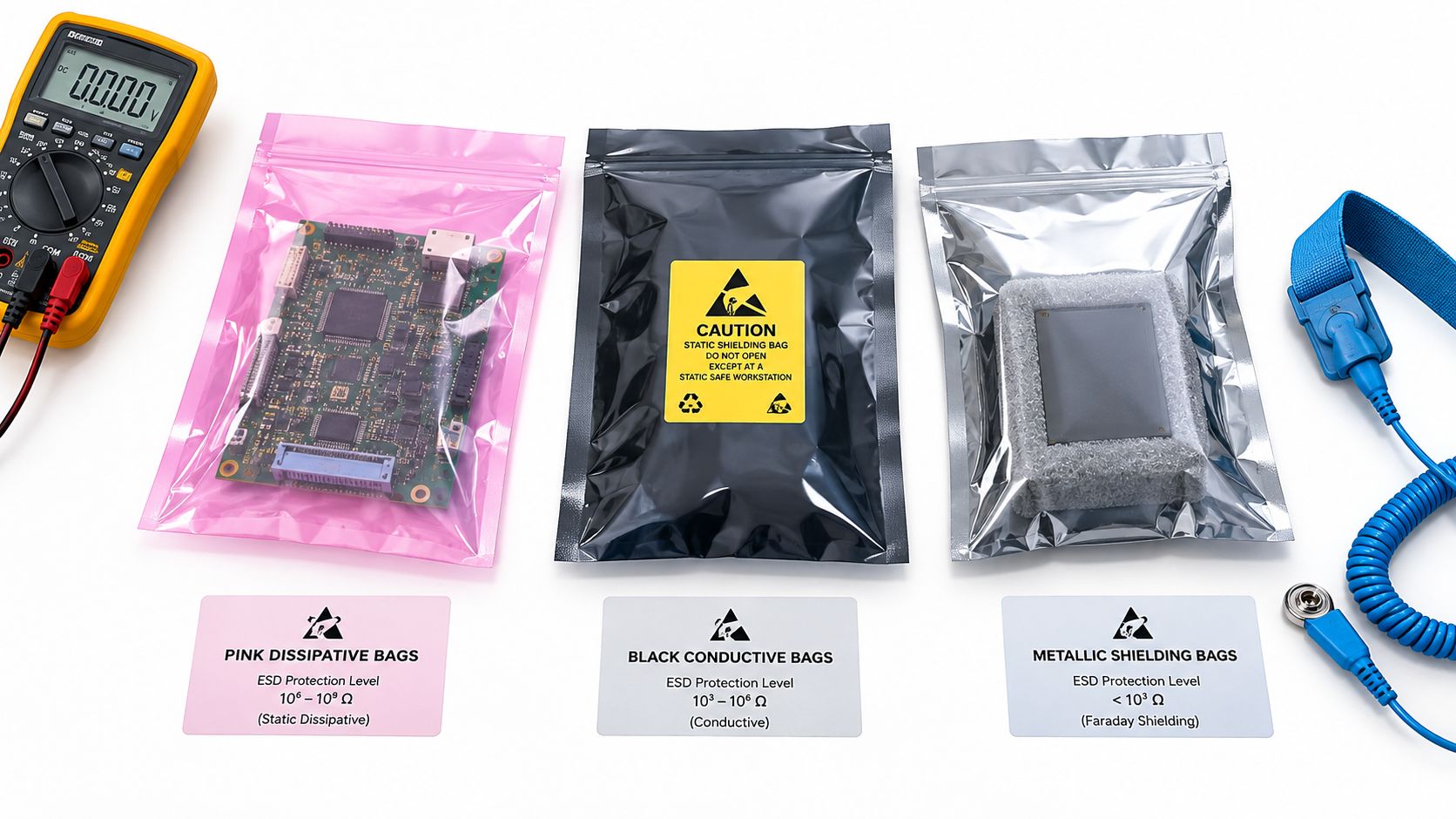
Match Protection to the Handling Route
| Bag family | Selection consideration |
|---|---|
| Pink anti static or dissipative film | Controlled handling and storage where the specified film meets your ESD requirements |
| Metallized shielding bag | External discharge protection for transport or shipping |
| Black conductive bag | Conductive packaging, with light blocking where the specified material provides it |
Don't treat pink film as a substitute for a shielding bag. A completed board leaving a controlled work area may need protection beyond the low-charging or dissipative function used during internal handling.
For components that also need light protection, check opacity along with electrical properties. Black color by itself isn't proof that the package meets either requirement.
Confirm the Component Requirement
Your ESD coordinator or component packaging specification should settle the protection class. The packaging guidance for sensitive components from American Additive Manufacturing offers additional context when reviewing those choices.
Compare the documented options in the anti static packaging category. Check closure requirements too, since a protective bag must be used as specified.
Protective packaging complements your ESD bench procedures. It doesn't replace them.
How to Choose the Right Reclosable Bag in Five Steps
A kit that fits on paper can still slow a loading line if the bag is tight around the parts or closure. Approve a filled sample against the usable inside dimensions, then keep it with the purchasing record so each station orders to the same specification.
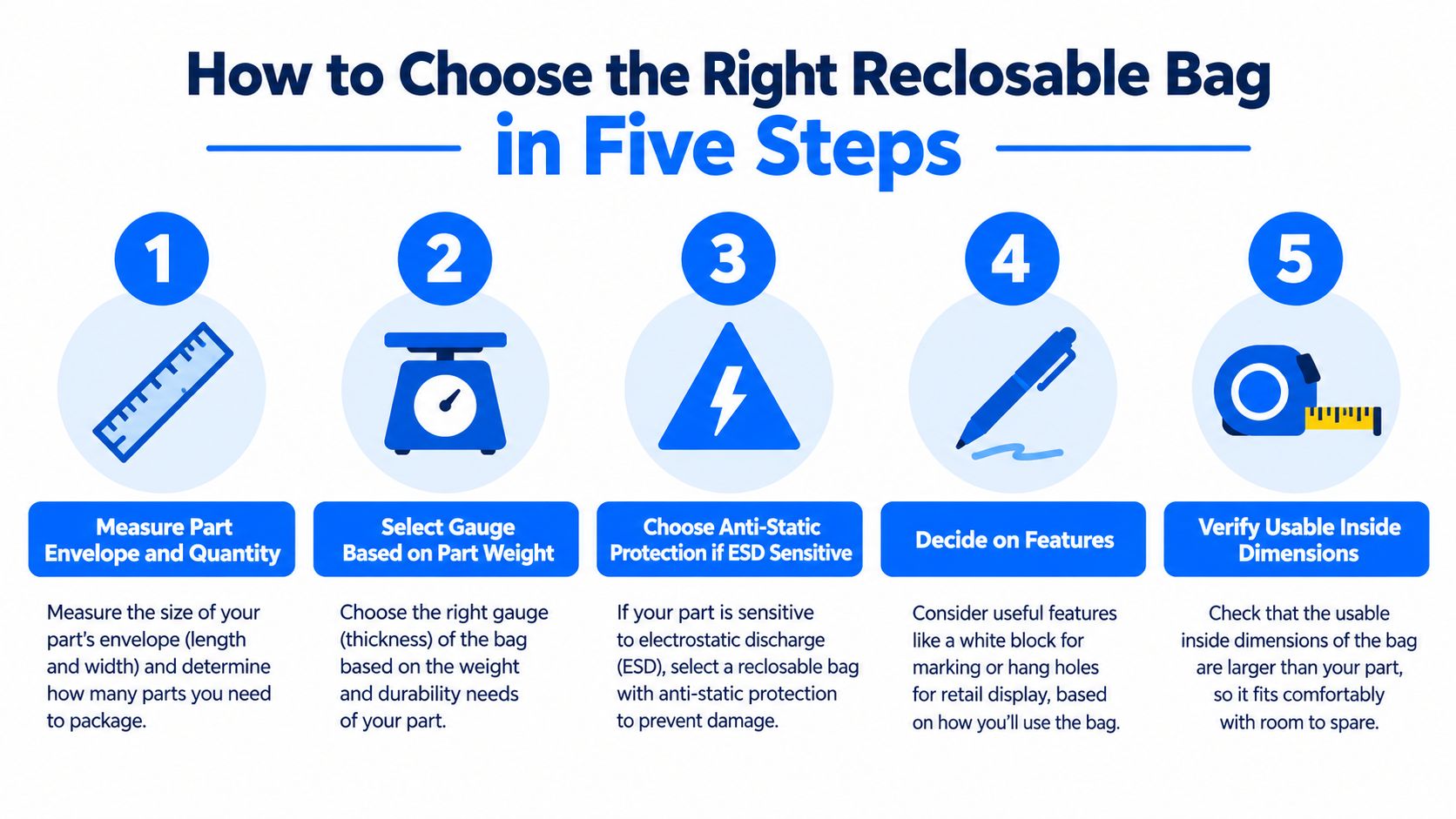
- Measure the full kit. Check the largest part's envelope and the full quantity going into each bag. Use the interior dimensions, accounting for dimensional tolerances, rather than relying only on a nominal size label.
- Confirm closure clearance. Load the candidate bag and check that parts go in and come out without snagging. Close and reopen the zipper with the intended fill.
- Select the gauge. Test the bag against sharp edges and the handling conditions the parts will encounter. Choose thickness based on that trial.
- Choose the features. Specify any write-on panel, hang hole, or required ESD class on the purchasing record, not just in a station note.
- Approve and order. Record the physical specification and supplier item identifier, then order the selected reclosable bags by the case of 1,000 from the category linked in the size chart above.
Attach the approved sample and its measurements to the purchase order so receiving can check the shipment against the specification. For a custom size, provide the loaded dimensions and application, not only the desired outside dimensions.
Use the video as an additional visual reference during selection.
Shop in Stock Reclosable Bags and FAQ
When a parts bag is ready to order, match the product to the approved specification, then check its listing for available formats and pack details. The packing and shipping bags category offers a place to compare related packaging options.
Are Reclosable Parts Bags Sold by the Case?
Yes. Case quantities are typically 1,000 units, so confirm your storage space before ordering multiple cases of larger formats such as 12x15. Check the selected product's pack quantity before placing the order.
Can You Get Volume Pricing or Custom Sizes?
For repeat requirements, ask about volume pricing. For pallet quantities or project-size orders, request a quote. Contact a specialist about custom sizes before planning around a change to a stock format.
Are Hang Holes Available in Every Gauge?
Availability can vary by size and gauge. Check the individual product specification, and confirm that the hole fits your fixture before ordering.
What Marker Should You Use on White Block Bags?
Test the marker with a filled sample bag. Check that it dries, does not smear during handling, and stays readable after the bag is labeled and stored.
Is a Pink Bag Enough for Shipping Electronics?
Color alone does not confirm protection. Match the documented protection class to the component and shipping requirements, including shielding where required.
Can You Recycle Used Parts Bags?
Ask your facility's recycler whether it accepts the bags, especially if the film is contaminated. The EPA's materials recovery data report a 10% in 2018 recycling rate for the broader polyethylene bag, sack, and wrap category. That figure is not a separate rate for reclosable parts bags.
Do State Packaging Rules Affect Purchasing?
They can affect material and documentation requirements. Review applicable obligations with the Association of Plastic Recyclers' recycled-content policy guidance. A recyclable label alone does not demonstrate compliance.
What If a Bag Arrives Out of Spec?
Hold the affected stock and compare it with the approved sample and purchase specification. Send the supplier the measurements, item identification, and photos before releasing the bags to the floor.
Based in Salt Lake City since 1997, Material Handling USA offers in-stock SKUs, volume pricing, and nationwide shipping for business buyers, including reclosable bags for parts and kits. For pallet quantities, custom sizes, or project-size orders, contact a product specialist at 1-800-326-4403, Mon to Fri 8am to 5pm MT.