Strapping Seals Guide: Open, Closed, and Buckle Options
You tensioned the strap, crimped the seal, and sent the pallet to the dock. By the time it reached the truck, the band had slipped and the load leaned.
That failure starts at the joint, not the strap. This strapping seals guide helps you match open, closed, serrated, smooth, and buckle closures to your strap so you buy the right case the first time.
Table of Contents
- Why Seal Choice Matters for Every Strapped Load
- Open Versus Closed Seals and When to Use Each
- Serrated or Smooth Seals for Your Strap Material
- Wire and Plastic Buckles for Cord Strap
- Matching Seal Width to 1/2, 5/8, and 3/4 Inch Strap
- How to Choose the Right Strapping Seal Step by Step
- Shop Strapping Seals and Buckles in Stock
- Strapping Seals Questions Buyers Ask Most
Why Seal Choice Matters for Every Strapped Load
You pull a pallet tight and watch the strap creep at the seal. The strap didn't break. The joint let go.
A seal joins the overlapping ends of a tensioned strap so bundles, pallets, and unit loads stay closed during handling and transport. Think of it as the knot in a loop. If the knot slips, the loop's strength doesn't matter.
That's why seals aren't just carton accessories. ASTM D3953 for steel strapping and seals defines uses that include closing, reinforcing, and bundling articles for shipment, unitizing and palletizing loads, and bracing cargo for carloading and truckloading. It also covers lifting and lashing.
A tested system, not a loose part
The same standard covers breaking strength, elongation, and seal joint strength. You're buying performance, not appearance.
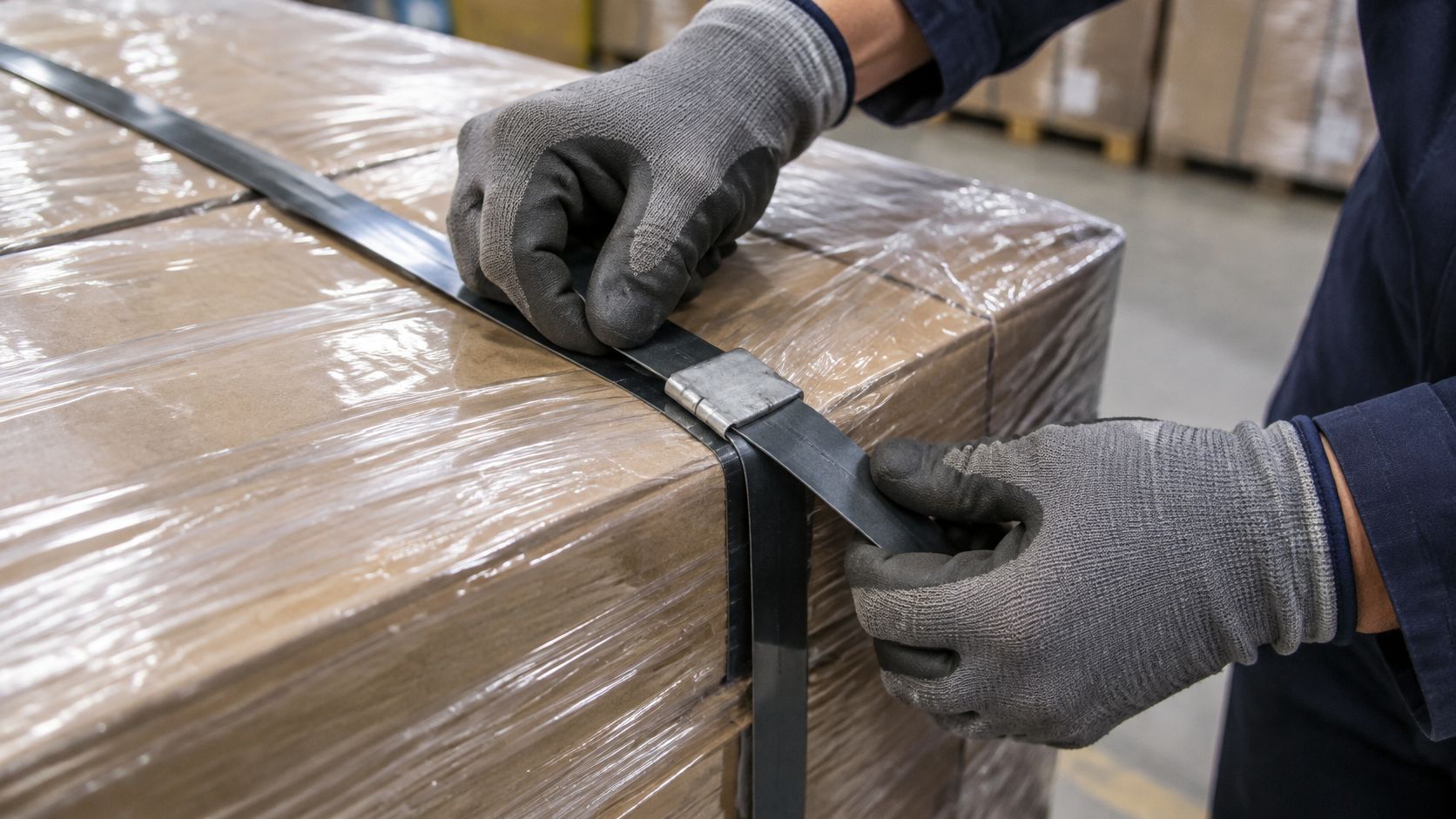
So don't pick by width alone. Check the strap, seal, and tool together, then choose the style that fits your load shape.
Open Versus Closed Seals and When to Use Each
The first choice is simple. Does the seal go on before tensioning, or after.
Open seals, also called snap on seals, are open on one side. You place them over overlapping strap ends during or after tensioning, then crimp them with a sealer. They're like a snap on bracelet you can add after the loop is tight.
Use open seals for flat loads. Stacked cartons, lumber bundles, and palletized products work well because you can pull the strap tight first and add the seal where the ends meet.
The comparison below shows the basic split at a glance.
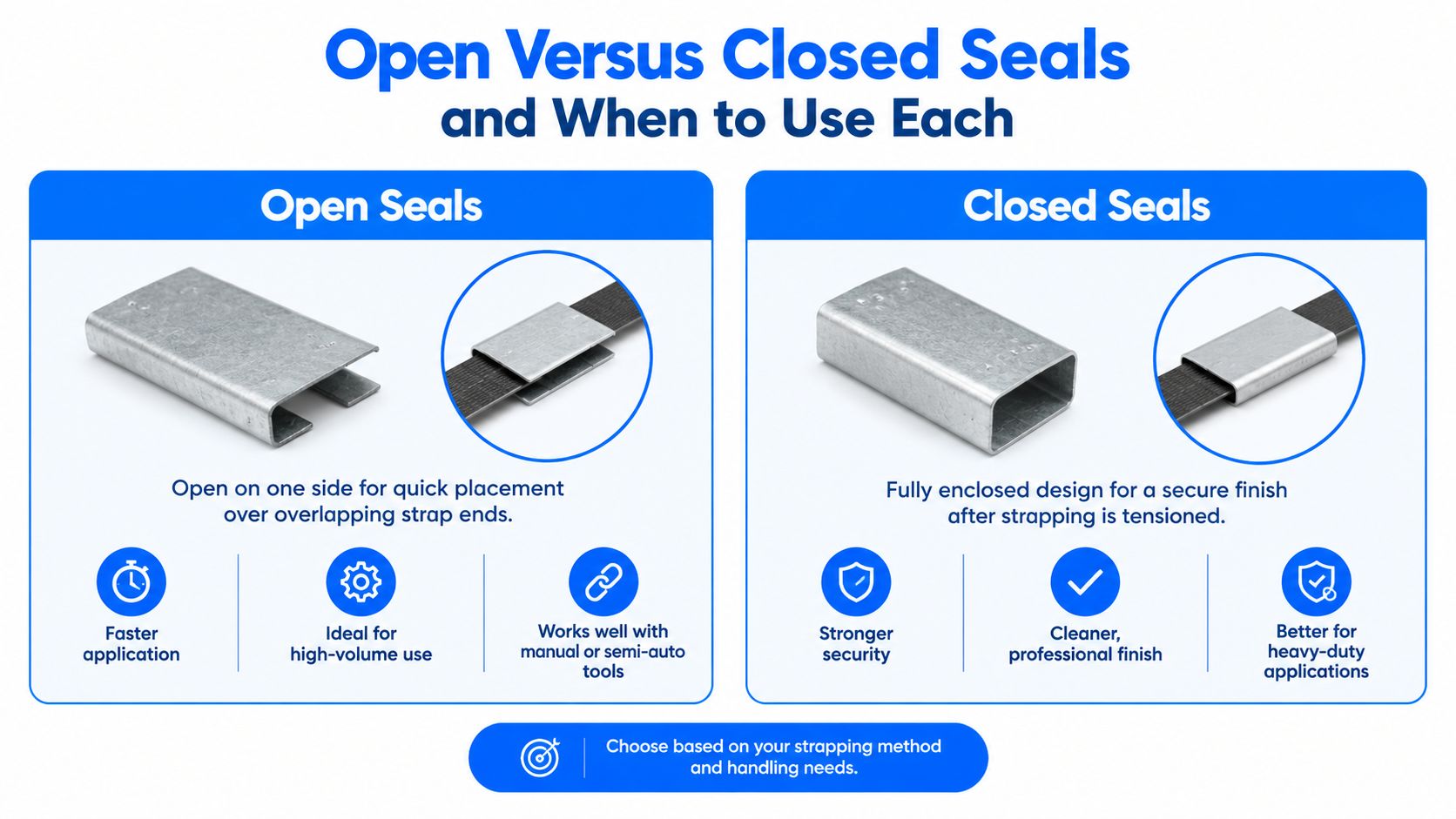
Closed seals, also called thread on seals, work the other way. You feed them onto the strap before tensioning, like sliding a ring on before you tie the knot. The seal stays in place while you position and pull the band.
Choose closed seals for rounded or irregular loads, such as pipes, coils, or round bundles. On a curved surface, a seal you add later can slide off before you crimp it.
Practical rule: If the load is flat and you tension first, pick open. If the load is round and the seal must travel with the strap, pick closed.
Watch how the seal is placed and crimped before you train a new operator.
The style also has to match your tool. A pusher style closed seal is threaded before tensioning, while an open seal is snapped over the joint afterward. Use the wrong order and you can't crimp the joint correctly.
Plan your order quantity too. Seals typically come per case, commonly 1000 or 2000 pieces. Pick the style first, then order the case size that matches your volume.
Serrated or Smooth Seals for Your Strap Material
Open versus closed tells you when the seal goes on. Serrated versus smooth tells you how it grips. Buyers mix these up often, so treat them as two separate choices.
Serrated seals have teeth that bite into the strap. They're like tread on a shoe gripping a slick floor. That bite helps on plastic strap, such as polypropylene or PET polyester, because those surfaces are smoother than steel.
Smooth seals have no teeth. They rely on the crimp made by your sealer and the contact between seal and strap. They're the usual choice for steel strap with notch or crimp joints, where the sealer creates the hold.
Match the profile to the material
- Serrated for plastic: Use it when you need extra engagement on polypropylene or PET.
- Smooth for steel: Use it when your steel system is built around a notch or crimp joint.
Don't treat them as interchangeable. The wrong pairing can damage the strap, fail to crimp correctly, or reduce holding power. If you're still deciding between strap materials, review polyester versus steel strapping for your load before you pick a seal profile.
Check three things together every time. Confirm the strap material, the seal style, and the sealer jaw pattern. If one of the three doesn't match, don't order yet.
Wire and Plastic Buckles for Cord Strap
Buckles close a strap a different way. You don't use a metal seal or a crimping tool.
You thread the strap through the buckle and pull it tight by hand or with a tensioning tool. That makes buckles a simple choice for cord strap and some plastic strapping where you want a fast, adjustable closure.
Wire buckles
Wire buckles are built to improve threading and resist slip. They're a good fit for cord strap on bundles you tension by hand or with a basic tensioner. Pick wire when you want grip and simple threading.
Plastic buckles
Plastic buckles help when corrosion is a concern or you need a non scratch closure around finished surfaces. Use them near painted, polished, or other surfaces a metal closure could mark.
Buckles don't come in one universal size, so check the stated strap range on the product spec before you order.
Published buckle specs list ranges, not a single fit. For example, one plastic buckle range covers 3/8 to 1/2 inch strap, another covers 1/2 to 5/8 inch strap, and a 5/8 inch model is listed for polypropylene or cord strapping. Your exact model may differ.
Match the buckle material and width to your strap, then verify the manufacturer's stated application. If the spec doesn't name your strap type, choose a different buckle.
Matching Seal Width to 1/2, 5/8, and 3/4 Inch Strap
Start with the exact match rule. A 1/2 inch seal fits 1/2 inch strap, a 5/8 inch seal fits 5/8 inch strap, and a 3/4 inch seal fits 3/4 inch strap. Don't force a close size.
| Strap Width | Seal Width | Check Before Ordering |
|---|---|---|
| 1/2 inch | 1/2 inch | Strap material, thickness, and sealer jaw |
| 5/8 inch | 5/8 inch | Strap material, thickness, and sealer jaw |
| 3/4 inch | 3/4 inch | Strap material, thickness, grade, and crimp count |
Width is the starting check, not the whole decision. That's the part many buyers miss. ASTM D3953 minimum joint efficiency requirements set 75% for double notch joints and 45% for single notch joints in heavy duty strapping.
In plain terms, the joint holds less than the strap alone. An undersized seal or a shallow crimp reduces load transfer and can cause early failure, even when the strap is strong enough.
For steel, also confirm thickness, grade, and joint method. Verify your sealer makes the required number and depth of crimps for that seal. If you need to restock the strap itself, shop strapping bands by width and material and match the seal to that exact specification.
How to Choose the Right Strapping Seal Step by Step
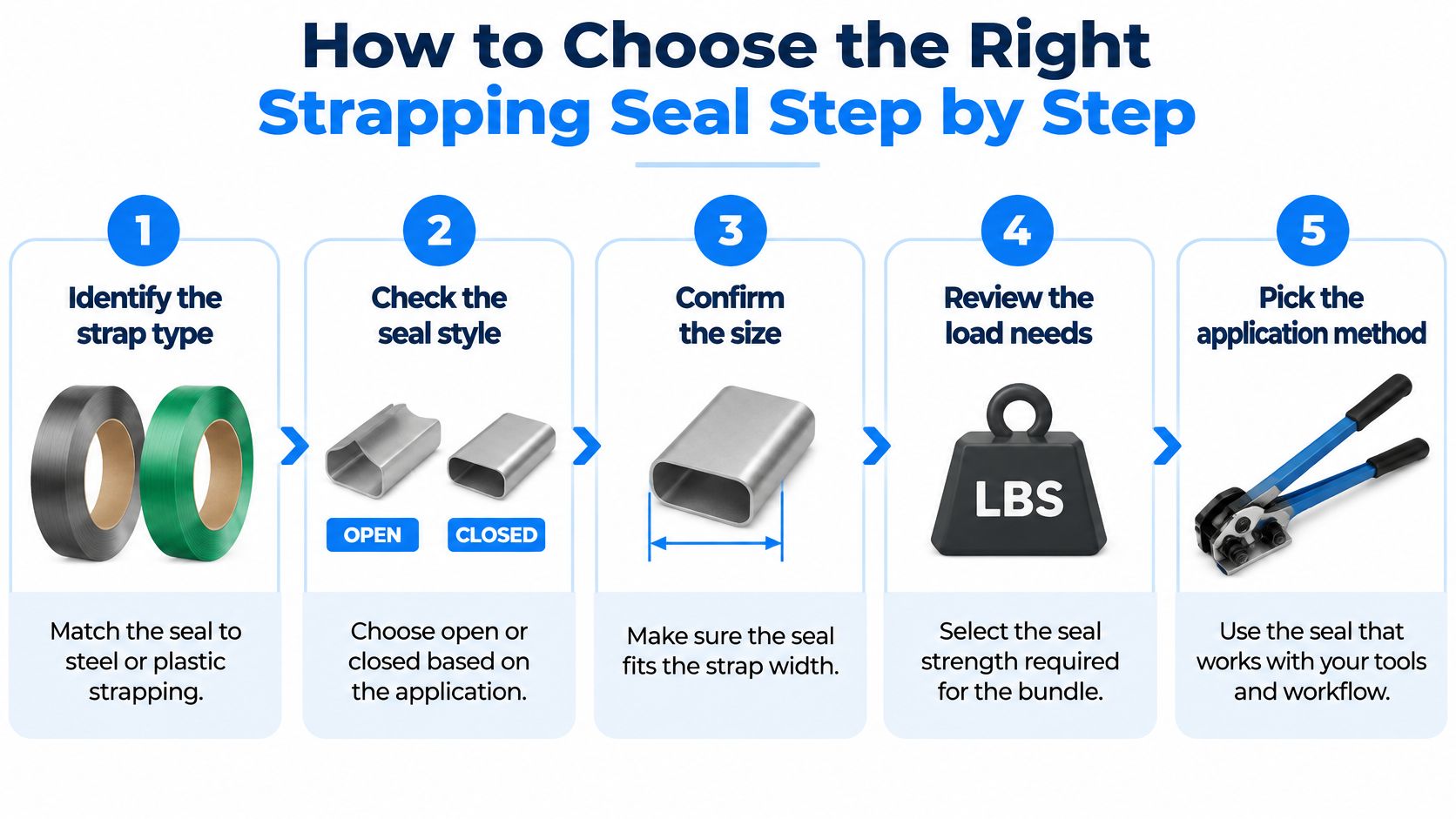
A seal only works as part of a strap, seal, and tool system. Treat the pieces like a key and lock: a seal that fits the strap can still fail if the tool cannot form the right joint. Check the whole setup before ordering by the case.
- Name the strap material. Steel, polyester, and polypropylene use different joining systems, so choose a seal made for your strap.
- Confirm the specifications. Check the strap's thickness and grade, then verify the seal and tool are compatible with them.
- Match the seal style to the load. An open seal suits flat loads tensioned before closure. A closed seal can suit round or irregular loads.
- Choose the seal surface and tool. Serrated seals suit plastic strap; smooth seals suit steel notch or crimp joints. Confirm the sealer jaw matches the seal.
- Select the closure for cord strap. If you do not use a crimper, choose a compatible wire or plastic buckle.
- Test before placing a bulk order. Make sample joints and compare their strength with the strap's specified minimum breaking strength.
Use this infographic as a quick check at the dock:
Joint efficiency compares joint strength with the strap's minimum breaking strength. ASTM guidance on joint efficiency calculation lists 75% for conventional double notch, crimp, and sealless joints and 90% for USLM crimp joints. Use these figures as a reference when evaluating test results.
If a sample joint falls short, inspect the crimp dies, seal fit, overlap, and tool alignment. Correct the cause, then test again. Before buying by the case, confirm that your strapping tools and sealers can form the intended joint.
Shop Strapping Seals and Buckles in Stock
A seal, strap, and tool work as one system, so check that the parts fit and the joint holds before ordering by the case. Material Handling USA, based in Salt Lake City, has served businesses nationwide since 1997. You can order seals, buckles, strap, and tools through one account.
Start with the part you need, then confirm it matches the rest of your setup:
- Seals and buckles: Shop strapping seals and buckles by width, style, and strap type.
- Strap: Shop strapping by type and width to find a match for your closure.
Check your tool's jaw pattern against the seal, and test a sample joint before placing a larger order. Volume pricing is available, with price breaks by the case or pallet. For pallet quantities, custom sizes, or a project quote, call a product specialist at 1-800-326-4403, Mon to Fri 8am to 5pm MT.
Strapping Seals Questions Buyers Ask Most
Can you use a serrated seal on steel strap
Don't assume you can. Serrated seals are built to bite into smoother plastic strap, while steel systems usually use smooth seals with a notch or crimp joint. Check the seal, strap, and sealer jaw together and choose the profile made for your strap.
Can you use a closed seal on a flat load
You can, but you must thread it on before tensioning. On a flat pallet where you tension first, an open seal is usually easier to place and crimp. Pick based on your tensioning order, not habit.
How many seals come in a case
Seals typically come per case, commonly 1000 or 2000 pieces. Check the product spec for the exact count before you set your reorder point.
Can a buckle replace a seal
On cord strap and some plastic strap, yes, if the buckle spec names your strap type and width. A buckle doesn't need a crimper, but it isn't a substitute for a crimped steel seal. Choose the closure your strap system was designed for.
Can you order a seal by width alone
No. Width gets you to the right shelf, but material, thickness, grade, style, and tool decide if the joint holds. Confirm all of them, then test a sample joint.
Can a specialist help with custom sizes
Yes. Call 1-800-326-4403, Mon to Fri 8am to 5pm MT, for pallet quantities, custom sizes, or a quote on project size orders. Have your strap material, width, and thickness ready so you get a direct match.
Order your seals, buckles, strap, and matching tools in one place with volume pricing by the case or pallet. Visit Material Handling USA to shop in stock strapping supplies today, or call a product specialist at 1-800-326-4403 for help matching a seal to your exact strap.