Tennsco Lockers Guide: Sizes, Tiers and How to Order
You ordered lockers that match the catalog photo. Did anyone check whether a tall, narrow cabinet stays put when a worker pulls an open door?
A room full of the wrong openings wastes floor space and fails a site walk. This Tennsco lockers guide walks tier, size, steel construction, delivery format, anchoring, and accessible openings so the order matches the people who use it.
Table of Contents
- Lockers That Fit Your Users and Your Room
- Tennsco Locker Sizes and Tier Styles Compared
- How to Spec a Locker Order Step by Step
- Construction Gauges for Ventilated and C-Thru Lockers
- Assembled or Unassembled Lockers and the Labor Tradeoff
- Anchoring and Installation Checklist Before Use
- ADA Compliant Lockers and Accessible Openings
- Frequently Asked Questions About Tennsco Lockers
- Shop Tennsco Lockers in Stock and Call for Quotes
Lockers That Fit Your Users and Your Room
A plant adds a second shift and needs coats, bags, and phones. How many openings remain once a clear aisle and a reachable latch are part of the layout?
Tier is the stack of doors in one cabinet. One full-height opening suits a coat. Two or three shorter openings put more people on the same floor area, if the gear still fits. A phone belongs in a short box, not a tall door.
Put the floor anchor and the install sign-off on the order, not in a later assembly note. An unfastened cabinet can shift when a door is pulled. Place the accessible opening where the user meets the handle without crossing traffic.
Material Handling USA, the Salt Lake City store open since 1997, stocks 58,000+ SKUs, offers volume pricing, and ships nationwide. The Tennsco shelving buyers guide covers steel shelving for the same room. Teams that outgrow a closet often start with cost-saving storage strategies for growing businesses before they commit floor space to permanent lockers.
Tennsco Locker Sizes and Tier Styles Compared
Which door height does each person need? A single tier locker is one full-height door. A published representative model is 15 inches wide, 18 inches deep, and 78 inches high, with a 72-inch opening height, per the Tennsco locker specifications. That opening fits coats, uniforms, and larger personal items. The tall body is also what gets anchored to the floor or wall, so height belongs in the purchase, not in a later assembly note.
| Style | Opening and depth | Openings and height | Best use |
|---|---|---|---|
| Single tier | 15 in wide, 18 in deep (representative model) | One full-height opening, 78 in high | Coats, uniforms and larger personal items |
| Double tier | Same cabinet height split into two openings | Two openings per unit | Offices and schools needing more compartments per floor area |
| Triple tier | Same cabinet height split into three openings | Three openings per unit | High user counts in a compact floor area |
| Box locker | 12 or 15 in opening, 12, 15 or 18 in deep | Five or six high, single or three wide | Phones, keys and small gear |
| Full steel range | 12, 15, 18 or 24 in opening, 12, 15, 18, 21 or 24 in deep | Check the product spec | Matching width and depth to coats and gear |
Double tier and triple tier lockers split that same general cabinet height into two or three smaller openings. You get more user compartments on the same floor area, which suits offices and schools. On a triple stack the bottom door sits in reach of a seated user, so name those openings when you pick the tier.
Box lockers are the small doors. The Tennsco commercial catalog lists 12 inch or 15 inch openings, depths of 12, 15, or 18 inches, and five high or six high stacks. You can order them single wide or three wide, with or without legs, and with a built-in lock or a padlock hasp. They fit phones, keys, and small gear. Legs lift the bottom row; without legs that row stays near the floor.
The wider steel range runs opening widths of 12, 15, 18, or 24 inches and depths of 12, 15, 18, 21, or 24 inches. Match opening width and depth to the gear before you order. A coat on a hook needs depth the way a packed bag needs width. Self-storage unit sizes in the Admiral's Yard Self Storage sizing guide describe a different kind of space and do not replace these steel opening sizes. Dimensions, opening counts, legs, and lock options change by model, so confirm the exact product spec before you order. Browse the full model list when you shop Tennsco lockers by brand.
How to Spec a Locker Order Step by Step
Decide the big items first so the cart stays accurate.
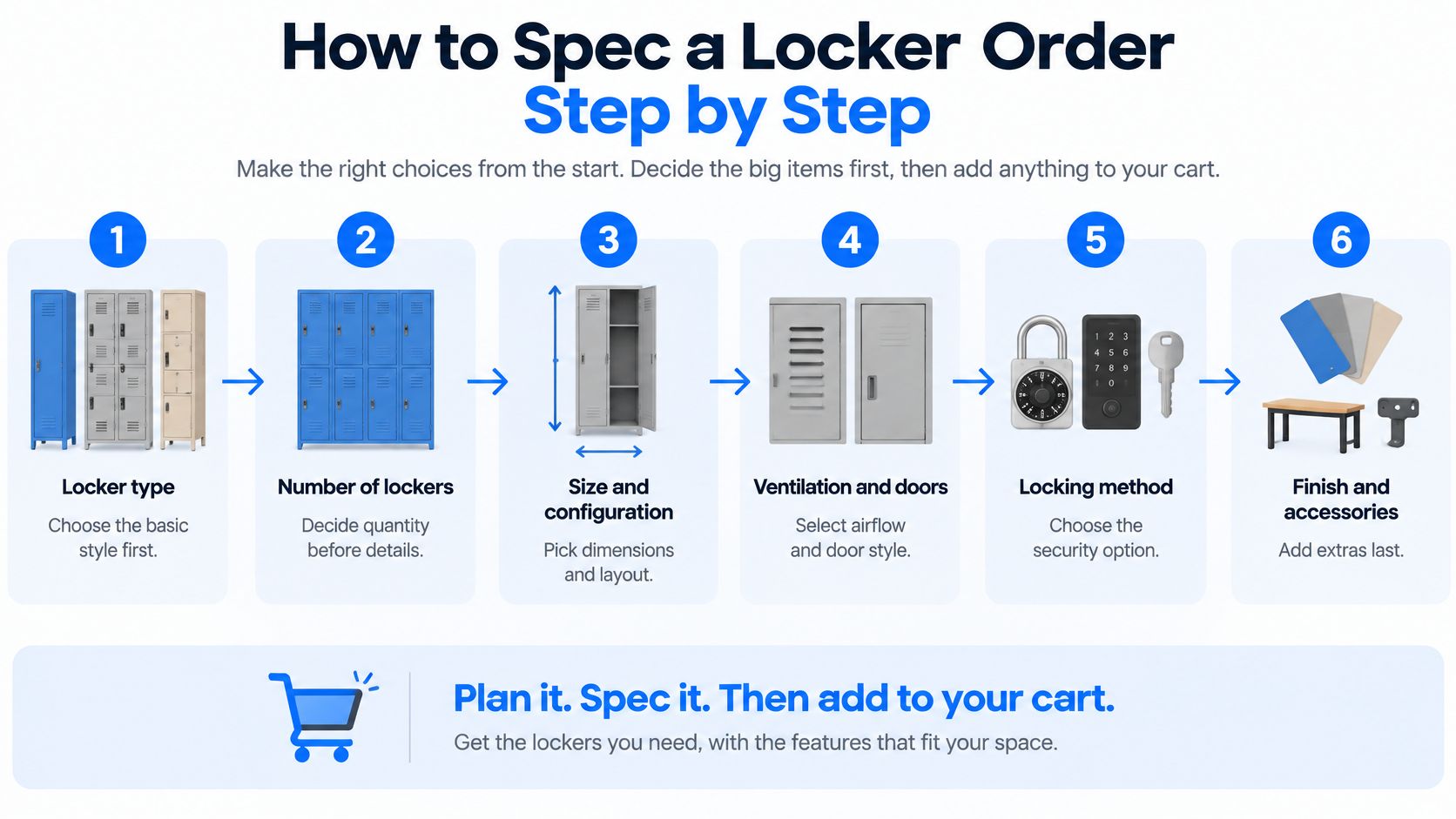
- Count users and what they carry. Coats point to single tier. Shared floor space points to double or triple tier. Phones point to box lockers.
- Set the mix for each room. A warehouse bay may need mostly full-height doors, while a school hall needs more openings per square foot.
- Match width and depth to the items. Coat rods and hooks only help if the opening is deep enough for the garment.
- Pick the door style. Solid steel hides contents. Ventilated doors move air. C-Thru doors let staff see inside.
- Mark seated-user openings now. Note which doors must work from a chair, then use the accessible-opening rules before you finalize counts.
- Choose assembled or unassembled. Freight drops when units ship flat. Labor drops when they arrive welded.
- Name the anchor plan and the signer. Write who approves wall or floor attachment before the truck leaves.
- Total openings and lock type. Add built-in locks or padlock hasps, then ask for a project-size quote.
Material Handling USA provides buying guides and planning tools you can share with maintenance and purchasing so the same list reaches every reviewer.
Practical rule: If you can't name the signer for anchoring, the order isn't ready to ship.
Construction Gauges for Ventilated and C-Thru Lockers
What does the gauge number change on the locker you are about to order? Gauge is the thickness of the steel. It works like wire size: a lower number means thicker metal and more resistance to dents.
| Component | Ventilated | C-Thru |
|---|---|---|
| Doors | 14 gauge | 16 gauge, optional 1/8 inch polycarbonate box-locker door |
| Frames | 16 gauge | 16 gauge |
| Sides, tops, shelves and bottoms | 16 gauge | 16 gauge |
| Backs | 18 gauge | 18 gauge |
The ventilated and C-Thru locker specification sets ventilated doors at 14-gauge steel, frames and sides, tops, shelves and bottoms at 16-gauge, and backs at 18-gauge, while C-Thru doors, frames, and those same body parts are 16-gauge, backs are 18-gauge, and box lockers can take an optional 1/8-inch polycarbonate door.
Finish, hinges, and the pre-lock
Cleaning and phosphatizing come first, in a multi-stage pretreatment, then polyester/epoxy powder paint goes on electrostatically. That film is what resists corrosion in plants and schools.
Full-loop, tight-pin hinges are welded to the frame and riveted to the door. Taller doors get an extra hinge. Shorter doors use a pair. A pre-lock lets you set a padlock or built-in lock while the door is open, then secure it by closing. Single-tier doors use several latches along the locking channel so the door pulls in evenly.
Read the frame gauge before you name who signs the install. Anchors hold in the frame, not in the thinner back. On an accessible opening, the extra hinge and the pre-lock are what let a seated user swing the door and lock it without a second reach.
Assembled or Unassembled Lockers and the Labor Tradeoff
The key choice is freight versus labor hours.
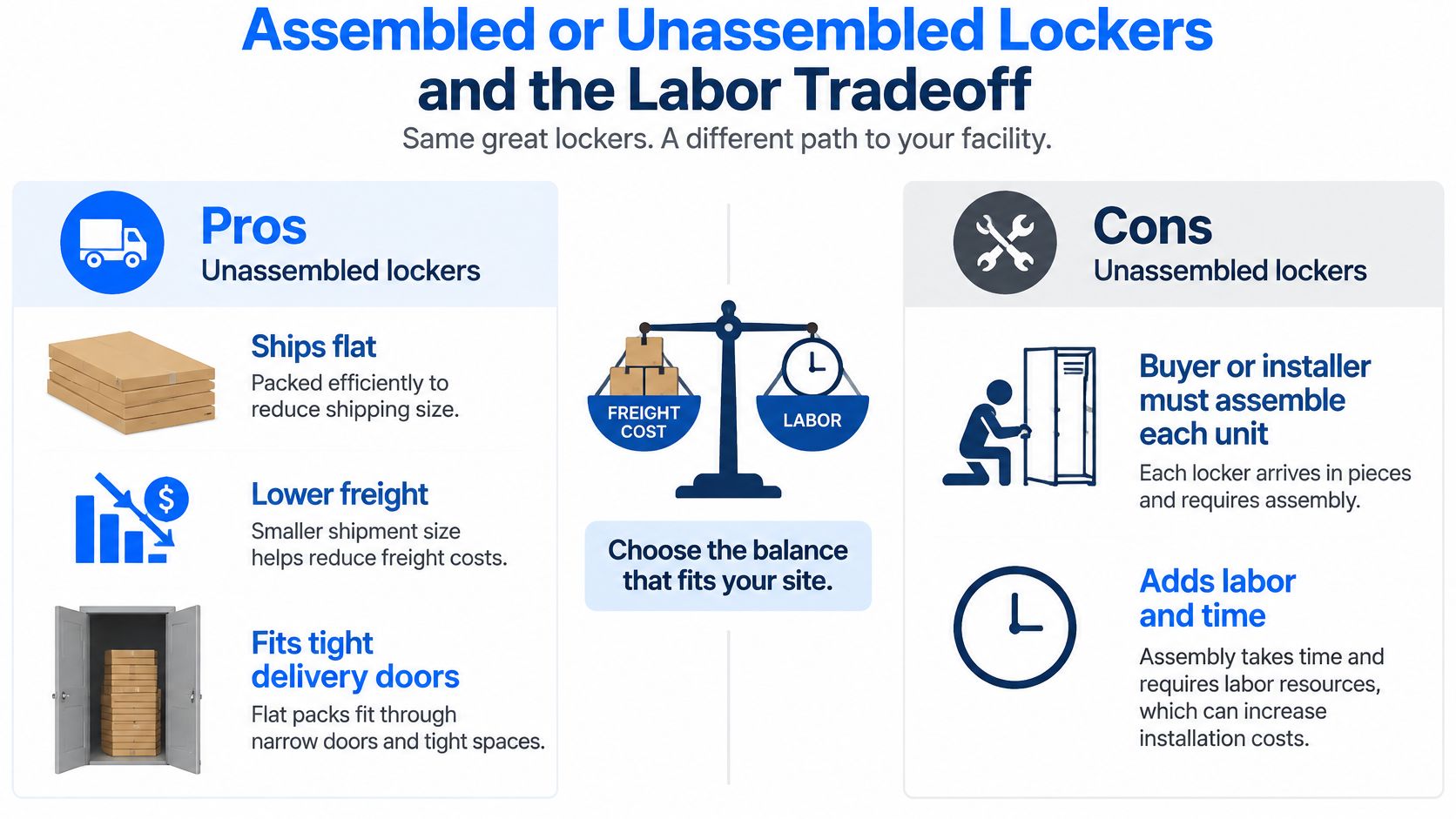
Unassembled units ship flat. Freight is lower, and the cartons fit tight doors and small docks. Someone on site still has to build each cabinet, so you need tools, floor space, and time.
Welded or assembled units arrive ready to set in place. You save crew hours. They take more room on the truck and at the dock.
A school with maintenance staff already on payroll often wins with unassembled lockers. A plant with no spare labor usually wins with welded units, even when freight is higher. Both formats still need the same level, square, and anchor check before anyone uses them. Compare formats when you shop lockers by category. Measure the dock, the hallway, and the crew before you pick a format.
Anchoring and Installation Checklist Before Use
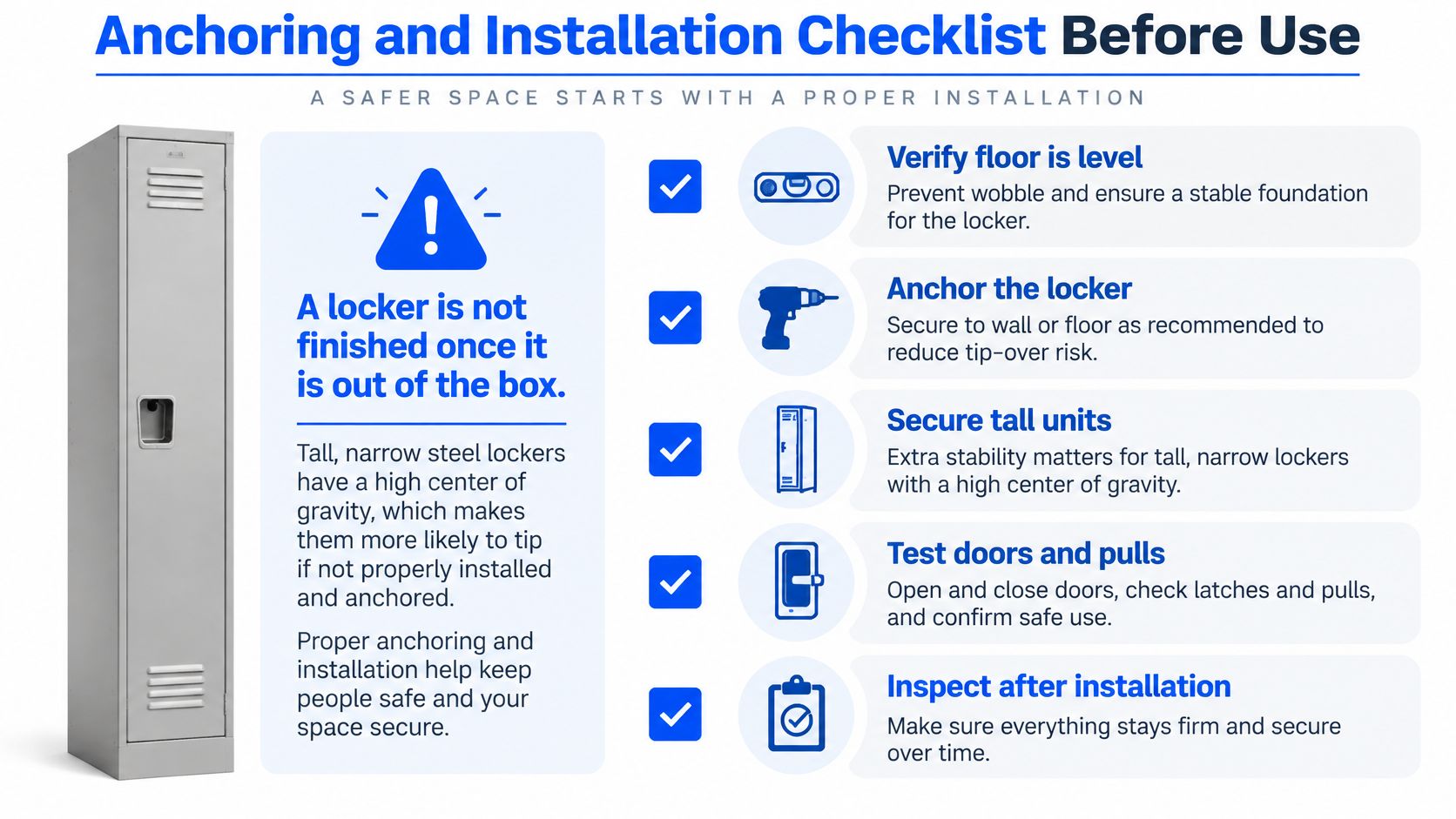
A finished-looking row is not a stable row. A tall, narrow steel box has a high center of gravity and a small footprint. Door weight, a wavy floor, or a user pulling an open door can tip it.
The Tennsco unassembled locker instructions require units level and square, adjacent lockers bolted together, and the bank anchored to a wall and/or floor before use. Unanchored units may topple. Back-to-back units should be bolted together too. A connected row is not self-supporting unless the paperwork and your site engineer say it is. That rule covers welded and knock-down bodies.
Before install
- Check the floor. Confirm the finished slab is level.
- Square the frames. Shim or correct the base so doors won't bind.
- Match the anchors. Pick fasteners for the wall or floor substrate and the expected load.
- Ask engineering. Confirm whether seismic or high-traffic use changes the attachment.
- Name the signer. One person approves the layout before release.
After install
- Check fasteners. Confirm each anchor is fully engaged.
- Cycle the doors. They should close without binding.
- Write it down. Record wall or floor attachment and file it with the order before the lockers go into service.
A one-line note that says "anchor to the wall or floor" is not an installation plan.
ADA Compliant Lockers and Accessible Openings
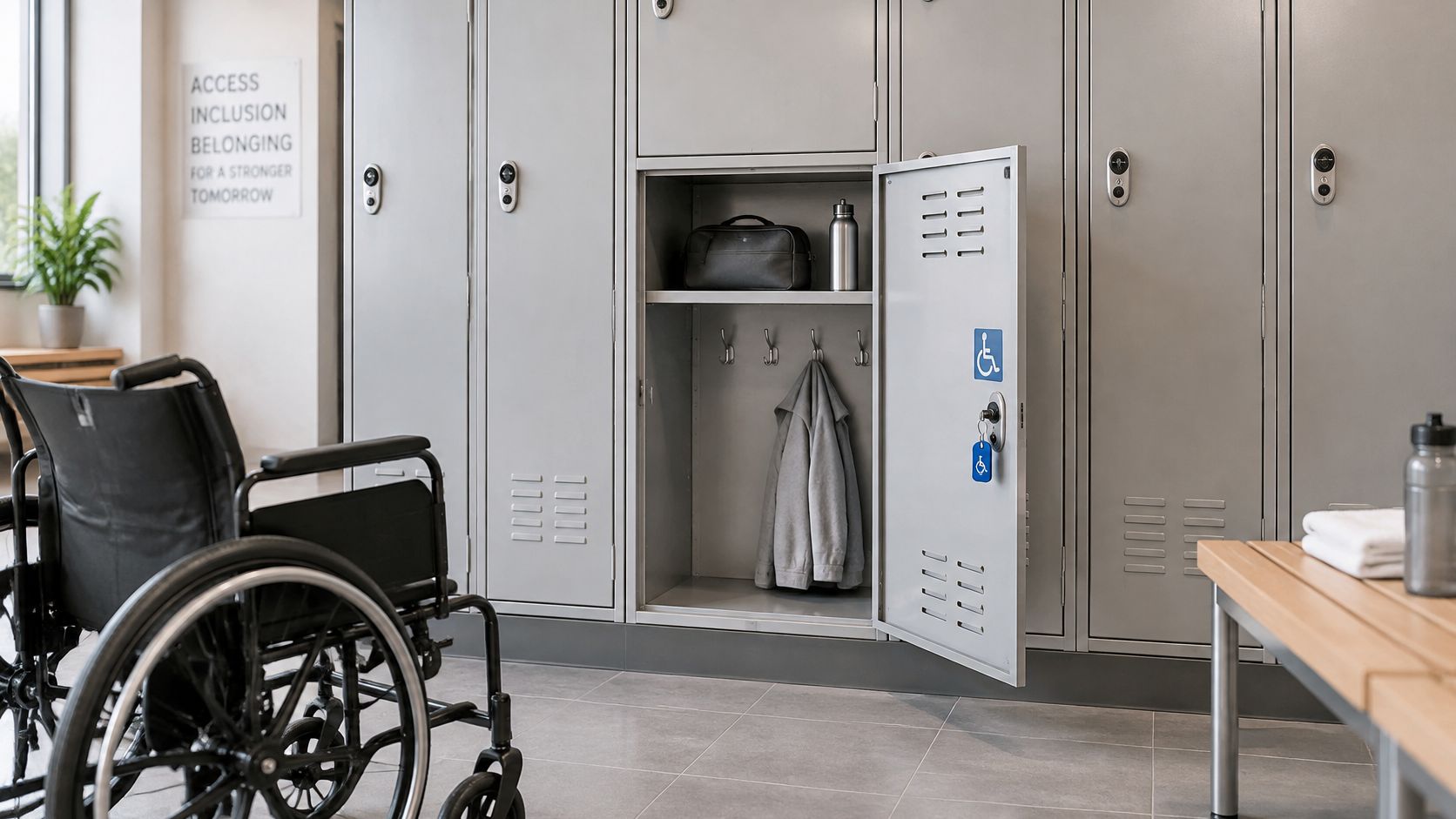
ADA compliant lockers are built for easier use from a seated position. The Tennsco lockers brochure lists three features: coat hooks, an upper shelf at a reduced height, and a special ADA compliant key cap. The larger key head is easier to grip and turn, and it supports single-handed operation.
You can specify a single tier locker, the bottom opening of a double tier unit, or the bottom two openings of a triple tier unit. A mixed room can include those openings inside a normal run instead of a separate cabinet type.
Count the accessible openings before you order. Then confirm dimensions, legs or a base, hardware, and where each opening sits in the row. Buying the right model does not, by itself, make the room compliant. Have the finished layout reviewed against the accessibility rules for your facility and jurisdiction. Our accessibility products page is the place to line up related reach and access gear for the same project.
Frequently Asked Questions About Tennsco Lockers
What is the difference between single tier and double tier lockers?
A single tier locker gives one full-height opening for coats and larger items. A double tier locker splits that same general height into two smaller openings so more people share the floor area.
Are box lockers good for phones?
Yes. Box lockers suit phones, keys, and other small gear. Order five high or six high, single wide or three wide, and pick a built-in lock or a padlock hasp on the spec sheet.
Should I buy assembled or unassembled?
Choose unassembled when lower freight and flat cartons matter more than site labor. Choose welded or assembled when your crew can't spend hours building each unit.
Do Tennsco lockers need anchoring?
Yes. Install them level and square, bolt neighbors together, and anchor the bank to a wall or floor before use. Unanchored units may topple.
Are ADA lockers required in every room?
Not every room needs them. Match accessible openings to that room's users, then have the finished layout reviewed for your facility and jurisdiction.
Can I get custom sizes?
Yes for many project orders. Call a product specialist when standard widths and depths don't fit the room or the gear.
Do you ship nationwide and offer volume pricing?
Yes. The store ships nationwide. Price breaks apply by the case or pallet, and project-size orders can be quoted.
Shop Tennsco Lockers in Stock and Call for Quotes
A locker order works like a furniture layout pinned to the floor plan. The model has to match the wall, the users, and how the bank will be fixed before anyone hangs a coat. Compare in-stock models when you shop Tennsco lockers by brand or shop lockers by category. Unit cost follows quantity, so one published price would miss case, pallet, and project breaks.
Write three decisions down before you ask for a number. Opening count and tier come from the size tables. Put the anchor choice, wall or floor, on that same sheet. Mark which openings sit at an accessible height, and note where the installer signs off that the bank is level, square, and bolted.
Call a product specialist at 1-800-326-4403 for pallet quantities, custom sizes, or a project-size quote. Material Handling USA stocks Tennsco lockers alongside the storage gear plants, schools, and warehouses specify from Salt Lake City.