Chrome Wire Shelving Sizes: Depth, Width and Height Guide
You've measured the back-room wall, found a shelving unit that looks right, and started counting how many bins it will hold. Then you notice the catalog size doesn't tell you how much room remains between the posts, or whether the shelf rating fits your load.
Choosing chrome wire shelving sizes starts with usable depth, not just the width in the product name. Check the space your cartons need, the aisle your team needs, and the rated load before you choose posts and shelf counts.
Table of Contents
- Standard Chrome Wire Shelving Sizes at a Glance
- Depth Sizes From 12 to 36 Inches and Their Inside Measurements
- How to Choose a Shelf Size From Your Space
- Width, Post Height and Capacity Ranges
- How to Configure a Unit Step by Step
- Chrome, Epoxy and Stainless Finishes Compared
- NSF Certified Options and When to Require Them
- Common Questions About Shelving Sizes
- Shop Chrome Wire Shelving by Size
Standard Chrome Wire Shelving Sizes at a Glance
Commercial chrome wire shelving is specified by shelf width, shelf depth, and post height. Width is also called length in some catalogs, so confirm which dimension runs along the wall before you order.
The standard commercial range includes the nominal dimensions below. Not every manufacturer offers every combination, and a product family may skip some widths or depths.
Standard chrome wire shelving dimensions
| Dimension | Sizes offered (inches) | What it controls |
|---|---|---|
| Shelf width | 24, 30, 36, 42, 48, 54, 60, 72 | Shelf length and footprint along the wall |
| Shelf depth | 12, 14, 18, 21, 24, 30, 36 | Front-to-back room for cartons, totes, and bins |
| Post height | 54, 63, 74, 86 | Vertical storage space and tier arrangement |
A name such as 48-inch shelving isn't a complete specification. You still need depth, post height, shelf count, and capacity to compare units correctly.
The category includes compact storage and full-height commercial racks. These are nominal ordering sizes, not guaranteed inside measurements or final assembled footprints.
Buying rule: Select a size range from the catalog, then approve the actual outside and inside dimensions on the exact model's spec sheet.
If you're also deciding how much separate storage space you need, Standby Self Storage's self storage size charts and examples offer a room-scale comparison. For shelving, make the final decision with a tape measure and the product drawing.
Depth Sizes From 12 to 36 Inches and Their Inside Measurements
A 24-inch-deep shelf rarely gives you 24 clear inches between the posts. Nominal depth is the ordering dimension, outside depth is the full front-to-back measurement, and inside depth is the clear space a container can occupy.
Outside depth can land slightly above or below the catalog number too, depending on how the manufacturer measures the wire deck and collars. Treat every catalog dimension as nominal until you check the model drawing.
Nominal and inside depth by shelf size
| Nominal depth (inches) | Inside depth (inches) | Typical use |
|---|---|---|
| 12 | Under 12 | Narrow wall units and small bins |
| 14 | Under 14 | Tight aisles and narrow cartons |
| 18 | Under 18 | Totes and small cartons after a fit check |
| 21 | Under 21 | Mid-depth bins |
| 24 | Under 24 | Larger cartons and multi-bin storage |
| 30 | Under 30 | Deep storage where aisle space allows |
| 36 | Under 36 | Deep storage with adequate retrieval clearance |
The corner posts and their mounting collars cut into the usable span, and the size of that deduction varies from one series to the next. Plan on inside depth running a few inches under nominal, then confirm the exact figure on the drawing for the unit you intend to buy. I would not approve a depth without that number in hand.
Check the container, not just its base
Measure the widest part of a tote, including handles, lid edges, and any taper. A container may sit flat on the wire deck and still catch between the posts when you pull it forward.
Say the drawing for an 18-inch nominal shelf shows an inside depth below 16 inches: a 16-inch-deep tote will not slide out cleanly. Turning the tote can solve the problem, but only if its other dimension and your picking method allow it.
- Check retrieval space: Leave room to grip and lift a loaded container.
- Check support: A carton that overhangs the wire deck loses the shelf's support under its edges.
- Check accessories: Shelf ledges, dividers, and liners can shrink the usable arrangement further.
How to Choose a Shelf Size From Your Space
A back room can have plenty of wall length and still fail at the aisle. In tight rooms, depth usually sets the layout because it pushes into walkways and decides how far a worker reaches; width runs along the wall and can often be split into shorter bays. Before picking a width, check inside depth, the post deduction, and the model's per-shelf rating against the actual load.
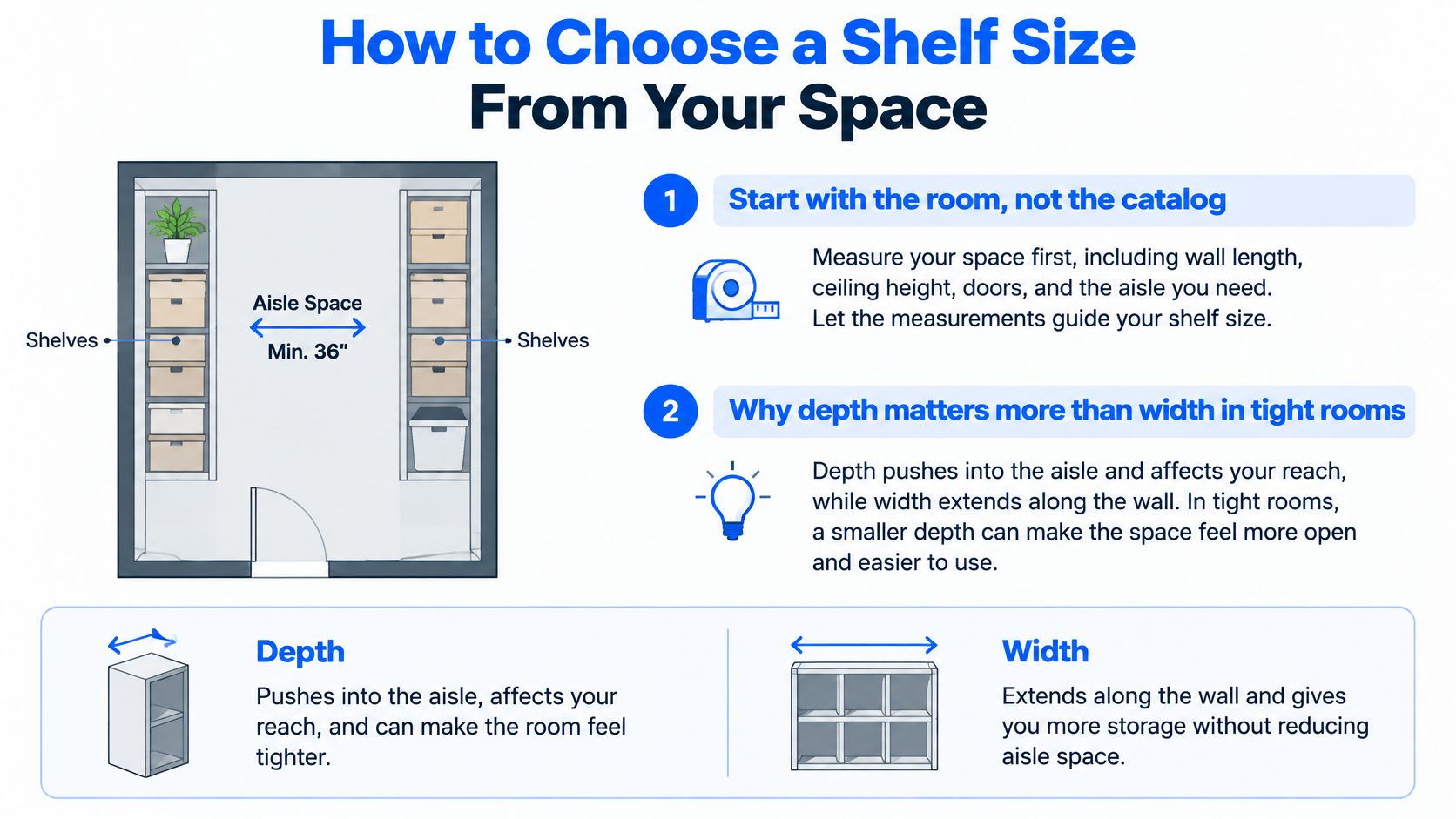
Use this checklist before you select a footprint.
- Measure the clear room dimensions. Record wall-to-wall width, ceiling height, and the aisle in front of the proposed unit. Include pipes, outlets, door swings, and uneven walls.
- Measure the largest loaded carton or bin. Use its widest point, then add working clearance so staff can remove it without forcing it between posts.
- Calculate the clear opening. Corner posts and deck edges make usable depth smaller than the nominal dimension. Use the manufacturer's inside measurement whenever it is published.
- Choose depth first. Start with 12 to 18 inches in narrow rooms, or consider 21 to 30 inches where the aisle and retrieval method allow.
- Match width to the bin layout. A common back-room starting point is 18 by 48 inch shelves on 74 inch posts with four or five shelves. Treat that as a trial layout, then confirm container spacing and shelf rating.
- Check the delivery and operating routes. Confirm doorway access, ceiling and sprinkler clearance, and a safe walking path with the shelves loaded.
For open-front containers, compare their external dimensions using our jumbo bin box size guide. Do not substitute a bin's advertised storage capacity for its physical footprint.
Record a complete fit check
Write down outside width, outside depth, usable depth, assembled height, and required clearance. Browse the shelving and storage racks category with those measurements beside you.
When shelving is part of a larger build-out, teams may explore modular facilities at UC Irvine for that separate scope; the shelf choice still rests on measured clearance, inside depth, and the rated load.
Width, Post Height and Capacity Ranges
Capacity depends on shelf size, construction, and load distribution. A longer shelf doesn't automatically carry the same weight as a shorter shelf from the same product family.
Many commercial wire shelves carry evenly distributed ratings in the range below. The exact model's rating takes priority over a general catalog range.
Shelf width and capacity ranges
| Shelf width (inches) | Capacity per shelf, evenly distributed | What to check |
|---|---|---|
| All widths | 600 to 800 lb in many catalogs, not a universal rating | Brand, construction, and shelf size |
| 36 | Up to 800 lb in one published line | Exact model rating |
| 48 | Up to 800 lb in one published line | Exact depth and product series |
| 60 | Up to 500 lb in one published series | Lower rating than shorter shelves in that series |
| 72 | Use the exact model's published rating | Shelf rating and total unit capacity |
An evenly distributed load spreads weight across the shelf. A heavy drum, machine, or dense stack in the center creates a different loading condition, even when its total weight falls below the stated shelf rating.
A shelf rating isn't permission to place the entire load on a small contact area.
Check the whole unit
Post height affects your storage layout, but it doesn't give you unlimited capacity. Add the planned load on every tier and compare that total with the assembled unit rating.
Casters and add-on sections can change that limit. Shared-post layouts also need the correct connectors and an approved arrangement.
For a consistent product family, use the Metro brand page to narrow your comparison. Check shelf capacity, post compatibility, assembled height, and stationary or mobile limits on the final specification.
How to Configure a Unit Step by Step
A wire shelving unit combines posts, shelves, connectors, and leveling or mobility hardware. Choose those components as a compatible system, not as separate parts that happen to look alike.
Use the common back-room layout as your planning case, then adjust it to the containers and clearances you measured.
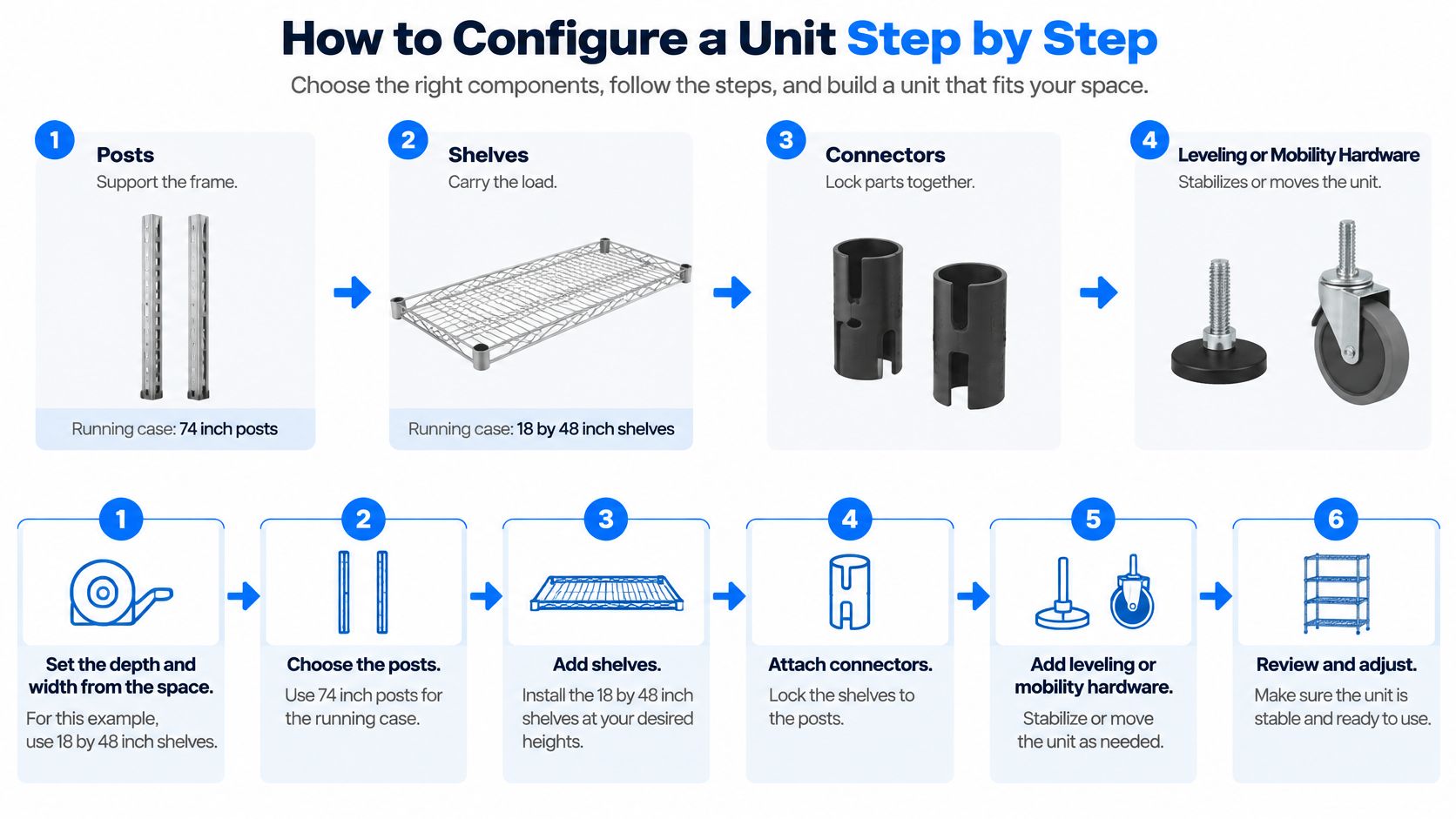
- Set depth and width before assembly. Check the clear loading area against your largest container. Lay out the components and confirm that shelves, posts, and sleeves belong to the same compatible series.
- Fit split-sleeve connectors at matching positions on each post. Follow the sleeve orientation marks, then seat each shelf corner fully over its connector.
- Select post height before ordering. Don't treat post height as an adjustment you can make during assembly. Confirm the finished height with feet or casters installed.
- Position shelves for the actual stock. Many systems adjust in 1-inch increments, which lets you reduce wasted vertical space while leaving hand clearance above each container.
- Choose fixed or mobile hardware. Leveling feet suit a stationary bay. For a mobile unit, verify caster compatibility, locking arrangements, overall height, and the complete unit's mobile rating.
- Level the unit before loading it. Start loading at the bottom, keep the heaviest stock low, and stop if the frame rocks or a shelf corner isn't seated correctly.
Plan shelf spacing around retrieval
Don't divide the post height into equal openings just because it looks tidy. A tall carton needs a different opening from a shallow parts bin.
Account for the thickness of each shelf and any ledges or dividers. If you need to tip a container to remove it, allow room for that motion rather than measuring only its upright height.
Our warehouse shelving guide helps you compare shelving arrangements with the wider storage task. Before approving the assembled configuration, confirm its total capacity, hardware compatibility, and required NSF status.
Chrome, Epoxy and Stainless Finishes Compared
Choose chrome for dry indoor rooms, epoxy for humid or cold storage, and stainless for washdown applications. Size won't solve a finish mismatch.
Chrome works well for paper goods, packaged stock, and supplies in dry back rooms. For damp or frequently cleaned areas, match the finish to moisture exposure and cleaning chemicals before you compare shelf dimensions.
Chrome, epoxy and stainless finish comparison
| Finish | Best environment | Avoid in | Cleaning note |
|---|---|---|---|
| Chrome | Dry indoor storage, offices, retail back rooms | Humid, cold, or washdown areas | Wipe clean and confirm approved cleaners |
| Epoxy | Humid or cold storage, basements, cold rooms | Frequent washdown unless the model is approved | Check coating and cleaning limits |
| Stainless | Washdown, food prep, frequent sanitizing | Budget dry storage where cost matters most | Confirm grade and chemical compatibility |
The finish comparison below gives you a quick environment check.
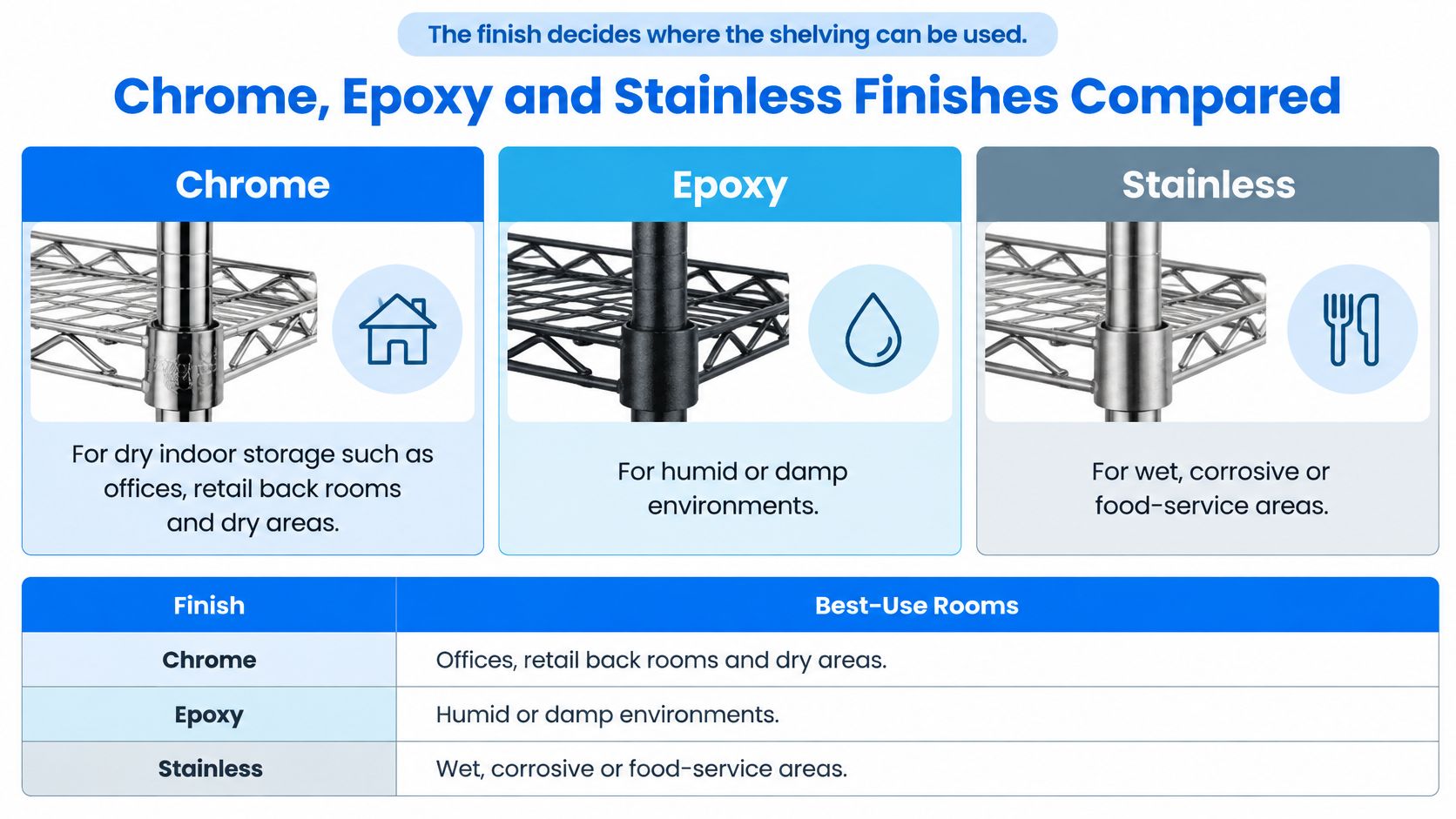
Match cleaning conditions to the specification
Cold storage often introduces condensation. Don't judge the room only while it's empty or while the refrigeration system is off.
Epoxy coatings also need the right cleaning process. Damage to a coating can expose the metal beneath it, so inspect contact points and follow the manufacturer's cleaning limits.
Stainless isn't a single universal specification. Confirm the grade and its suitability for your chemicals, especially where staff use strong sanitizers.
For controlled environments, compare lab shelving for storage rooms before settling on a finish. Include your cleaning procedure in the purchasing notes so the person selecting the product understands the actual exposure.
NSF Certified Options and When to Require Them
Chrome plating doesn't mean NSF certification. NSF status belongs to a listed product or model range, not to the finish alone.
Certification labels need to match the equipment you're buying, not just the appearance of a similar unit.
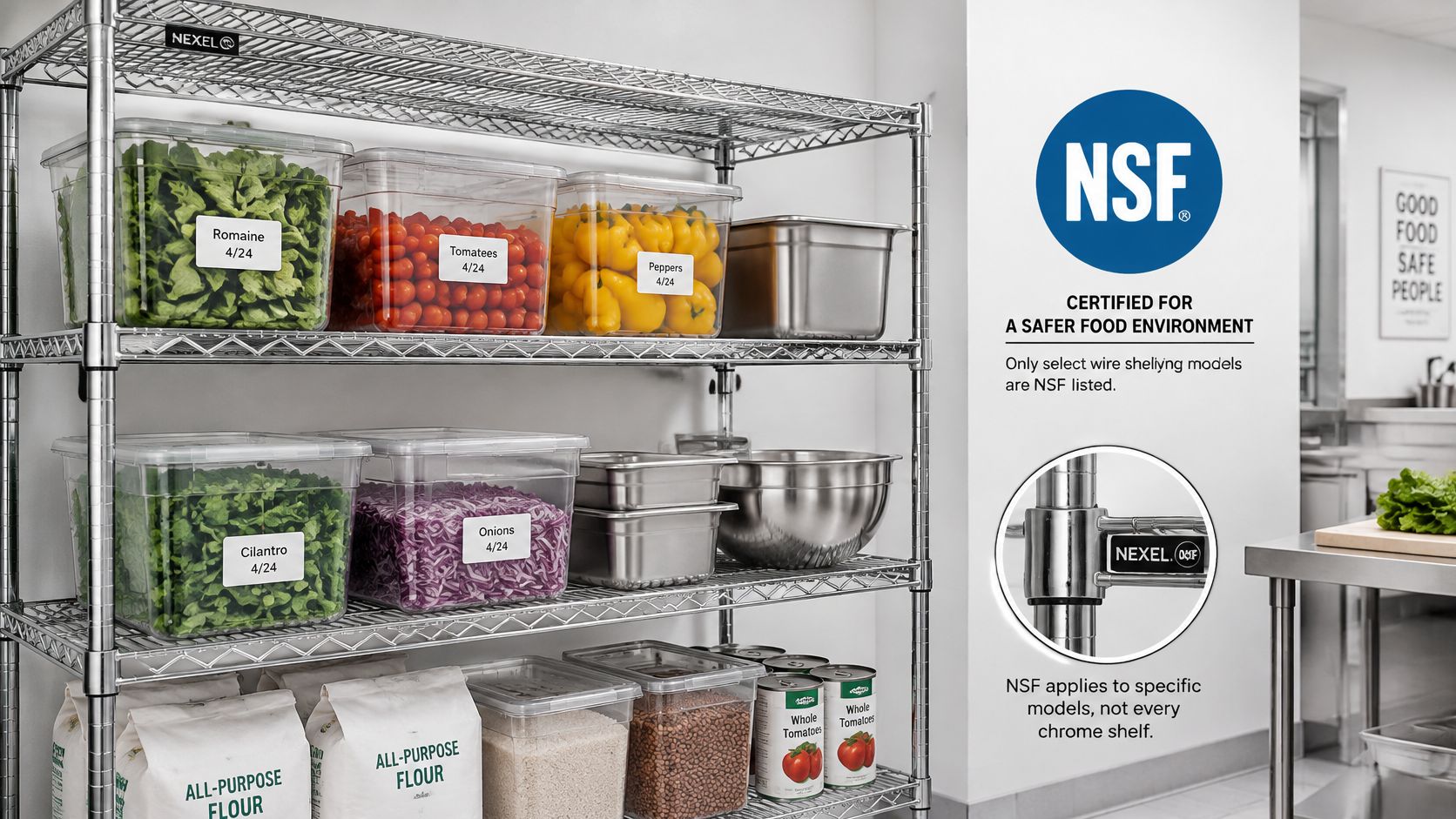
The NSF certified food-equipment listings include chrome-plated shelving with listed widths of 14 to 24 inches, lengths of 24 to 72 inches, and heights of about 8 to 74 inches. Listed model information also includes loading capacities from 30 to 500 kilograms across the applicable configurations, not a blanket rating for every certified shelf.
Verify the exact configuration
When your purchasing standard or food facility requires NSF, match the manufacturer, model, finish, dimensions, and accessories to the certification record. Check how the listing identifies width and length, since catalog naming conventions aren't always consistent.
- Match the model: A certification for one series doesn't cover an unrelated product.
- Match the hardware: Confirm that the selected feet, casters, and shelf arrangement are included.
- Match the environment: Certification doesn't turn a dry-storage finish into a washdown finish.
Use the video as supporting context, then rely on the product record for approval.
Keep the model number and certification information with your purchase record. Don't accept a generic NSF statement in place of verification for the configuration you plan to install.
Common Questions About Shelving Sizes
What is the most common chrome wire shelving size?
A common starting configuration is 18 by 48 inch shelves on 74 inch posts, with four or five shelves. Confirm container fit and retrieval clearance before using that layout for your room.
Does a 48-inch shelf give 48 inches of usable space?
No. Corner posts reduce the clear opening, and the nominal size may also differ from the outside measurement. Use the model drawing's inside dimensions rather than assuming the full catalog width is available.
How much weight can a shelf hold?
Many commercial shelves are rated 600 to 800 pounds evenly distributed, but that isn't a universal capacity. Check the exact shelf size, construction, and total unit rating before loading.
Are all chrome wire shelves NSF certified?
No. Certification applies to specific listed models and configurations. Verify the product record whenever your purchasing standard requires NSF.
Can I use chrome shelving in a cold room?
Choose an epoxy-coated system approved for humid or cold storage instead. Check its temperature range and cleaning limits rather than choosing by coating color alone.
How deep should a shelf be in a narrow room?
Start with 12 to 18 inches nominal depth, then check both the clear opening and the remaining aisle. A shallow unit only works if it supports the containers you need to store.
Do casters change the rating?
They can. Use the assembled mobile unit's published rating, and include caster height when checking doorways and overhead clearance.
Shop Chrome Wire Shelving by Size
Approve the measurements before you add a unit to the cart. Start with the shelving and storage racks category, then compare each candidate's spec sheet against your room sketch and load list.
Material Handling USA sells shelving and storage racks and backs them with buying guides and planning tools. The Salt Lake City supplier has served businesses nationwide since 1997 and offers volume pricing on qualifying orders.
Shop in stock
A nominal 48-inch shelf does not hand you 48 inches of storage. Run every finalist through three checks:
- Usable depth: Will the largest loaded container fit inside the posts and come out cleanly?
- Outside footprint: Will the unit sit against the wall without blocking doors, services, or circulation?
- Rated load: Does the per-shelf rating, and the rating of the complete unit, cover your planned stock?
Use the Metro brand selection when you want a project to stay within one manufacturer's compatible system. For healthcare and laboratory storage, start with the lab shelving selection and add finish and cleaning requirements to your comparison.
For a broader facility project, Partitioning Services Limited's storage guidance for logistics developers gives context for coordinating storage with the building layout. Keep that wider layout review separate from approving the individual shelf specification.
Call a U.S. product specialist at 1-800-326-4403 about pallet quantities, custom sizes, or project-size orders. Shop the category with your measurements, container dimensions, and load requirements in hand.
Material Handling USA offers shelving and storage racks, volume pricing, and product guidance to help you match shelf dimensions to your space and load. Visit Material Handling USA to compare options, or call with your room measurements and project quantities before placing your order.