Shelving Types: A Side-by-Side Comparison
| Type | Capacity/Shelf | Best For | Key Feature |
|---|---|---|---|
| Wire Shelving | 500–2,000 lbs | Food service, healthcare, coolers | Open design; air/light flow; NSF available |
| Boltless / Bulk Rack | 700–3,500 lbs | Industrial parts, tools, general storage | Fast assembly; no tools needed |
| Bin Shelving | 100–600 lbs | Small parts, hardware, fasteners | Open-face bins for pick-and-place operations |
| Selective Pallet Rack | 2,000–10,000 lbs/level | Pallet storage with forklift access | Direct access to every pallet |
| Push-Back Rack | 2,000–6,000 lbs/lane | High-density pallet storage | 2–5 pallets deep; LIFO access |
| Cantilever Rack | Variable by arm | Lumber, pipe, sheet goods, long stock | No front column obstructions |
Wire Shelving: Food Service & Healthcare
Wire shelving (also called chrome wire shelving or NSF wire shelving) uses an open wire grid that allows air circulation, easy visual inventory, and quick cleaning with commercial sanitizers. Key specifications:
- NSF certification: Required for food service and healthcare environments. Confirms material safety and corrosion resistance.
- Post diameter: Standard 1" posts support more weight than slim-profile designs.
- Shelf sizes: Common widths are 18", 21", 24", 30", 36", 48". Lengths typically 36"–72".
- Finish: Chrome (most common), zinc (budget), polymer (best for wet/cold environments), stainless steel (highest corrosion resistance).
- Casters: Available for mobile shelving; brake casters recommended for loaded units.
Boltless Shelving: Industrial Bulk Storage
Boltless (rivet) shelving uses a simple rivet-lock connection between the angled upright posts and shelf clips. Key advantages:
- Assembles in 15–30 minutes with no tools (just a mallet).
- Shelf heights are adjustable on 1.5–2" increments.
- Available with steel or particle board shelves; steel for industrial, particle board for archive or retail storage.
- Add-on units share uprights with starter units — cost-effective when expanding storage.
Pallet Racking: High-Capacity Warehouse Storage
Selective pallet racking is the standard for warehouses storing palletized product. Key components:
- Upright frames: The vertical components that determine row height. Column depth typically 36"–48" for standard racking.
- Beams: The horizontal bars that support pallets. Beam length matches your aisle design.
- Beam capacity: Rated as a pair — a 96" beam pair might carry 4,000–8,000 lbs depending on gauge.
- Row spacers & column guards: Required for OSHA compliance; protect uprights from forklift damage.
10,000+
lbs — typical max system capacity per row of selective pallet racking
NSF
Certification required in food service and healthcare shelving
1.5"
Typical shelf height adjustment increment on boltless shelving
Shop Warehouse Shelving
Shop All Shelving →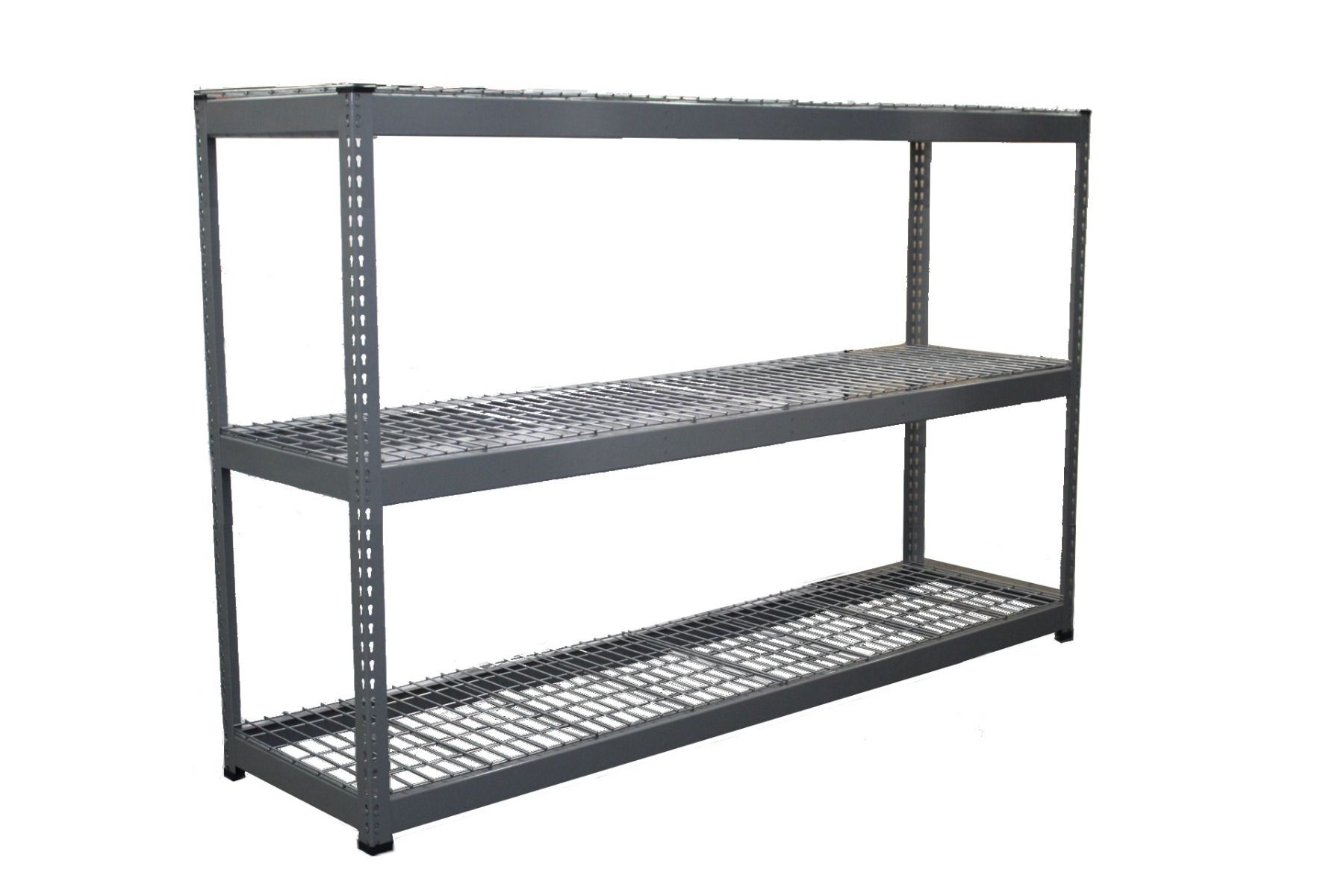
Interlake Heavy Duty Boltless Shelving with Wire Decking - - - Interlake Heavy D
$519.95
Shop Now →
Jaken Boltless Shelving Beam - 12" Double Rivet
$3.05
Shop Now →
Jaken Boltless Shelving Beam - 12" Single Rivet
$1.92
Shop Now →
Jaken Boltless Shelving Beam - 36" Single Rivet Hvy Dt
$8.60
Shop Now →
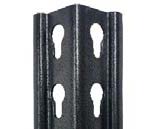
Jaken Boltless Shelving Post 10' Heavy Duty
$27.05
Shop Now →
Jaken Boltless Shelving Post 10' Series 200
$22.55
Shop Now →
Frequently Asked Questions
What is the difference between wire shelving and boltless shelving?
Wire shelving uses an open wire grid for air circulation, light penetration, and easy cleaning — preferred for food service, healthcare, and walk-in coolers. Boltless shelving uses solid steel or particleboard shelves with a beaded-post construction requiring no nuts or bolts — faster to assemble and better for heavy industrial items.
How much weight can industrial shelving hold?
Wire shelving: 500–2,000 lbs per shelf. Boltless shelving: 700–3,000 lbs per shelf. Pallet racking beam pairs: 2,000–10,000+ lbs per level. Always check the manufacturer's specified capacity and never exceed rated loads.
What is NSF-certified shelving?
NSF certification indicates that shelving meets food safety standards for material composition, surface finish, and corrosion resistance. It's required by health codes in commercial kitchens, food processing, and healthcare environments where shelving may contact food or is regularly sanitized with chemicals.
What is the difference between selective pallet racking and push-back racking?
Selective pallet racking provides direct access to every pallet position — the most common type, works with standard forklifts. Push-back racking stores pallets 2–5 deep on inclined rails, maximizing density but allowing only LIFO access. Push-back stores 2–3x more pallets per aisle than selective racking.
Do I need special tools to assemble boltless shelving?
Most boltless shelving requires only a rubber mallet to knock the rivet shelves into the angled post slots. No nuts, bolts, or special tools needed. Assembly typically takes 15–30 minutes per unit.