Clear Spray Bottle: A Buyer’s Guide for Janitorial Teams
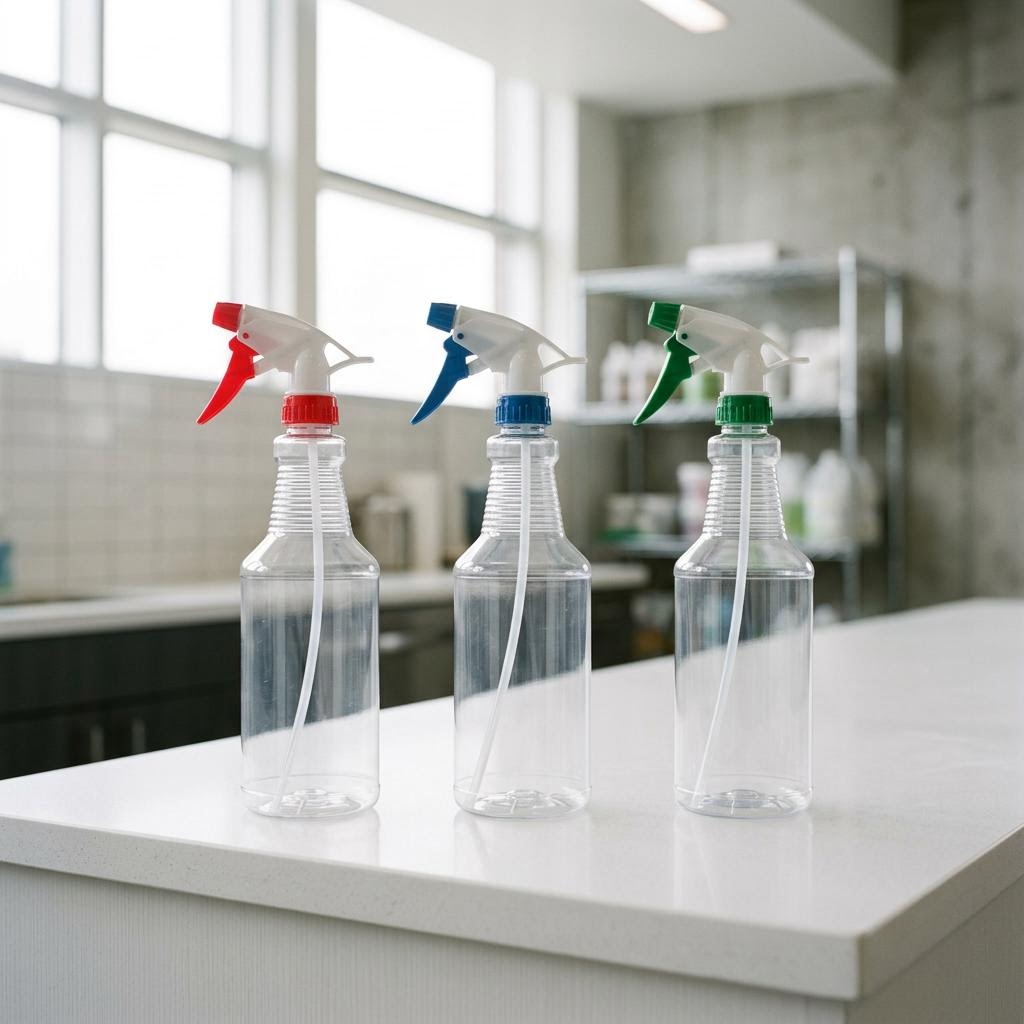
On a Monday morning, the housekeeping closet is already open and the first cart is gone. A custodian reaches for the clear spray bottle that should hold glass cleaner, only to find a milky film in the neck, a cracked shoulder, and a trigger that's sticking because somebody topped it off with the wrong chemical last week. The bottle looked harmless. The refill wasn't.
That's the mistake many organizations make with a clear spray bottle. They treat it like a generic container, then let the chemistry, the trigger, the label, and the refill process sort themselves out. On a facility floor, that's how you end up with wasted product, dead sprayers, unclear labels, and a container that's more liability than tool.
Table of Contents
- Why the Right Clear Spray Bottle Matters on the Floor
- Understanding Bottle Materials and Resin Choices
- Matching Nozzle and Trigger Types to the Job
- Chemical Compatibility by Cleaner Type
- Sizing, Capacity, and Ergonomic Considerations
- Labeling Standards and Compliance for Facilities
- Refillable Systems, Recycling, and Reuse Workflows
- Choosing Your Next Clear Spray Bottle Order
Why the Right Clear Spray Bottle Matters on the Floor
The bottle itself rarely gets the blame first. Crew members notice the streaky hallway, the leaking shoulder, or the sprayer that no longer atomizes, then they assume the batch was bad. In practice, the failure is usually upstream. The chemistry didn't belong in that resin, the trigger was wrong for the task, or the bottle was reused without a real relabeling process.

A good clear bottle gives you visibility, which is useful in schools, clinics, warehouses, and janitorial closets where staff need to confirm contents fast. That's one reason the format stayed popular after the mid-century shift to molded plastic packaging and trigger sprayers became the norm. The economics still matter today, low-cost polymer bodies, lightweight shipping, and user-controlled dispensing all make sense for cleaning and maintenance work as the historical development of spray bottles shows.
Practical rule: choose the bottle for the chemical first, then worry about how nice it looks on the shelf.
That's the lens I use when spec'ing bottles for facilities. A clear bottle is useful when crews need to see fill level or identify a water-based cleaner at a glance, but it becomes the wrong choice the moment compatibility starts to slip. If you're buying for a mixed site, the key question is whether the station needs visibility, resistance, or both.
A decent starting list of janitorial supply categories is useful when you're standardizing closets across buildings, and the buying logic is cleaner when bottles, triggers, and label stock are specified together rather than one at a time. One practical reference point is the janitorial supply catalog at Material Handling USA's guide to janitorial supplies, since it puts the bottle in the same purchasing context as the rest of the floor program.
Understanding Bottle Materials and Resin Choices
PET, HDPE, and PP behave very differently
PET is the resin most buyers picture when they say “clear spray bottle.” It's glass-like, easy to inspect, and good for many water-based cleaners. The trade-off is that it doesn't love aggressive chemistry, especially solvent-heavy formulas and stronger alcohol blends. If the bottle has to stay clear and the contents are mild, PET earns its place.
HDPE gives up the clean, transparent look and buys you resilience. It's the safer choice when the formula is harsher, because it handles bleach, quats, and many acids better than PET. The downside is obvious on the shelf, it goes cloudy, and it can yellow over time. That's not cosmetic fussing, it's a trade you make when the chemistry matters more than the view.
PP sits in a different lane. It can handle higher temperatures and rougher formulations, but it usually isn't what a buyer means when asking for a clear bottle. In the field, PP tends to show up when the application needs toughness more than presentation.
Read the resin code before you read the catalog copy
The chasing-arrows symbol on the base tells you more than the marketing photos do. If a supplier says “clear” but doesn't name the resin, you're guessing. If the bottle will sit in food areas, verify the suitability claims carefully and make sure the spec fits the environment, not just the color.
| Property | PET | HDPE | PP |
|---|---|---|---|
| Clarity | High, glass-like | Low, cloudy to opaque | Usually low to moderate |
| Chemical resistance | Good for mild formulas | Better for harsher cleaners | Strong for many demanding uses |
| Best fit | Water-based cleaners, visible fill checks | Bleach, quats, acids, stronger cleaners | Heat and chemical resistance where clarity isn't critical |
| Typical buyer trade-off | Visibility over toughness | Durability over visibility | Toughness over appearance |
The biggest buying mistake is assuming clarity and resistance improve together. They usually pull in opposite directions. If the formula is aggressive, the clear bottle is not the smarter choice just because the contents look nice through the wall.
Matching Nozzle and Trigger Types to the Job
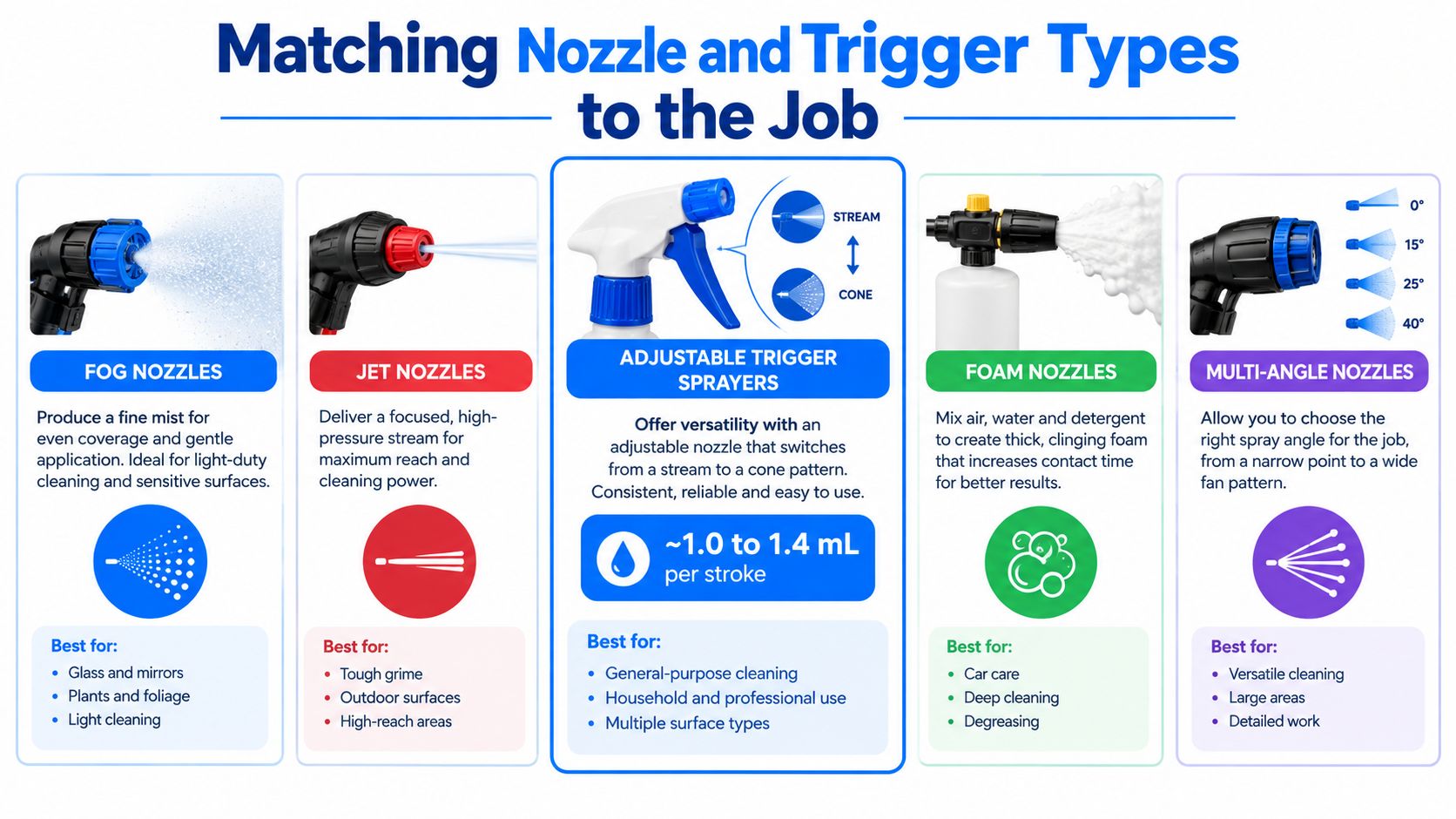
A trigger head isn't just a pump. It determines how much liquid leaves the bottle, how the staff uses it, and whether the product lands where you want it. Commercial sprayers commonly fall in the 0.3 to 1.5 mL per stroke range depending on design and application, and that spread changes waste, coverage, and user fatigue Borejet's sprayer overview.
Match output to the task
A fine-mist head is the right call for glass cleaner, air freshener, and any job where overspray wastes product. Lower-output sprayers help on detail work because the user can control placement without soaking the surface.
An adjustable trigger sprayer is the workhorse for most facilities. It can swing from stream to cone mist with a nozzle turn, which makes it flexible enough for mixed cleaning stations. Foam heads are a different animal, they mix air into the liquid and cling better on vertical restroom surfaces. Stream-only heads are for distance and precision, not broad coverage.
Useful habit: keep one stream-only bottle in the caddy even if most of the team prefers mist.
For healthcare and specialty environments, pump-action devices and ultrasonic foggers can make sense, but they're not general-purpose janitorial picks. They solve narrow problems and should be bought that way. If you need disinfection coverage, use the adjustable mist. If you're deep-cleaning restrooms, foam is usually the better choice. If you're targeting toilet bowls, drains, or one specific point, stream-only saves time and reduces waste.
The actual bottle and the actual head have to be specified together. A good bottle with a poor nozzle behaves like a bad bottle, because the user experiences the pair as one tool.
Chemical Compatibility by Cleaner Type
Bleach, quats, vinegar, and solvents do not behave the same
Sodium hypochlorite is where a lot of clear-bottle plans go wrong. If the program uses bleach, the bottle choice has to be conservative, because PET is only useful in a narrow lane and shorter storage windows. For stronger or hotter bleach programs, I move buyers toward HDPE instead of trying to force a clear presentation into a chemistry that doesn't want it.
Quaternary ammonium disinfectants are easier to manage, especially at standard dilution ranges. PET and HDPE can both be workable depending on the exact formula and storage conditions, but the label still needs to tell the truth about what's inside. That's not a cosmetic issue, it's a safety issue.
Vinegar and citric-based descalers usually behave better in clear packaging when the dilution is routine and the storage period is short. The moment you shift to more concentrated mixes, you need to test the resin against the product, not against the assumption that “it's just vinegar.” Solvent-bearing cleaners are a different story again. Alcohol, ammonia, and d-limonene can stress PET, so HDPE or a more compatible specialty container is usually the better route.
Match the chemical to the container, not the shelf appearance
The practical buyer question is simple: what will the bottle hold, and for how long? A bottle that looks perfect on delivery day can fail later if the contents are too aggressive or the storage conditions are wrong. That's why chemical compatibility needs to come before bottle visibility.
| Cleaner | Active Range | PET | HDPE |
|---|---|---|---|
| Bleach | Sodium hypochlorite formulas | Limited, short-term only in some cases | Preferred for more demanding use |
| Quat disinfectants | Standard dilution ranges | Often workable depending on formula | Often workable depending on formula |
| Vinegar | Mild acetic acid solutions | Usually workable at routine dilution | Better for stronger or concentrated mixes |
| Citric descalers | Routine cleaner blends | Usually workable at routine dilution | Better for concentrate storage |
| Solvent cleaners | Alcohols, ammonia, d-limonene | Poor fit | Better fit |
If your restroom grout cleaner contains a strong alkaline or bleach-heavy formula, stop calling it a clear-bottle application and spec the right opaque resin instead. The right bottle is the one that survives the chemistry and still lets the team use it safely.
For teams buying bulk liquids and refill stock, the product category at Material Handling USA's cleaning chemicals section is a practical place to keep packaging decisions tied to the chemistry instead of the display image.
Sizing, Capacity, and Ergonomic Considerations
Size should follow refill pattern, not habit
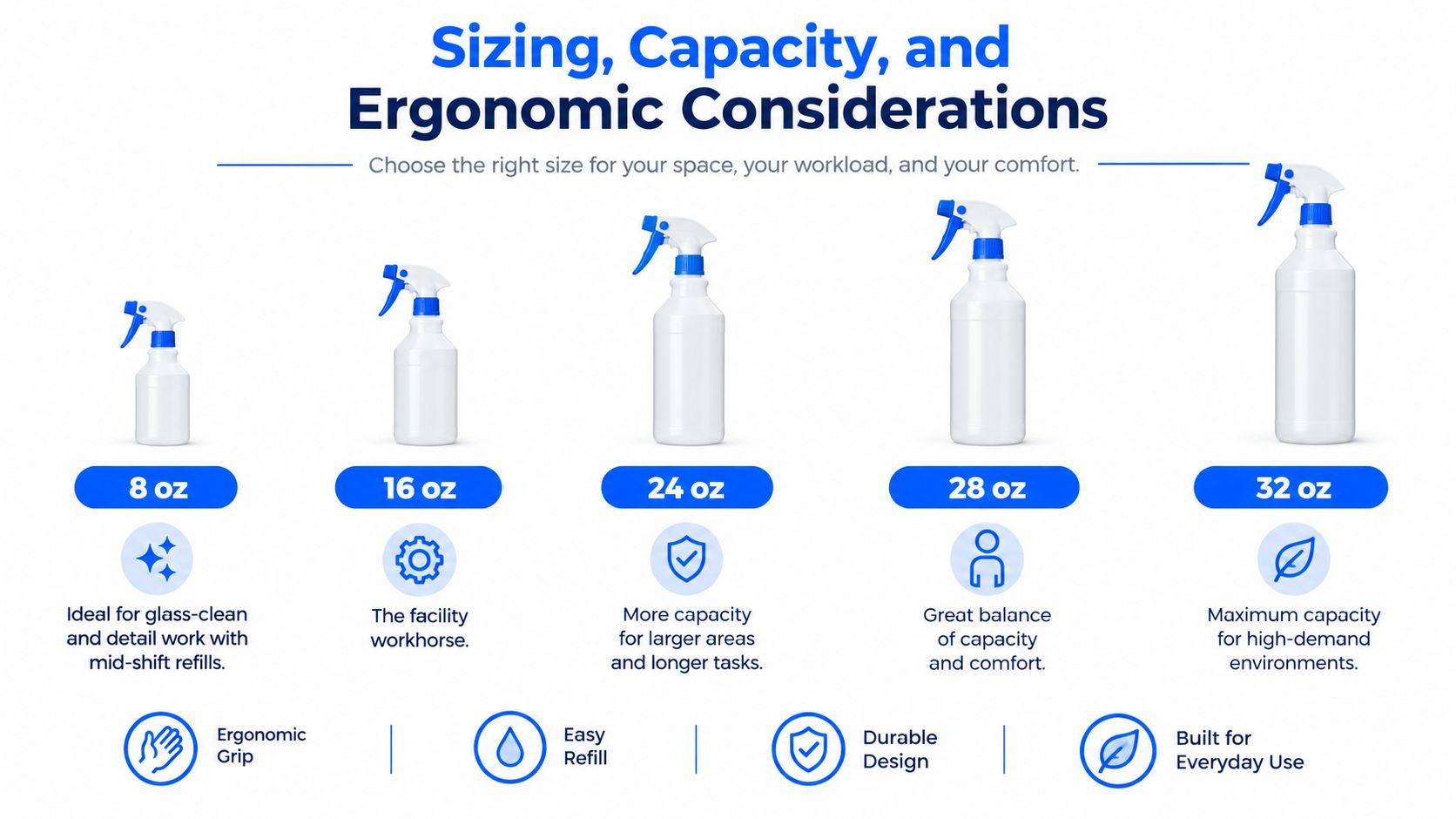
An 8 oz bottle works when the crew needs a light, portable tool for glass cleaning or detail work and doesn't mind refilling mid-shift. A 16 oz bottle is the default workhorse in most facilities because it balances handling, coverage, and refill frequency. 24 oz to 32 oz makes more sense for outdoor sanitation, floor crews, and stations where stopping to refill kills momentum.
That size decision becomes more important when the bottle is full. A 32 oz bottle feels different in the hand, especially for workers wearing gloves or moving through long shifts. The grip diameter, trigger travel, and overall balance matter more than buyers usually admit, because a bottle that fights the hand gets set down, then misused later by the next person.
Get the neck finish right
The neck finish has to match the trigger. 28-400 is the common spec for trigger sprayers, while 28-410 can turn into a mismatch if the wrong heads get mixed into the site's spare parts bin. A few bad cycles won't always reveal the problem immediately, then the threads strip and the bottle gets scrapped early.
Procurement note: standardize one neck finish across a site before you standardize a label color.
A site that runs multiple shifts should buy for consistency, not novelty. Standardize the neck finish, keep the bottle size tied to the task, and use color-coding only if the chemistry program can support it cleanly. If the bottles are handled hard, order overage so breakage and loss don't stall the shift.
Labeling Standards and Compliance for Facilities
A clear bottle doesn't excuse a weak label. In fact, it makes weak labeling easier to spot, because every scuff, smear, and fading edge stands out. That's good for audits only if the label system is built for field use.
Build the label stack in layers
The first layer is the product identity and hazard information that belongs with the chemical. For EPA-registered disinfectants, the EPA registration number has to remain tied to the product label, and the container can't just become a blank secondary bottle because somebody topped it off from a drum. The second layer is the GHS information, including signal word, pictogram, and hazard statements, which need to stay legible.
The third layer is the workflow record. I want bottle labels to show the batch date, refill date, technician initials, and dilution ratio. That gives supervisors something real to audit when a complaint comes in or a safety question gets raised.
Make the bottle readable under abuse
Healthcare and school custodial teams often use cap colors and banding to separate chemistries, but the label still has to carry the actual information. Clear bottles make migration, residue, and contamination easier to see, which is useful only if the label discipline is already strong.
A bottle that can be refilled without relabeling isn't reusable. It's just untracked.
For field-touched containers, choose a label stock that can survive handling. Gloss laminate or polyester facestock holds up better than a plain paper label in wet closets and around repeated wipe-downs. If your team can't keep labels legible for the life of the bottle, shorten the replacement cycle and treat the bottle as a controlled asset, not a generic refill jug.
Refillable Systems, Recycling, and Reuse Workflows
A refillable program works when the facility treats it like a process, not a nice idea. The payoff is simple: fewer replacements, less plastic turnover, and a consistent container standard across sites. The risk is just as simple, cross-contamination and bad relabeling can undermine both worker safety and product performance.
Use a central return and inspection loop
The cleanest workflow starts when the empty bottle comes back to a refill station. Staff inspect it for clouding, stress cracking, damaged triggers, or lingering odor before it gets filled again. If the bottle carries the wrong residue or shows wear, it gets pulled instead of recycled back into service.
That's where HDPE often makes sense for high-reuse programs. It usually tolerates more refill cycles than PET before stress fracture becomes a concern, especially in rough-duty settings where bottles move between carts, closets, and custodial sinks all day.
Keep the refill record attached to the bottle
A refill system also needs traceability. The bottle should carry the new batch date, the dilution ratio, and the exact chemical identity every time it leaves the station. If the product is EPA-registered, the registration information has to remain tied to the right product and use instructions.
For teams managing bulk dilutions and storage, the container categories at Material Handling USA's drums, buckets, IBC totes, and tanks section fit naturally into that workflow because they connect the source container to the secondary spray bottle.
Best practice: don't let a bottle become “the cleaner bottle.” Let it remain a tracked container with one assigned formula at a time.
Refill programs also support recycling discipline because worn bottles leave the system in a controlled way instead of being mixed into random trash streams. That matters in multi-site facilities where one broken process at one site gets copied elsewhere fast. The more standardized the bottle, the easier the reuse loop is to supervise.
Choosing Your Next Clear Spray Bottle Order
The easy answer is to buy clear PET for everything visible. The right answer is to buy for the harshest chemistry at the station, not the average one. That single rule avoids most of the bottle failures I've seen in warehouses, schools, and clinics.
Use clarity where it helps, not where it tempts bad choices
For glass cleaner and water-based solutions in visible-use areas, a clear bottle makes sense because crews can confirm the contents at a glance. For bleach, solvent-heavy cleaners, or any chemistry above the comfort zone of PET, visibility is not an advantage if it leads someone to put the wrong liquid in the wrong resin. In those stations, opaque HDPE is the safer, longer-lasting call.
Before the purchase order goes out, make sure these items are locked:
- Chemistry list: match each formula to the right resin.
- Nozzle output: confirm the mL per stroke your task needs.
- Neck finish: keep triggers and bottles aligned, especially around 28-400.
- Color coding: assign it to chemistry classes, not guesses.
- Label stock: use material rated for chemical exposure.
- Refill rule: define when a bottle is refilled and when it's retired.
The bottle that looks best on the shelf is not always the bottle that saves time on the floor. The one that survives the harshest chemical, keeps the label readable, and matches the trigger your crew already uses is the one worth buying.
If you're standardizing spray bottles, labels, triggers, and refill containers across multiple sites, Material Handling USA can help you source the dispensing and janitorial pieces in one place. Visit Material Handling USA to review the available packaging and facility supply options, then build the next order around the chemistry your team uses.