Crinkle Paper Void Fill by the Case: How Much a Case Fills
A 10 lb box of crinkle paper fills roughly 40 to 60 small boxes, depending on density. Treat that as an estimate, not a guaranteed case yield.
Your pack station needs enough paper to finish the week, but ordering extra cases without testing ties up space and cash. Buying crinkle paper void fill by the case works best when you measure what your cartons use, then order against that result.
Table of Contents
- How Many Boxes One 10 lb Case Fills
- How to Estimate Your Case Quantity Step by Step
- Crinkle Paper Colors and Unboxing Appearance
- Crinkle Paper vs Packing Peanuts and Air Pillows
- Cost per Box for Crinkle Paper by the Case
- When Crinkle Paper Is the Wrong Choice
- Crinkle Paper Questions Answered
- Does crinkle paper protect products or only fill space?
- Is crinkle paper recyclable?
- Should I choose kraft or colored paper?
- What density or shred size should I pick?
- How much should I order for monthly shipments?
- Does crinkle paper add shipping weight?
- Can I buy by the pallet or request a custom size?
- Can I combine crinkle paper with other fill?
- Pick Your Case Size and Order in Stock
How Many Boxes One 10 lb Case Fills
A 10 lb case can take up little space before the crinkle paper is loosened, then occupy much more at the packing station. For purchasing, compare usable expanded volume and carton-test results, not case weight alone. Material Handling USA lists packaging paper; check the case's coverage specification before comparing products.
Coverage of a 10 lb crinkle paper case
| Case Type | Packed Volume | Expanded Volume | Estimated Small Boxes Filled |
|---|---|---|---|
| 10 lb kraft crinkle paper, 23 3/4 by 16 by 11 1/2 inch case | 2.3 cubic feet | Not stated for this example | 40 to 60, estimate |
| 10 lb colored crinkle paper, 4 1/2 by 3/8 inch shreds | Not stated for this example | More than twice packed volume | 40 to 60, estimate |
| Your own carton size | Measure the case | Measure at your pack station | Calculate from carton void volume |
The kraft and colored paper rows describe separate product examples, not interchangeable specifications. Use the figures shown for each example, then confirm the exact case dimensions, shred size, and expansion claim for the product you plan to buy.
Why expanded volume matters
Crinkle strips trap air between their folds. Loosening them preserves more usable loft; compressing them into a tight wad uses paper without providing the same fill.
A shallow gift box and a tall shipping carton can use different amounts, even if both are considered small boxes. Irregular product shapes also need paper around the gaps, not just a layer on top. Approve a case count by packing a representative carton and recording how much paper it takes to complete the box.
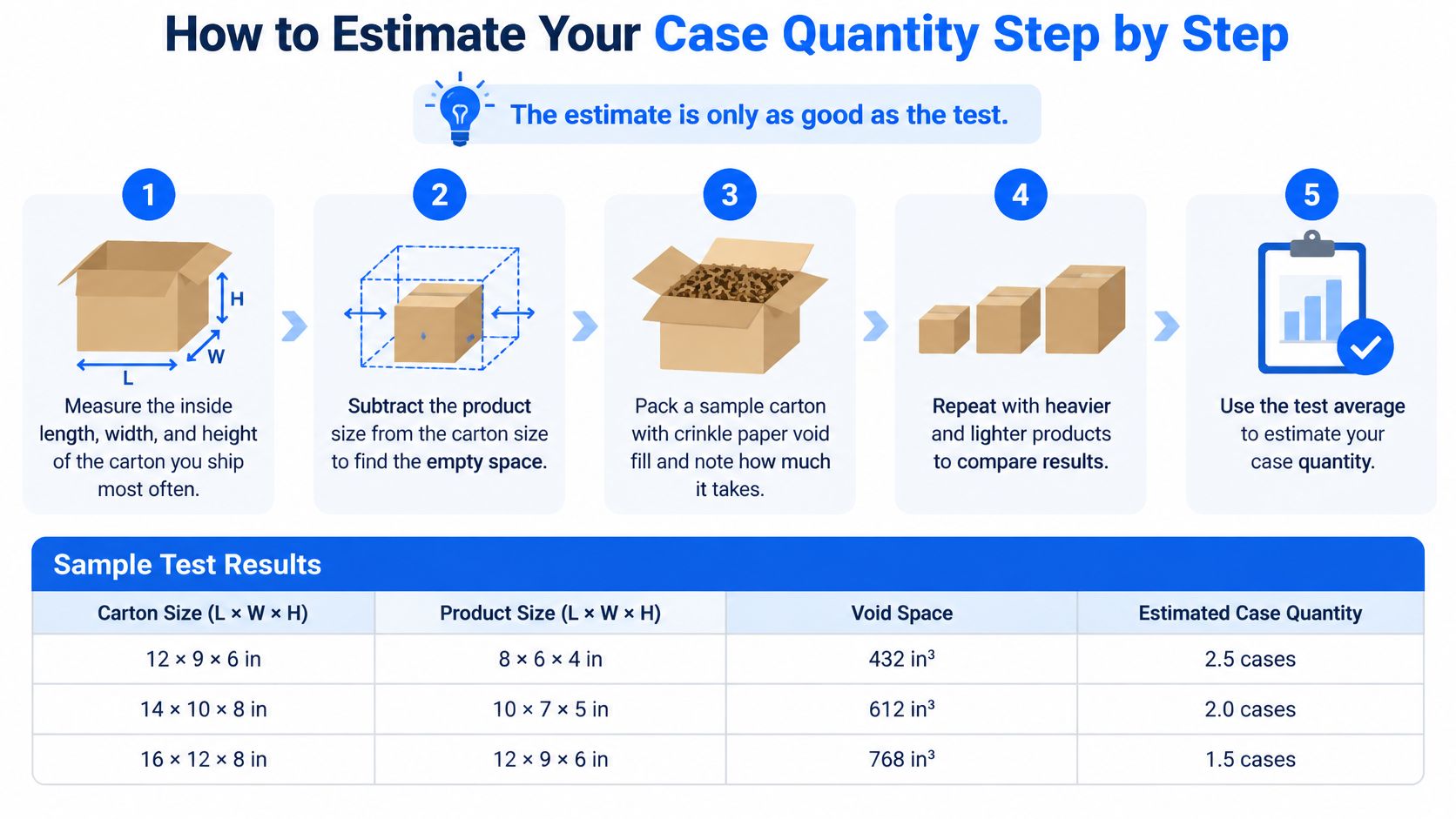
How to Estimate Your Case Quantity Step by Step
Your estimate is only as good as the test. Use the carton, product, and packing method your team will ship.
- Measure inside dimensions. Record length, width, and height. The corrugated box sizes chart helps you separate carton sizing from usable inside space.
- Subtract the product's approximate volume from the carton's inside volume. Include any insert or protective wrap so you don't count occupied space as empty space.
- Pack a representative order. Compare two shred sizes or densities in matching cartons. Keep the option that holds the product without crushing the strips, and record its specification.
- Weigh the paper on a bench scale, or record the fraction of a case used. Repeat with representative heavier and lighter orders, logging grams or cubic inches per carton.
- Calculate monthly need. Multiply average usage by monthly cartons. Add a safety factor based on observed settling, SKU mix, and handling waste, not a universal allowance.
- Divide monthly paper weight by case weight, using matching units. For volume planning, divide monthly expanded-volume need by usable expanded volume per case.
- Validate protection. Arrange representative drop and vibration testing before committing to pallet quantities.
ISTA's e-commerce test guidance requires adequate void fill to hold test weights securely and prevent movement or bouncing during top-load evaluation. Transit vibration can settle paper and expose gaps that weren't obvious at pack-out.
A full-looking carton is not proof of protection.
Set a repeatable pack-station standard: a minimum fill height, the recorded material amount, and a tactile movement check before sealing.
Use this flow as a visual reminder beside your test log.
Crinkle Paper Colors and Unboxing Appearance
When your customer opens a subscription box, the visible paper frames the product. Kraft gives an understated, natural look; choose a dye-free option when that's part of your packaging specification.
These examples show how paper color changes the presentation.
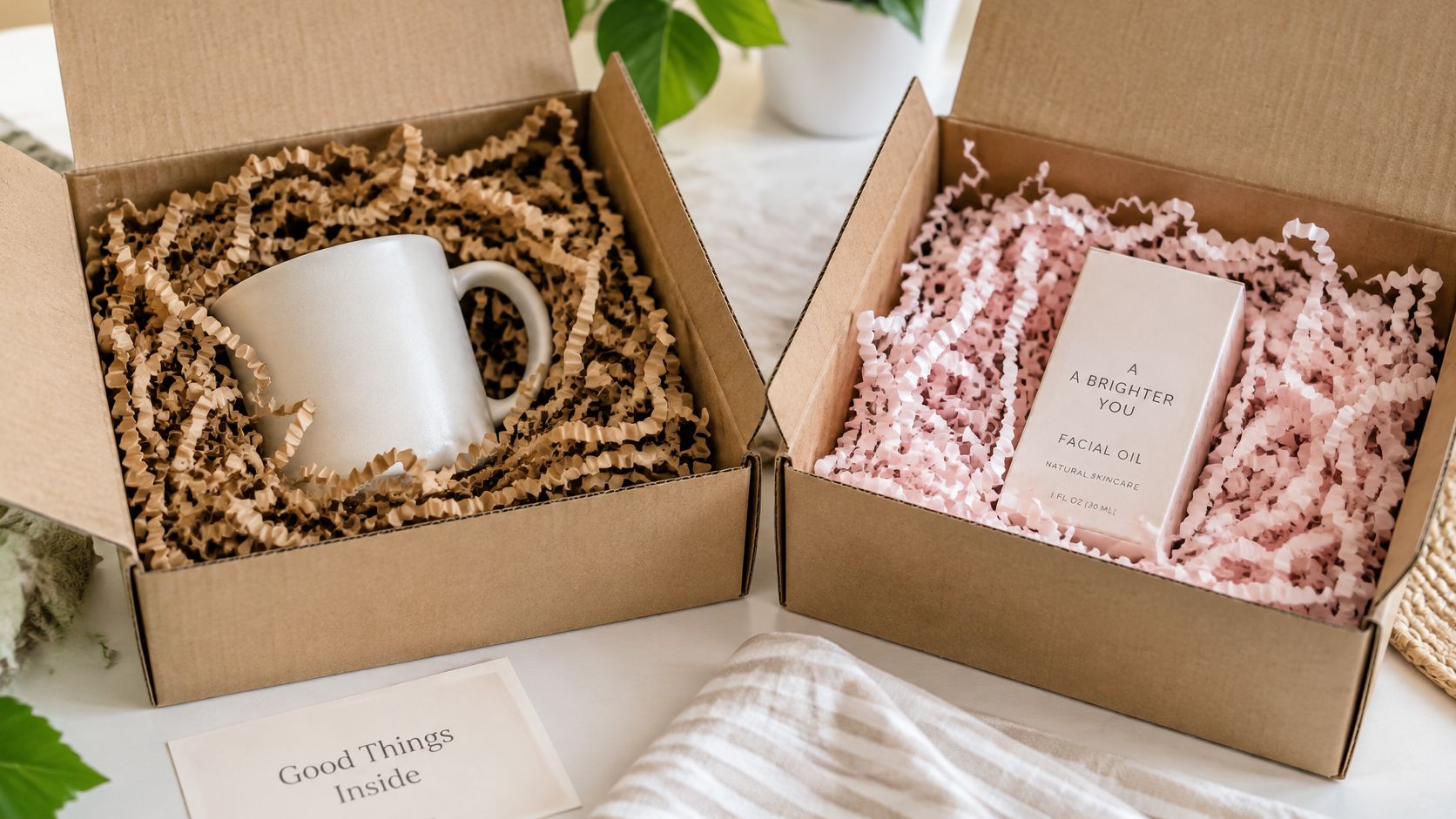
Colored strips can match brand palettes, seasonal themes, or gift packaging for retail ecommerce. Place them along the product's sides, where interlocking strips help nestle it in place, rather than piling everything on top.
Choose a color and shred size for each product family, set a repeatable amount, then open a finished carton after normal handling. Expansion, packing pressure, and any covering insert all affect what the customer sees. PledgeBox's guide can help you balance unboxing costs and sustainability without making presentation the only buying criterion.
For your next sample pack, shop packaging paper for kraft and colored crinkle paper. Color doesn't replace correct carton sizing or protection.
Use the video as another reference when reviewing the finished presentation.
Crinkle Paper vs Packing Peanuts and Air Pillows
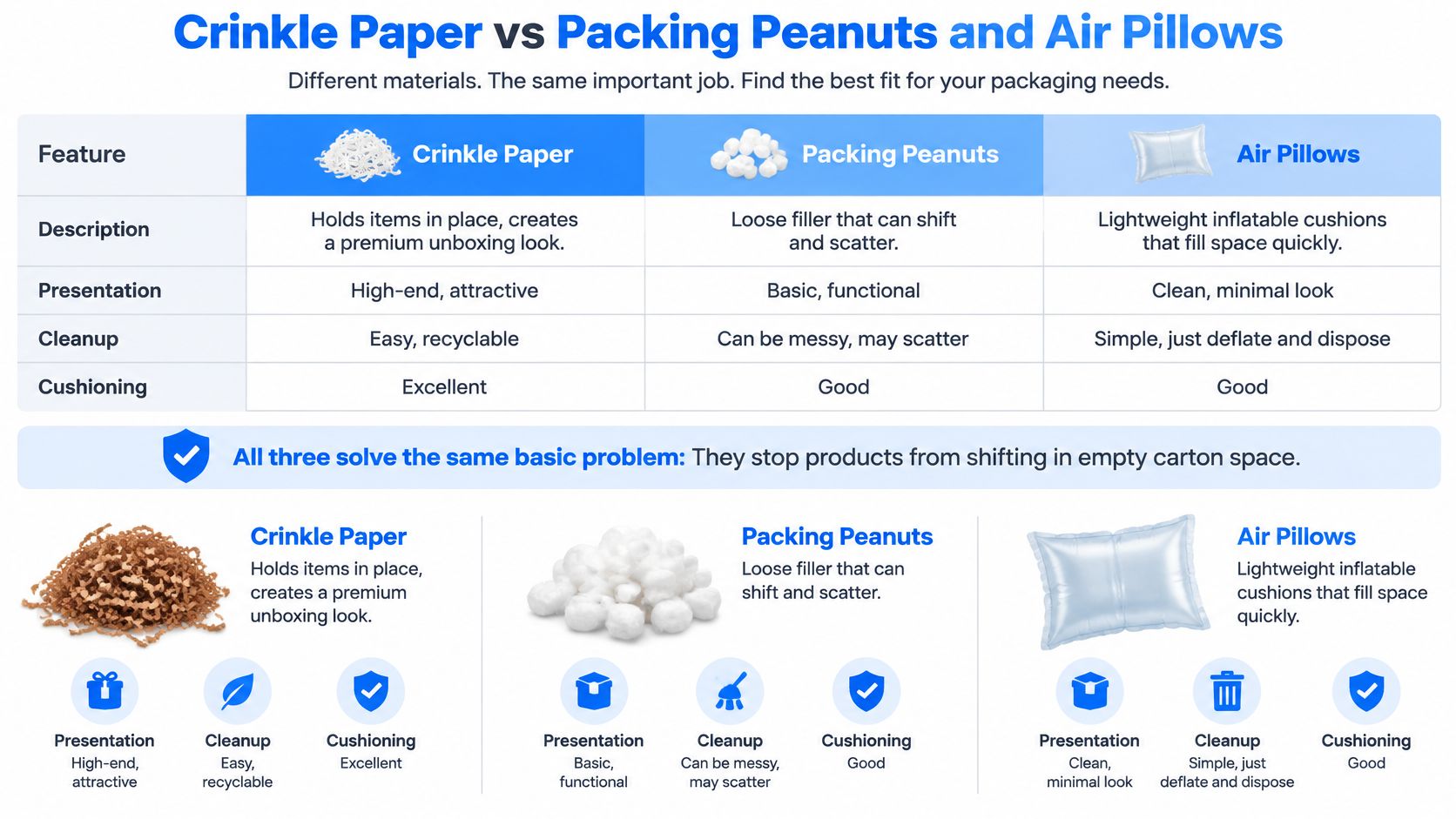
The right fill depends on the carton, the product, and how the material is stored and handled. Crinkle paper takes up little space before use, while loose packing peanuts need more room. Air pillow film stores compactly while deflated, though using it requires a machine and film supply.
Crinkle paper, packing peanuts, and air pillows side by side
| Factor | Crinkle Paper | Packing Peanuts | Air Pillows |
|---|---|---|---|
| Frustration on opening, one consumer study | Not measured in that study | 18 percent of participants | 6.25 percent of participants |
| Disposal in one consumer study | Typically recyclable with clean paper | Often thrown in the trash | Recycled 75 percent of the time in that study |
| Storage space | Compact before use | Bulky and loose | Compact while film is deflated |
| Shipping weight | Varies with the amount used | Varies with the amount used | Varies with the amount used |
| Presentation | Visible kraft or colored paper | Loose plastic pieces in this comparison | Plastic film |
The consumer study summarized by Corrugated News reported frustration among 18 percent of participants opening packing peanuts versus 6.25 percent for air pillows. It also reported that air pillows were recycled 75 percent of the time in that study. Those results are study-specific, and crinkle paper frustration was not measured.
Compare the complete packing job
Storage needs differ before packing begins: peanuts require room for loose fill, while crinkle paper and deflated air pillow film store more compactly. Shipping weight depends on how much material goes into each carton, so compare the amount used in a consistent pack test. If you are considering air pillow machines and films, account for the machine as well as film storage.
Then check whether the product stays put, how long packing takes, and how customers handle and dispose of the fill. Choose the smallest suitable carton and use enough material to control movement without adding unnecessary dimensional weight.
Cost per Box for Crinkle Paper by the Case
The case price alone doesn't show your packing cost. Use this formula with your quoted volume pricing or price breaks by the case or pallet:
Material cost per box = case cost × fraction of the case used per shipment
For a planning example, a 10 lb case contains 160 ounces: average use of 2 ounces supports about 80 boxes, while 4 ounces supports about 40 boxes, before waste, as illustrated in Allpack's void-fill guide. These are arithmetic examples, not protection claims or guaranteed yields.
Track the completed shipment
Waste, uneven application, and damaged material reduce usable coverage. Use your measured average from the weighing and monthly-planning steps, rather than selecting the most favorable sample.
Add these costs to material consumption:
- Labor: Time spent loosening, placing, and cleaning up paper.
- Storage and equipment: Space occupied by cases and any dispensing setup.
- Shipping and failures: Carton size, packed weight, and replacement orders.
Paper fillers can deliver different yields after expansion. Keep case weight, dimensions, average usage, packing seconds, movement or damage results, and carton size in the same log so you compare equivalent jobs.
The metric to track is cost per completed box, not the lowest case price.
When Crinkle Paper Is the Wrong Choice
Crinkle paper is primarily a motion-control material, not an engineered cushion. It's a practical choice for nonfragile goods and boxed products that need to stay in position.
Heavy items can compress the strips. Long transit and multi-stop routes can let vibration settle the paper, opening gaps around the product. Glass, ceramics, and electronics may need impact protection that loose paper alone can't provide.
Choose protection for the failure risk
Use bubble bags and rolls for impact protection where suitable, or specify foam for heavy or shock-sensitive products. Validate the material and thickness with the complete package.
Crinkle paper can work alongside corrugated inserts or molded pulp. Review protective packaging options when the product needs both restraint and cushioning.
Before ordering, check:
- Weight: Does the product flatten the paper?
- Route: Will extended handling cause settling?
- Fragility: Does the item need direct impact protection?
- Carton strength: Does the box keep its shape under testing?
More paper won't fix an oversized carton or strips crushed during packing.
Crinkle Paper Questions Answered
Does crinkle paper protect products or only fill space?
It controls movement and fills gaps. Add suitable cushioning when the product needs impact protection.
Is crinkle paper recyclable?
Yes, where local programs accept it. Remove attached tape, labels, and plastic, keep it dry, and reject contaminated material; the EPA's packaging guidance distinguishes recovery performance across paper packaging formats, so don't assume every format has the same outcome.
Should I choose kraft or colored paper?
Choose a dye-free kraft option for a plain appearance. Colored paper suits brand palettes and seasonal presentation, but confirm the actual product specification.
What density or shred size should I pick?
Test two options in the same carton. Select the one that restrains the product without needing tightly crushed strips.
How much should I order for monthly shipments?
Multiply measured average usage by monthly cartons, add a tested safety allowance, then divide by matching case weight or expanded volume.
Does crinkle paper add shipping weight?
Yes. Weigh the finished package and check case specifications; this guide doesn't publish a material-to-material weight comparison.
Can I buy by the pallet or request a custom size?
Yes. We offer volume pricing with price breaks by the case or pallet, and a product specialist can help with custom-size requirements.
Can I combine crinkle paper with other fill?
Yes. Pair it with corrugated inserts or paper cushioning when the package needs both movement control and protection.
Pick Your Case Size and Order in Stock
Choose your case size from tested usage, then order in stock. Before releasing the purchase, confirm:
- Specification: Case weight, case dimensions, color, and shred size match your approved sample.
- Coverage: Usable expansion matches your carton test.
- Protection: Any required impact cushioning is included.
Shop in stock
Shop packaging paper for crinkle paper void fill by the case, or shop bubble bags and rolls for products that need impact protection.
Material Handling USA has supplied industrial products since 1997. Our range includes shipping boxes and protective packaging, so you can coordinate cartons and fill on one order. Request volume pricing and price breaks by the case or pallet using your tested monthly quantity.
Call a product specialist at 1-800-326-4403, Monday to Friday, 8am to 5pm MT, for pallet quantities, custom sizes, or a quote on project size orders.
Material Handling USA offers packaging supplies within a catalog of 58,000+ in-stock SKUs, with nationwide shipping from our Salt Lake City-based business. Visit Material Handling USA to turn your tested crinkle-paper usage into a case order and coordinate the protective materials your shipments need.