Nitrile Gloves by the Case: What to Verify First
The grease gun is still on the bench mat, the tote is half full of oily housings, and you have three browser tabs open with case pricing for disposable nitrile gloves. Reordering looks like the easiest line on this week's list.
That's exactly where case buying goes wrong. A case price is one number, and it can sit on top of three separate problems: a glove selected for greasy-parts handling that ends up at the solvent bench too, a chemical application nobody checked against the exact model, and a 100/Case title that never gets reconciled with what shows up at the dock.
None of those problems appear in a shopping cart. They appear three weeks later, when a technician peels a torn glove off mid-task or the storeroom count doesn't match the purchase order. What prevents that is a verification sequence you run before a case becomes the shop standard: name the task, check chemical data on the exact model, trial the fit on real parts, audit the package count, then set the order quantity.
Table of Contents
- What to Verify Before a Case Order
- Separate Oily Handling from Solvents and Edges
- Match the Glove to Real Chemical Contact
- Trial Fit and Dexterity on the Actual Parts
- Audit the GLV2007L Package Count
- Estimate Need from Observed Glove Changes
- Release the Order After the Checklist
What to Verify Before a Case Order
Say you've found case pricing you like and you're ready to make that nitrile glove the storeroom standard for greasy-parts work. The price tells you one thing. It doesn't tell you whether the glove suits the task, whether chemical data exists for that exact model, or what a case contains.
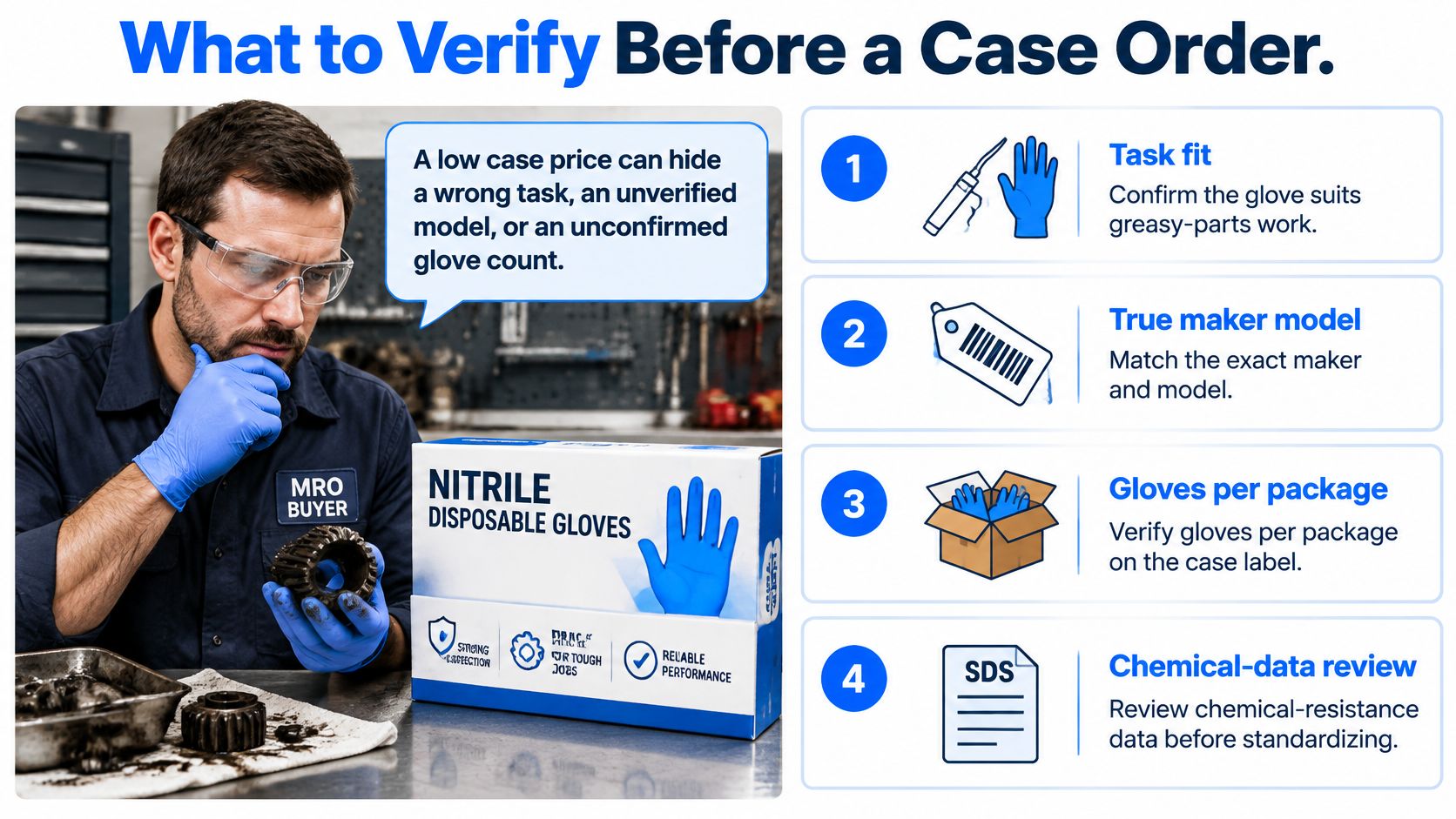
The legal frame is worth quoting, because it puts the burden on the buyer and the employer rather than the label. OSHA's hand-protection rule, 29 CFR 1910.138, requires employers to select and require appropriate protection when hands face hazards including skin absorption of harmful substances, severe cuts or lacerations, punctures, chemical burns, thermal burns, or harmful temperature extremes. Selection cannot rest on whether a glove says nitrile. Employers must evaluate performance characteristics against the task, workplace conditions, duration of use, and identified or potential hazards.
Five rows to clear before you request a quote
Print this, or paste it into the requisition, and mark each row pass or open. A row with no evidence is open, even if the case price looks settled.
| Check | Pass only if | Do not treat as a pass |
|---|---|---|
| Named task | Oily handling, solvent cleaning, and sharp-edge work are written as separate jobs | One nitrile description is used for every greasy-parts job |
| Chemical data | The exact manufacturer model has permeation and degradation data for the chemical, concentration, temperature, and contact duration | The word nitrile, a thicker glove, or another model's test sheet |
| Fit trial | Required sizes were worn while gripping the actual oily parts | The Large example title was assumed to fit the crew |
| Package count | Gloves versus pairs, boxes per case, and units per box are read from the current listing and carton | 100/Case is read as 100 pairs or a conventional master case |
| Order release | Buyer and safety reviewer confirm the same model, size mix, and current listing | The case price is approved before those details |
Browsing the store's Safety Gloves category is how you find candidates. Finding a candidate isn't evidence that it fits your parts bench. For the wider PPE picture, the Workplace Safety Equipment Guide covers gloves, eye protection, and signage as one system. A case order needs something narrower than a program overview.
One practical caveat on any product page you open, including one checked on November 18, 2026: a page that opens is not a statement of stock, price, freight, lead time, or included accessories.
Separate Oily Handling from Solvents and Edges
Walk the station before you compare industrial nitrile gloves. Three jobs share that bench and that glove dispenser, and they don't share a protection requirement.
- Oily-component handling. A technician lifts greased housings, fasteners, or machined parts out of a tote. The glove has to stay seated, keep ordinary shop grease off the skin during that handling, and survive being pulled on and off between parts.
- Solvent cleaning. A wipe-down, a parts-wash dip, or a longer wet contact has a chemical name, a concentration, a temperature, and a duration. Those four facts decide the glove, and none of them is captured by the word "nitrile."
- Sharp-edge work. Burrs on a fresh cut, stamping edges, and cut sheet can slice or puncture during the grip itself. That's a different hazard category, not a tougher version of the same glove.
Material-level guidance is useful as background and misleading as a decision. A chemical and liquid resistant glove reference describes nitrile as performing well with oils, greases, acids, caustics, and alcohols, and generally unsuitable for strong oxidizers, aromatic solvents, ketones, and acetates. Read that as a starting map. Your specific solvent, at your dilution, at your parts-wash temperature, still needs the maker's data for the exact model.
Task rule: if the edge can cut you, the disposable glove is not the control. Choose the edge control first, then decide whether a disposable glove goes underneath it.
When the hazard is an edge rather than grease on the skin, start in Hand & Arm Protection instead of in the nitrile case.
A single nitrile description doesn't establish suitability across all three jobs, and a disposable glove isn't established cut or puncture protection. Write one intended industrial task on the request. That single sentence is what the chemical check and the fit trial get tested against.
Match the Glove to Real Chemical Contact
Nitrile is a material family, not a chemical answer. Two assumptions cause most of the trouble here: that the word nitrile on a carton settles the solvent question, and that a thicker glove is automatically a safer glove. Neither holds up once you look at the actual exposure.
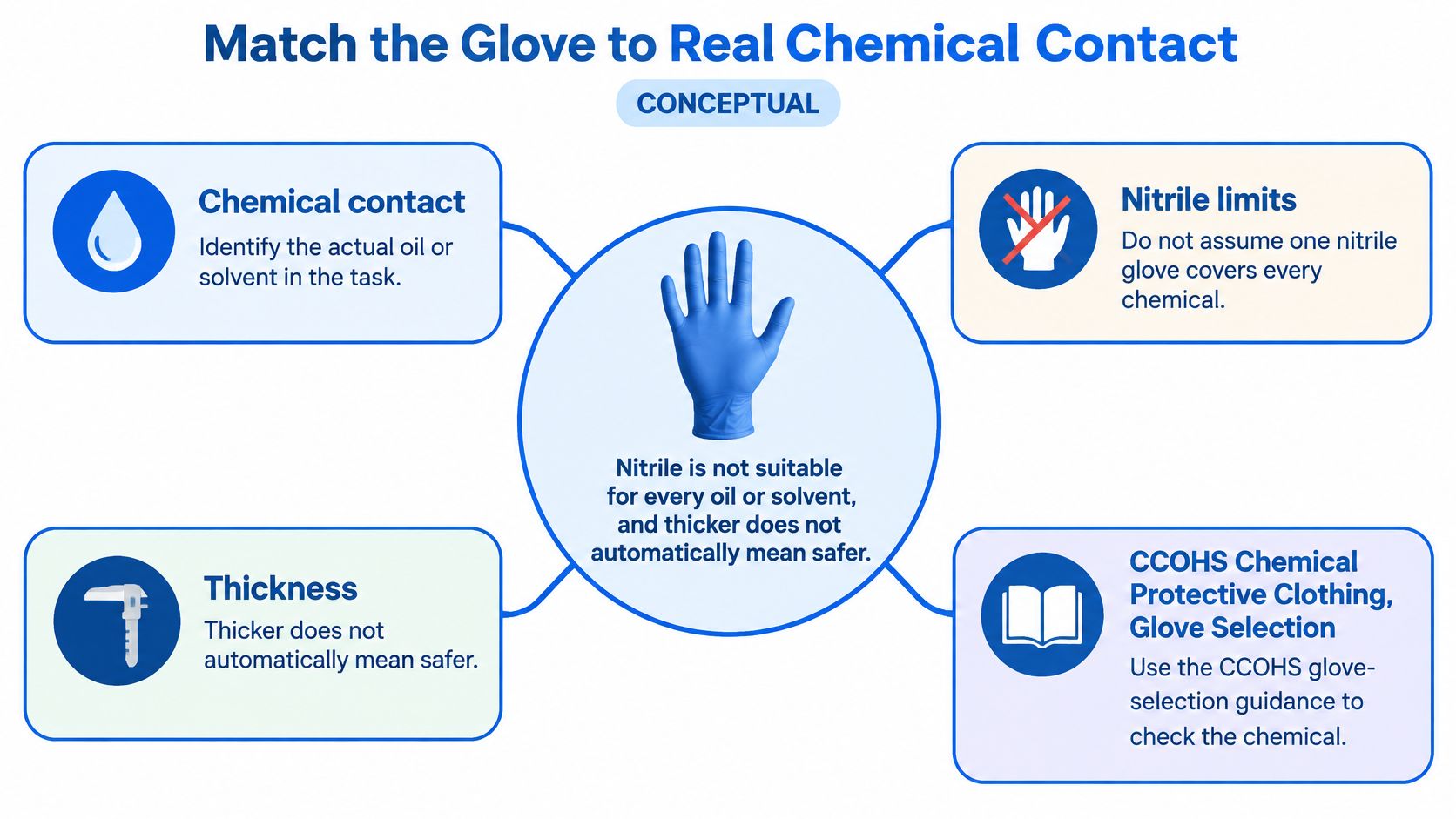
The CCOHS chemical protective clothing and glove selection guidance frames the question the way a safety reviewer needs it: assess the task and the chemical exposure, then match fit and the manufacturer's chemical data to that exposure. That's neutral selection context. It is not a test report for the model in your cart, and it doesn't transfer across products.
The spread within one material family is wide. A CDC-listed study tested eight nitrile and five neoprene glove products at roughly similar nominal thickness and found average breakthrough times against perchloroethylene ranging from 30 to 300 minutes across products all labeled nitrile, a tenfold spread (CDC PPE study). Tenfold. Same word on the box.
The four fields a reviewer has to hold
Ask for permeation and degradation data for the exact manufacturer model, and make sure the data covers your conditions rather than a generic test:
- The chemical as used, by product name, not by category.
- Concentration, including whether the shop dilutes it.
- Temperature, because a warm parts washer isn't a bench-top wipe.
- Contact duration and type, meaning a brief splash versus a soak or immersion.
Where does the store listing fit? The GLV2007L product page is evidence of the listing, the named size, and the visible configuration. It isn't a verified crosswalk to an Ansell manufacturer model number, and it isn't a test report. Thickness, certifications, examination status, or chemical tests published for a different TouchNTuff model don't carry over to this one. If a claim isn't in the documentation for the exact model you're buying, treat it as unverified.
Procedure discipline is the same instinct labs apply to their own work. Teams that culture organisms write down aseptic technique for mycology steps and repeat them every session, because "probably clean" isn't a standard anyone can audit. A solvent wipe deserves the same written standard.
Splash is an eye question as well as a hand question. If the wipe or wash can throw liquid, the eye protection on that job card needs its own review, for example the 3M AO Safety chemical splash goggles in a 10-case quantity as a starting point to confirm against the task.
If the data doesn't cover your contact, the case doesn't get standardized for that chemical task. That's the whole rule.
Trial Fit and Dexterity on the Actual Parts
Fit isn't a size chart. It's a trial with the part in hand, the way the crew works. Six steps, and each one produces a note you can file with the requisition.
- List every size the crew wears. Large on the example listing is one size, not a size mix. Someone on second shift wears medium, and someone wears extra large.
- Don sample gloves and grip the actual parts. Small fasteners, slick housings, threaded fittings. Watch whether fingertips bunch or the palm slips on the grease film.
- Repeat the grips with the station's own grease or oil. Clean-part handling and oily-part handling are different tests, and the second one is the one your bench runs.
- Record what you see. Cuff stay, fingertip bunching, slip, and any tear during ordinary donning are observations about that sample, not a verdict on the whole category.
- Check whether the wearer can finish the task without pulling the glove to regain dexterity. If the glove comes off for the fiddly part, the glove isn't doing the job.
- Stop if burrs or cut metal can contact the hand. Go back to a different control from Hand & Arm Protection rather than treating a disposable glove as cut protection.
Movement changes the answer, which is why the trial has to happen in motion. A CDC-supported study of 30 disposable nitrile products found that simulated hand movement shortened breakthrough time, raised the steady-state permeation rate, and increased cumulative 30-minute exposure by as much as threefold compared with static testing (CDC nitrile glove movement study). A glove resting flat on a bench is not the glove on a technician's twisting wrist.
Shop crews already keep written steps for blades and grinders, and RSB safety tips for DIYers is the same instinct applied to cutting tools. A fit trial earns the same paperwork, because the next person to run it won't be the person who ran it the first time.
Don't claim textured fingers, a grip pattern, or any cut rating unless the current documentation for the exact model states it. Those features don't migrate from a neighboring product in the same family.
The output of this section is an approved size mix. That mix is what purchasing multiplies later, never a single Large case.
Audit the GLV2007L Package Count
The example listing turns a vague worry into a specific counting problem. Here is the page as it appears.
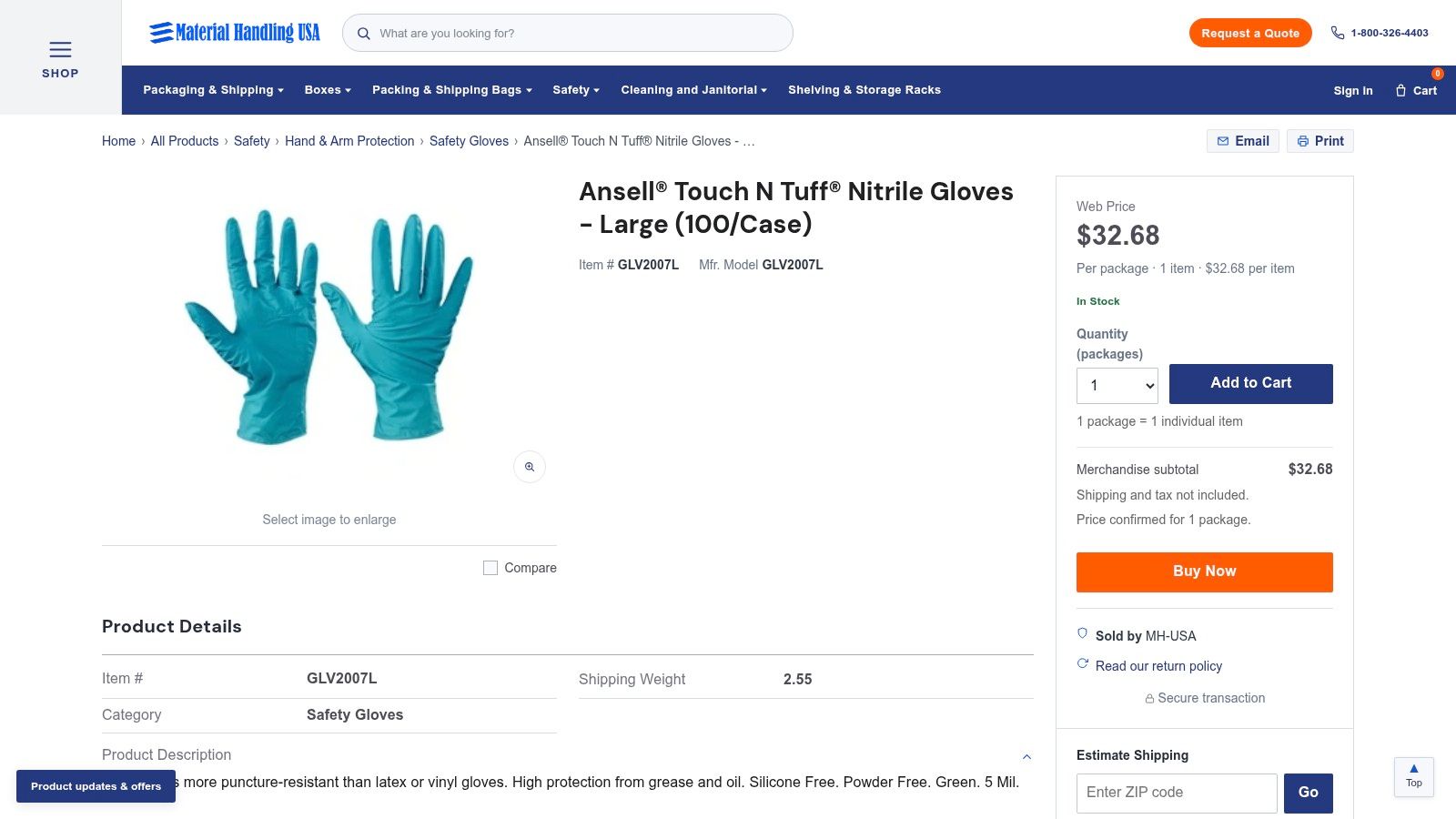
The listing is titled Ansell Touch N Tuff Nitrile Gloves, Large, 100/Case (the Large 100/Case listing). The store SKU is GLV2007L and the named size is Large. Two visible statements then pull in different directions: the title says 100/Case, while the interface can display one individual item. Neither statement establishes 100 gloves, 100 pairs, one inner box, or a multi-box master case.
A useful way to read the page is to treat the title like a shipping label and the interface like the scale at the dock. The label gives you a phrase. The scale tells you what one selectable unit appears to be. The final count comes from matching both against the current product page and carton, including gloves versus pairs, boxes per case, and units per box.
| Field | What the example listing shows | Buyer must confirm |
|---|---|---|
| Store SKU | GLV2007L | Selected variant is still the intended line |
| Listing title | Ansell Touch N Tuff Nitrile Gloves, Large, 100/Case | True manufacturer model, not only the store SKU |
| Size | Large | Other required sizes have their own current listings |
| UI quantity | Can display one individual item | Whether that unit is a glove, a pair, a box, or a case |
| 100/Case wording | Appears in the product title | Gloves versus pairs, boxes per case, and units per box from the current page and carton |
| Case math | Not established by the title | Current count per purchased unit before demand math |
What the ambiguity actually costs
A buyer who assumes the title means 100 pairs plans for twice the gloves that arrive. A buyer who pictures a multi-box master case plans for replenishment stock that may never show up in that form. Either mistake lands on the shelf as a shortage or as a surplus of the wrong size, and neither gets corrected by reading the price again.
Receiving checks aren't paranoia. FDA MedSun reporting identified at least 5,435 reports involving failed nitrile examination gloves between December 12, 2025 and February 28, 2026, covering rips, missing parts, foreign substances, gloves stuck together, inconsistent thickness, and incorrect sizing (FDA MedSun report). Write the lot, carton condition, and defect rate down at the dock, on the same sheet where you record the count.
The true manufacturer model still has to be confirmed separately, because the store SKU isn't that crosswalk. A package photo earns a place in your file only when it shows this SKU and the count text is legible and permitted for use. For broader glove categories and related safety purchases, use safety gloves and hand protection products as a navigation reference, then return to the exact listing details before approving the count.
Once the count is settled, keep unopened original packages labeled and contained. Storage Containers & Bins is where to look for a tote, and you check the carton dimensions against the tote before ordering either. The goal is simple storage: preserve the label, keep the carton closed, and make the count easy to recheck before the next order.
Estimate Need from Observed Glove Changes
Here is the only ordering formula worth running before the package count is confirmed.
Gloves to purchase for a period = (workers on the task x approved changes per worker in that period x gloves per change) divided by verified number of gloves in one purchased unit
Each input has a job:
- Workers on the task. The people assigned to the named job, split by size. Not the whole department.
- Approved changes per worker. Counted during a real period your shop chooses to watch. This article doesn't hand you a replacement interval, and neither should a supplier who has never seen your bench.
- Gloves per change. Usually two when both hands are covered, unless your station uses a different practice.
- Verified gloves per purchased unit. This denominator stays blank while the case could be read as 100 gloves or as one individual item.
A blank denominator produces a blank answer. That's not a dodge; it's the honest state of the arithmetic until someone reads the current page and the carton.
Worked example, deliberately unfinished: four technicians, changes counted across one observed week, two gloves per change, purchased-unit count unknown, so order quantity unknown. Run the same row separately for each size in the approved mix, because a medium-heavy crew and a mostly-large crew don't produce the same split.
Rule: an unknown unit count can't be averaged away. Fix the count, then multiply.
Two shortcuts to refuse. Dividing a case price by 100 assumes the title's number is the glove count. Converting the title into pairs assumes an answer the listing doesn't give. Copying another plant's monthly usage assumes their task, their change practice, and their package count match yours.
Recheck the selected variant before typing any number into the order.
Release the Order After the Checklist
The five rows from the top of this guide are the release gate. The purchasing manager and the safety reviewer sit down together with the current product page on screen and the fit-trial notes on the table, and they clear each line rather than splitting the work.
- Task. Read the named industrial task out loud. Confirm that solvent contact and sharp edges were handled as separate jobs and weren't folded into the oily-handling decision.
- Chemical data. Hold the exact manufacturer model sheet. Confirm permeation and degradation data for the chemical, concentration, temperature, and contact duration.
- Size mix. Match the ordered sizes to the trial notes. Don't multiply only the Large example line.
- Package count. Fill gloves versus pairs, boxes per case, and units per box from the current listing and the carton label.
- Current listing. Recheck the selected variant at order time. A read-only page check is evidence that the destination opened, not a promise of stock, price, freight, lead time, or included accessories.
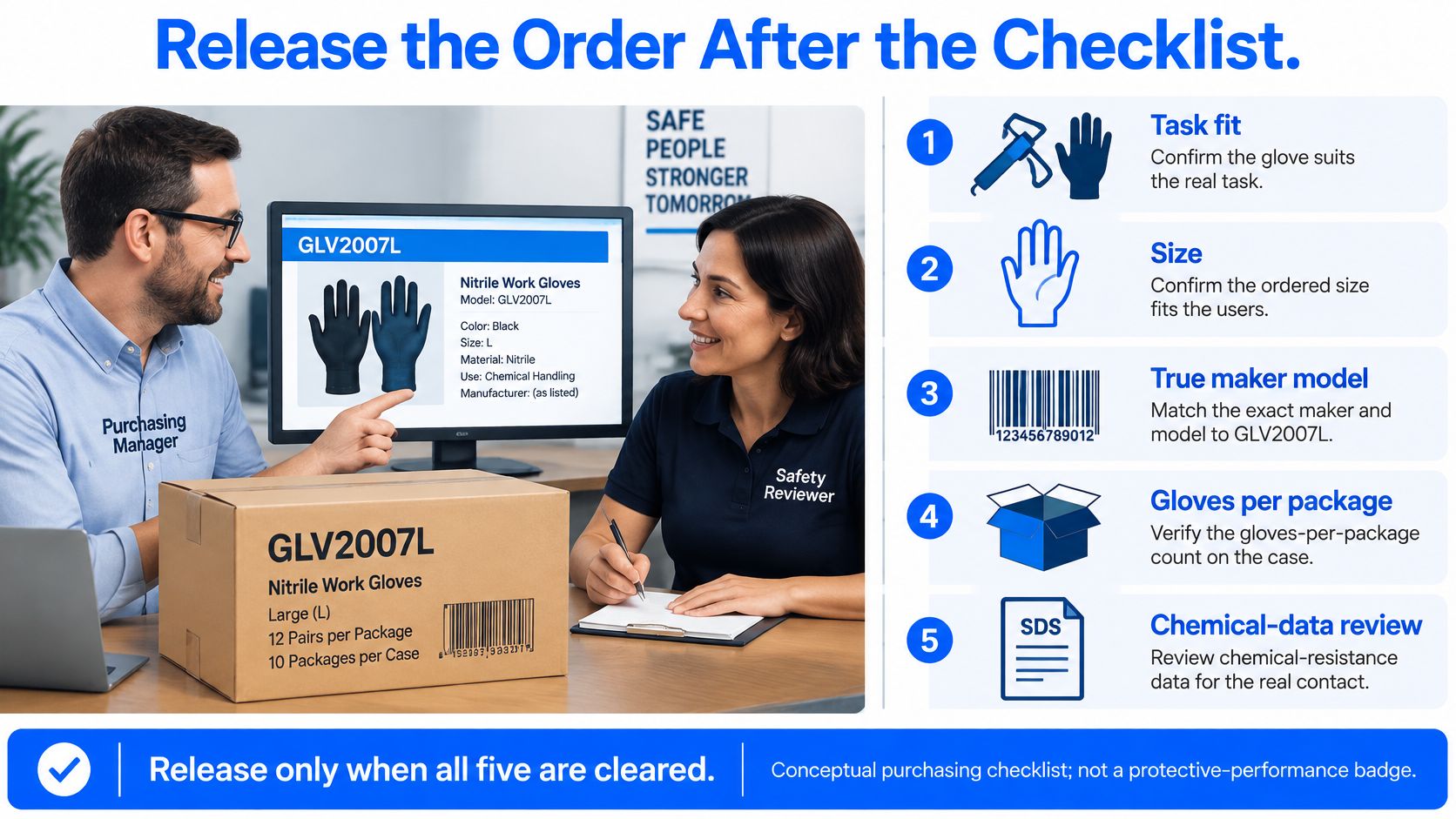
If any line is open, the order waits. That's cheaper than a pallet of gloves nobody can wear on the task safely, and it's far cheaper than re-running the whole selection after a lot fails at the bench.
Then work the confirmation in the right order. Review the Ansell Touch N Tuff Nitrile Gloves, Large, 100/Case listing as the worked example, compare other candidates in Safety Gloves only after they clear the same checks, and ask a Material Handling USA product specialist to confirm the exact model, the task suitability, and the package count before the order goes in.
Material Handling USA supplies industrial, packaging, safety, janitorial, and facility products to businesses nationwide, and the storeroom shoppers who buy nitrile gloves by the case can review the Large 100/Case listing alongside the wider Safety Gloves and Hand & Arm Protection ranges. When the fit trial and the chemical data check out, a U.S. product specialist can confirm the exact model, the size mix, and the package count before you commit to a case quantity. Visit Material Handling USA to compare the listed options and start the confirmation.