Skate Wheels for Conveyors How to Choose and Size Them
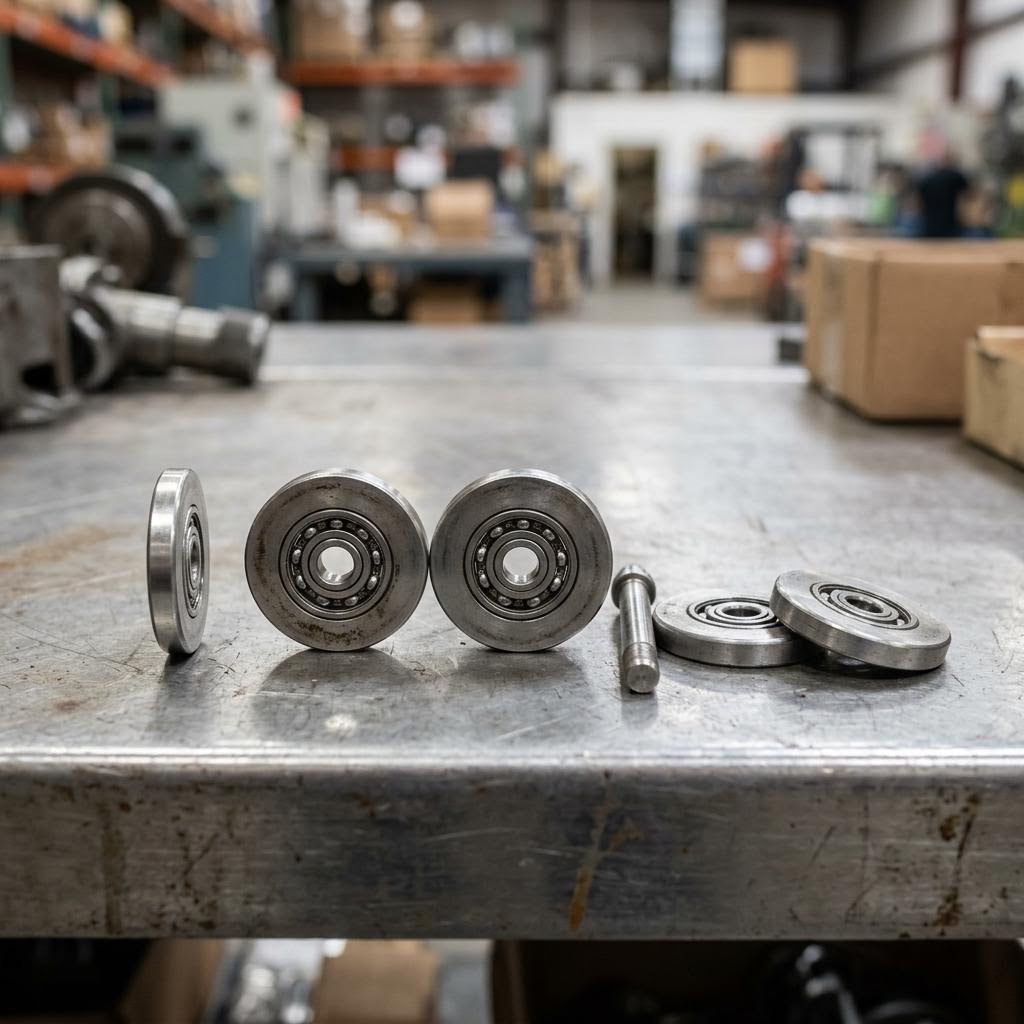
The dock crew is waiting on a carton that keeps hanging up, the pack line is backing up, and someone is about to drag in a heavier conveyor section that was never really needed. That's the moment when skate wheels for conveyors make sense, or fail fast if the load is wrong. If you're trying to move firm-bottom cartons, totes, or cases through shipping, receiving, or assembly, the key question isn't just whether skate wheels are cheaper, it's whether the wheel layout under each box can support the box cleanly.
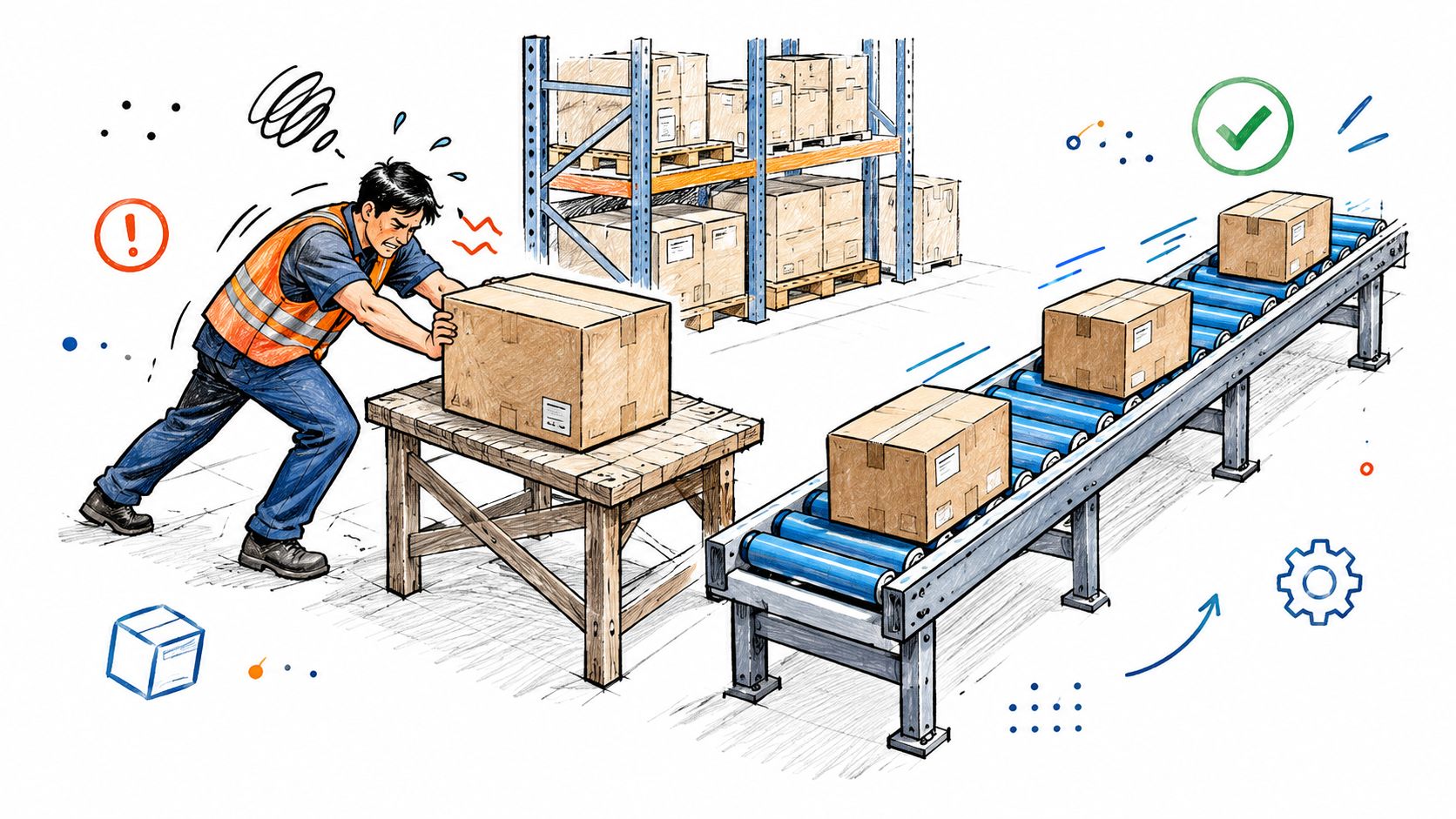
A good starting point is the broader material handling setup, because skate wheels are one piece of a bigger flow problem. If you're mapping carts, lanes, and staging areas, a practical overview like the one in the material handling equipment guide helps frame where gravity flow belongs and where it doesn't. The rest comes down to geometry, carton rigidity, and how many contact points you're really giving the load.
Table of Contents
- Introduction to Skate Wheel Conveyors and When They Make Sense
- How Skate Wheel Conveyors Work
- Skate Wheel Materials and Bearing Options Compared
- Load Capacity and Wheel Spacing Rules That Determine Performance
- Mounting Styles Frame Types and Layout Options
- How to Select Skate Wheels for Gravity and Powered Applications
- Choosing the Right Skate Wheel Conveyor for Your Operation
Introduction to Skate Wheel Conveyors and When They Make Sense
A skate wheel conveyor is easy to picture once you've seen one in use. Instead of a solid belt or full-width roller bed, the frame carries rows of small wheels that spin independently as a carton moves across them. That simple design is why this style has stayed common in warehousing and distribution, where operators need a lightweight, non-powered way to move packages without installing a full powered line.
The category is older than many of the systems around it, but the layout hasn't changed much because the basic job hasn't changed either. A typical section uses 1-15/16 inch outside-diameter wheels on a 2-1/2 inch tall steel or aluminum frame with a 1 inch flange, and the wheels are often spaced about 1 to 2 inches apart and grouped 3 to 7 per axle. That compact geometry is part of why skate wheel conveyors are still described as the most economical lightweight non-powered conveyor option in the market linked overview.
What they're really built for is controlled movement of lightweight cartons with firm flat bottoms. If the box is rigid, stable, and reasonably balanced, the wheels only need to reduce friction enough for gravity or a gentle push to do the work. If the load is soft, uneven, or too small to bridge several wheels, the same conveyor becomes fussy fast.
Practical rule: skate wheel conveyors are a fit when the package, not the conveyor, carries most of the shape control.
That's why you see them in shipping lanes, receiving docks, and assembly support areas more than in pallet movement. The setup is simple, portable, and easy to reconfigure, which matters when a facility needs a lane for a shift, a season, or a changing SKU mix.
How Skate Wheel Conveyors Work
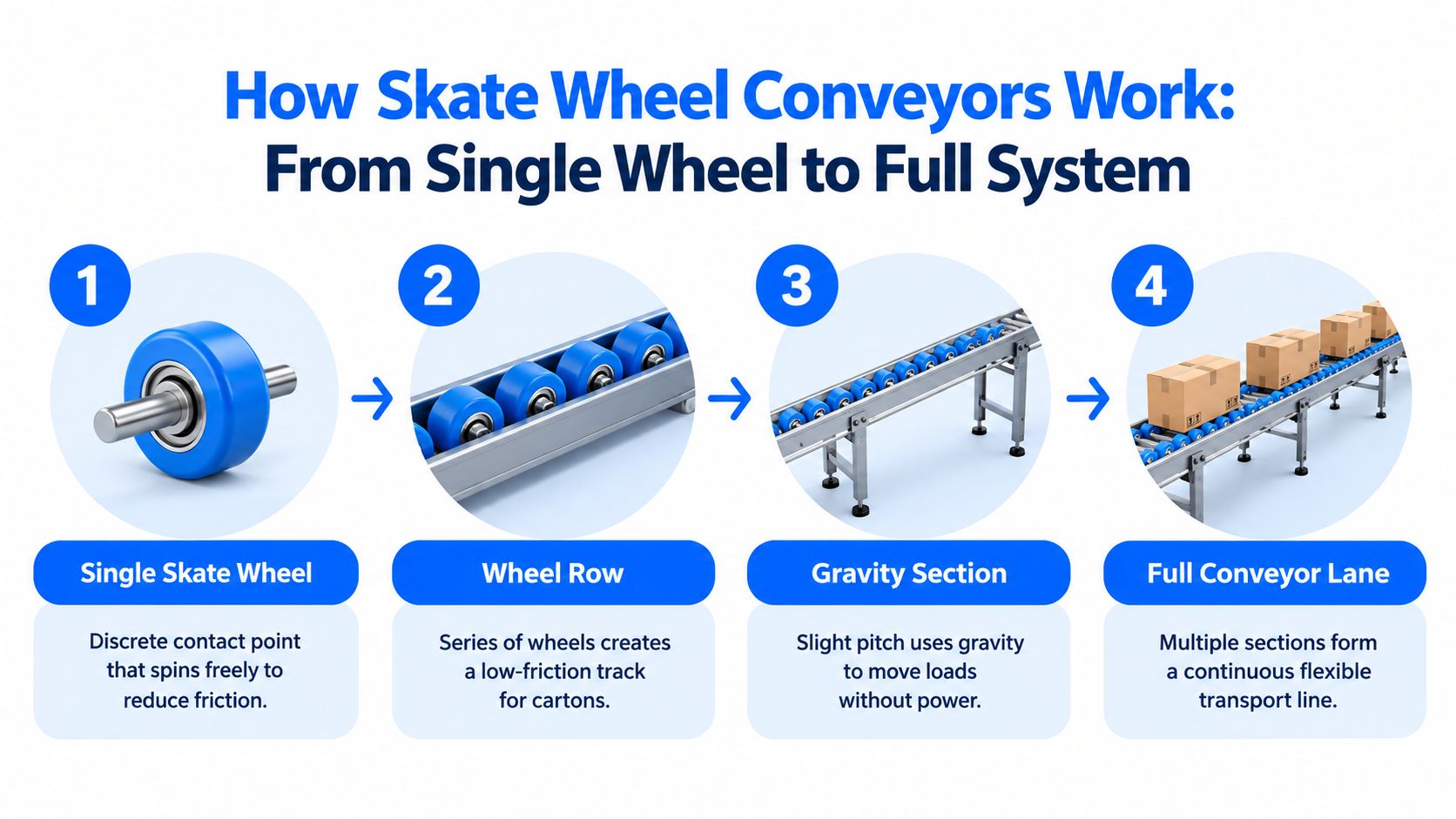
The simplest way to understand skate wheels is to compare them to stepping stones across shallow water. A full roller conveyor gives a carton a more continuous surface, while a skate wheel lane gives it a chain of small, discrete contact points. Each wheel turns on its own bearing, so the carton doesn't have to slide, it rolls from one contact point to the next.
From one wheel to a full lane
At the component level, a skate wheel is just a small wheel on an axle with a low-friction bearing. In commercial parts listings, you'll commonly see a 1-15/16-inch outside-diameter wheel with a 7-ball bearing set and a 1/4-inch bore, with commercial load ratings around 50 lb per wheel component listing. That doesn't sound like much until you realize that many wheels together create a stable path for a carton.
A gravity section works because the frame is installed at a slight pitch, just enough that the wheels and gravity do the rest. Some wheels are sold in light- to medium-duty bearing ratings from 21 to 180 pounds, while another published product line lists dynamic load limits of 50 pounds for light-duty steel housing skate wheel bearings and 60 to 100 pounds for a related bearing family industrial listing. Those numbers are a reminder that the wheel is the limiting element, not the frame alone.
Why the load shape matters so much
The wheel spacing creates the working surface. A small rigid carton bridges those contact points cleanly, so it rides with low resistance. A soft mailer, a rounded bag, or a short box with a tiny footprint can sink between wheels or wobble across them, which is when operators start fighting the lane instead of using it.
That's the hidden logic behind skate wheels for conveyors. They're not trying to support everything evenly the way a solid bed would. They're trying to support enough of the right things, in the right places, with as little friction as possible.
Skate Wheel Materials and Bearing Options Compared
The wheel material changes how the conveyor behaves in practice. Steel, aluminum, and plastic all show up in skate wheel components, but they don't belong in the same environments for the same reasons. If you choose by price alone, you'll usually miss the part that matters most, which is how the wheel behaves under your load, on your floor, in your dust level, and over time.
Steel, aluminum, and plastic each solve a different problem
Steel wheels are the most straightforward choice when you want a durable, compact component with a familiar load profile. Aluminum versions are lighter and are often selected where corrosion resistance or easier handling matters more than raw toughness. Plastic and poly wheels can be quieter and are often favored where gentle flow and low friction are the priority, especially for lighter cartons.
Here's the useful part for a buyer, not the marketing version. A 50 lb per wheel commercial rating is common in this category, and higher-capacity aluminum variants can reach 75 lb per wheel replacement parts listing. That's why the conversation should always start with the carton, not the frame.
| Skate Wheel Material Comparison for Conveyor Applications | |||
|---|---|---|---|
| Material | Load Rating per Wheel | Key Strength | Best For |
| Steel | About 50 lb per wheel | Durable, familiar, compact | General carton flow, shipping lanes |
| Aluminum | Up to 75 lb per wheel | Lighter weight, corrosion resistance | Portable sections, lighter frames |
| Plastic or poly | Varies by product line | Quiet, low-friction movement | Light cartons, quieter environments |
Bearings are doing more work than most teams think
A wheel that looks fine can still feel rough if the bearing is poor, contaminated, or not suited to the load. In commercial components, the bearing package is often part of the spec, not an afterthought, and published products note 7-ball bearing sets and 1/4-inch bores as part of the standard construction component listing. Some replacement wheels are also described as lubricated for life and designed for one million revolutions at full load maintenance discussion.
If the wheel spins freely but the bearing feels gritty, the conveyor stops acting like a low-friction lane and starts acting like a drag path.
For maintenance-sensitive spaces, that matters as much as load rating. Dust, grease, and washdown exposure can change how a wheel behaves long before the frame wears out. If your operation has food, healthcare, or fine-dust concerns, the bearing and wheel material choice should be made with cleaning in mind, not just with the SKU sheet in front of you.
Load Capacity and Wheel Spacing Rules That Determine Performance
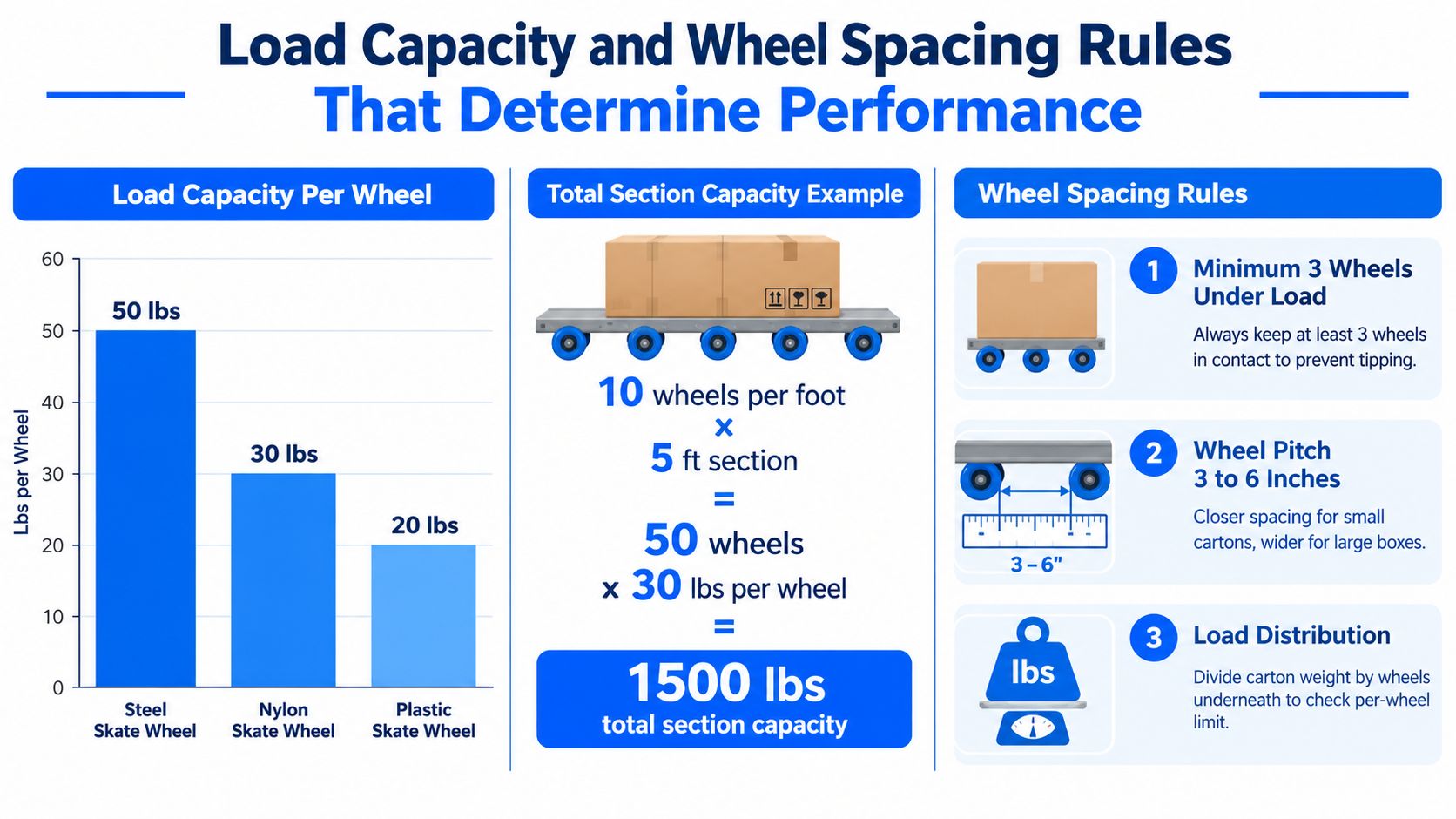
This is the part most buyers skip, and it's the part that causes the most trouble. A skate wheel conveyor is not rated by frame length alone. Capacity is governed by wheel count and axle spacing, because each wheel carries part of the load. If you stretch the spacing too far, the carton starts sagging between wheels, which leads to binding, tip-over, and uneven flow.
The two sizing checks that actually help
One published 10-foot, 24-inch-wide section is rated at 350 lb total and 50 lb per wheel gravity conveyor listing. That example shows the key idea. Total section capacity is the sum of many small supports, not a single frame number you can apply blindly.
A useful rule from independent guidance says every conveyed carton should have ten wheels underneath it, while another design guide says the package length in the travel direction should be divided by 3 to estimate maximum axle center spacing design FAQ. Neither rule is magic, but both point in the same direction. Short cartons need tighter support, and longer cartons can tolerate more spacing, as long as the load stays rigid.
A mixed-SKU example you can actually use
Suppose you have two carton types moving through the same lane. One is short and stiff, the other is longer but still flat-bottomed. If the short carton only touches four wheels, it may rock or bridge unevenly, especially at the seam between sections. If the longer carton touches many more wheels, it will usually track more steadily because the weight is spread out.
The core question for operations is not, “How long is the conveyor?” It's, “How many wheels are under each box at the point where the carton is least supported?” That's the number that tells you whether the lane will move cleanly or turn into a hand-guided bottleneck.
Sizing check: divide carton weight by the wheels actually carrying it, then compare that result to the per-wheel rating.
Gravity slope still has to be gentle
Even with proper wheel support, the conveyor still needs enough pitch to move. For gravity flow, steel and poly skate wheels typically need only 5/16 inch to 3/8 inch per foot of drop design FAQ. That's a small drop, but it's enough when the wheels are right and the carton is rigid enough to ride the lane instead of fighting it.
Mounting Styles Frame Types and Layout Options
The wheel itself is only part of the decision. The frame style determines how the lane fits into the building, how fast you can move it, and whether it's meant to stay put or change every week. A lane that works on a dock door doesn't need the same frame logic as a flow-rack insert or a side guide.
Straight lanes, portable sections, and flexible setups
Straight gravity sections are the simplest form. They're the default when you need a defined path between two fixed points, such as packing to shipping or receiving to sortation staging. Portable and expandable units matter when the layout changes, because skate wheel conveyor sections are lighter than roller conveyor and can be moved quickly for temporary setups and 90-degree curves in dock, shipping, and receiving layouts industrial listing.
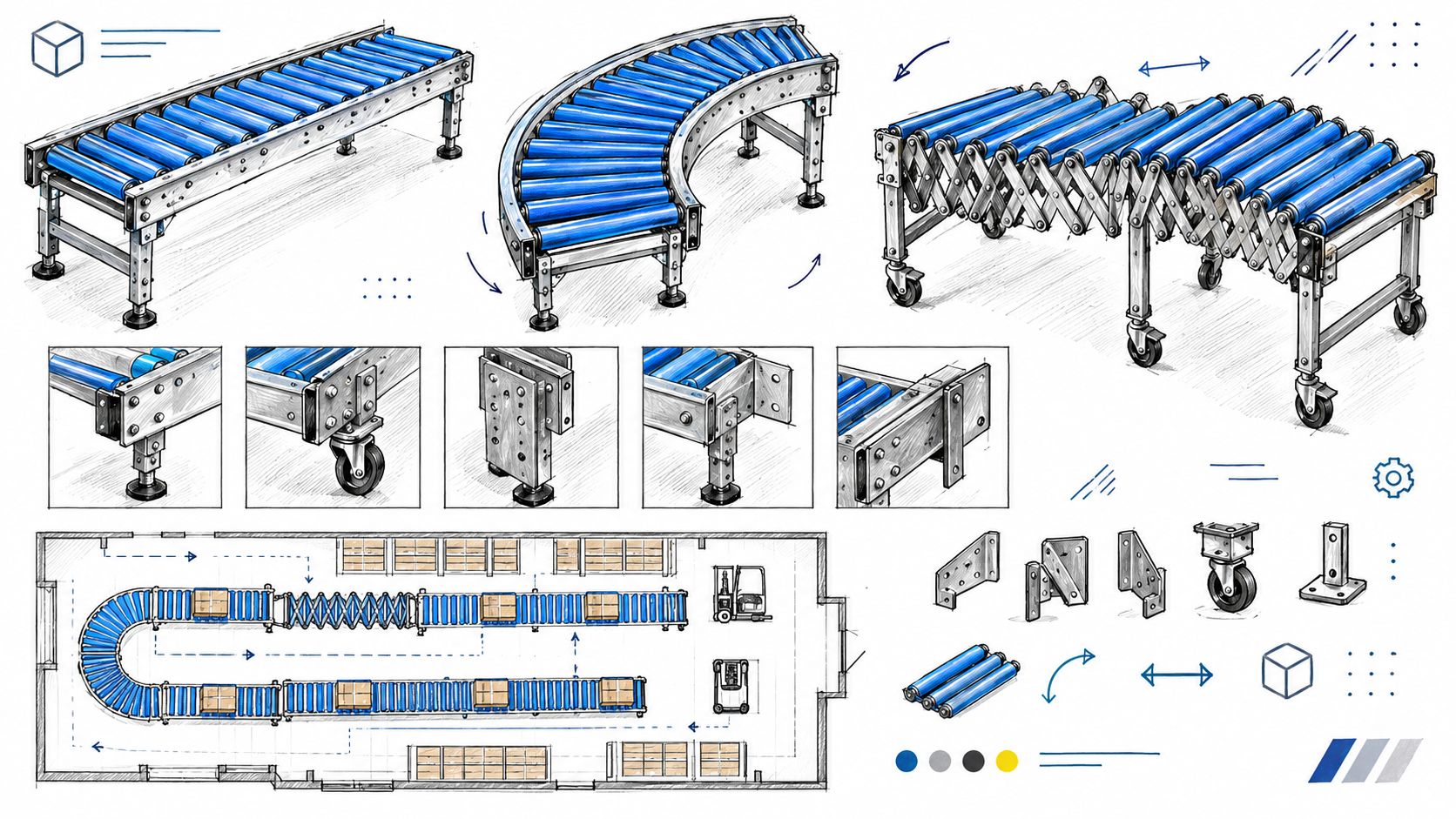
Flow-rail inserts are a different animal. They're used inside racking or gravity lanes where the goal is controlled carton movement within a shelving or pick-face structure. Side-guide applications use skate wheels to keep a carton centered or to guide it along an edge where a small amount of lateral control helps the operator.
Frames, legs, and how the physical layout changes behavior
Steel frames are the common rugged choice. Aluminum frames are easier to move and are usually the better fit when portability matters more than stiffness. Fixed legs make sense for permanent lanes, while telescoping or adjustable supports help when the floor, dock plate, or truck interface changes from one setup to the next.
If a team keeps rebuilding the same lane for every shift, the frame should be chosen for quick repositioning, not just for static load. If the line is permanent, the right answer may be a more rigid section with more intentional support geometry. Either way, the frame should match the carton mix, because the wheels can only do so much if the structure underneath them is wrong.
How to Select Skate Wheels for Gravity and Powered Applications
A good selection process is less about memorizing product names and more about asking the right five questions in order. The first is always about the carton, because the conveyor is only useful if the carton can ride it cleanly. After that, the wheel count, wheel rating, slope, and maintenance reality start falling into place.
A simple selection workflow
-
Define the carton footprint and rigidity.
A firm, flat-bottom carton is a natural fit. Soft bags, small cartons, and uneven packages usually need another conveying method. -
Count the wheels under the load.
Don't size by section length alone. Use the number of wheels supporting the carton and check whether that support is spread out enough to keep the load level. -
Match per-wheel load to the conveyed weight.
If the wheel is rated for a certain load, that limit matters at the point of contact. A section with more wheels can carry more because the weight is distributed. -
Choose material and slope together.
For gravity flow, steel and poly wheel systems often need only 5/16 inch to 3/8 inch per foot of drop design FAQ. That gentle pitch works when the carton is rigid and the lane is clean. -
Check maintenance and cleanliness needs.
One conveyor manual tells operators to keep conveyor surfaces clean of dirt, debris, and grease buildup and to inspect for wear and loose hardware regularly maintenance guidance. That's not a small note, because contamination can erase the low-friction benefit you bought the system for.
Where powered assist changes the conversation
If you're using powered or accumulation-style equipment, the goal shifts from “move with as little resistance as possible” to “control the product predictably.” That's where cleanliness, accumulation behavior, and product control matter more than a bare-bones gravity pitch. Skate wheels can still belong in the layout, but only if the carton mix and operating environment don't create constant cleanup work.
For buyers comparing options, a broad product catalog like Material Handling USA's material handling category can help you compare wheels, supports, and adjacent components in one place. The point isn't to buy faster, it's to keep the conveyor spec tied to the actual carton flow problem instead of a generic catalog description.
Choosing the Right Skate Wheel Conveyor for Your Operation
The right choice is usually the simplest one that still respects the load. Skate wheel conveyors work well when you're moving lightweight, flat-bottom cartons and you want a portable, economical gravity option. They stop making sense when the load is soft, unstable, pallet-scale, or likely to bring dirt, debris, or washdown conditions into the lane.
The sizing mistake to avoid is treating the frame like the whole answer. The answer is how many wheels are under each carton, how closely those wheels are spaced, and whether the carton can bridge the gaps without sagging. Keep the surfaces clean, inspect for loose hardware, and choose the frame style that matches whether the line is permanent or temporary.
If you're sorting through conveyor sections, casters, or facility supply options, the broader Material Handling USA product categories make it easier to line up the right components without splitting your order across multiple vendors. For a new layout, start with the carton dimensions and wheel support, then build the lane from there.
If you're ready to specify a lane with less guesswork, visit Material Handling USA to compare conveyor-related materials, wheels, and facility supplies in one place. Their team can help you narrow the right components for carton flow, dock setups, and related material handling needs.