Wholesale Shipping Boxes Bundle vs Pallet Guide
Your packing line is either waiting on a late box delivery or making room for a pallet that arrived before you had space for it. Both problems come from treating wholesale purchasing as a simple unit-price decision. When you compare a wholesale shipping boxes bundle vs pallet, you need to account for box usage, storage, handling, freight, damage risk, and how quickly you can consume the stock.
For current product options, box families and direct shopping links, visit our shipping boxes selection and shopping page.
A bundle gives you flexibility. A pallet gives you a stable load unit and fewer handling touches. The right choice depends on your box sizes, monthly demand, facility, and delivery setup.
Table of Contents
- The True Cost of Buying Boxes in Bulk
- Bundle Quantities and Pallet Quantities Explained
- Volume Price Breaks and Hidden Storage Costs
- How to Forecast Box Usage and Set Reorder Points
- Choosing Between Parcel Delivery and Freight Shipping
- Shop In Stock Shipping Boxes and Packaging Supplies
- Common Questions About Wholesale Box Orders
- What is a bundle of shipping boxes?
- When does a pallet make sense?
- Is the pallet always cheaper per box?
- Do I need a forklift for a pallet?
- How should I handle damaged cartons on arrival?
- Can I order a custom box size?
- Should I buy one pallet for several box sizes?
- How often should I update my reorder point?
The True Cost of Buying Boxes in Bulk
A missed carton reorder usually shows up at the packing table first. Orders stack up, the team starts substituting sizes, and any savings from a lower box price disappear into rush shipping, extra labor, and slower outbound flow. The opposite mistake is buying a full pallet for the discount, then finding out the load takes space you needed for inventory and equipment.
Box cost is only one line on the bill.
What matters is total landed and held cost. A pallet can lower the per-box rate and cut receiving touches, but it also brings freight handling, the pallet base, protective wrap, and inventory that may sit for weeks if demand slips. A bundle often carries a higher unit price, yet still wins if it fits on a shelf, turns quickly, and avoids tied-up cash and floor space. Compression strength matters too. If the boxes will sit under other stock, poor storage conditions or overstacking can crush edges and reduce usable cartons before you ever pack an order.
Practical rule: Buy the smallest quantity that keeps replenishment reliable and does not force you to store packaging you cannot use soon.
Boxes and pallets do different jobs in shipping operations. Corrugated boxes are the packaging itself. A pallet is the handling platform that lets a warehouse move many bundled cartons with a pallet jack or forklift. That distinction matters for waste and recovery as well. The EPA packaging and recycling data reports that in the United States in 2018, approximately 32.1 million tons of corrugated boxes were recycled, a 96.5% recycling rate, while approximately 3.1 million tons of wood pallets were recycled from an estimated 11.5 million tons of wood pallets and other wood packaging.
Before placing the order, check these four points:
- Consumption: How many cartons of this exact size leave the shelf each month, and how quickly will this order turn?
- Storage: Can you keep the stock dry, flat, easy to reach, and safe from crushing, on shelving, in a rack bay, or on floor space you can spare?
- Handling: Can your crew unload, move, and break down a pallet safely without adding repeated touches?
- Landed cost: What do freight mode, receiving time, storage space, damage risk, and slow-moving inventory add to the quoted box price?
Bundle Quantities and Pallet Quantities Explained
Stock boxes ship flat in bundles of 25 for large sizes or 50 for small sizes. The per-box rate drops when you buy a full bundle and drops again at pallet quantity. The lower pallet rate only helps if you can consume the cartons before storage, damage, or changing requirements erase the savings.
A bundle works well when you pick several sizes for different products, test a new carton, or replenish a long-tail SKU. You can stage bundles near a packing station without breaking down a full pallet. A pallet works better when one size moves steadily and your receiving area can move the complete load without repeated manual sorting.
| Feature | Bundle Quantity | Pallet Quantity |
|---|---|---|
| Typical use | Irregular demand, mixed sizes, testing | Predictable demand for one size |
| Stock format | Flat cartons grouped for staged picking | Multiple bundles consolidated on a load platform |
| Handling | Shelf, cart, or manual movement may work | Usually needs pallet equipment or freight handling |
| Storage | Smaller commitment and easier access | Dedicated floor or rack space required |
| Freight | May move as parcel or multiple cases | Often moves as a skid or freight shipment |
| Main advantage | Flexibility and lower inventory exposure | Fewer touches and better unit-load stability |
| Main risk | More receiving and handling events | Overstock, space use, and load-design problems |
Pallets became foundational because they turn many cartons into one mechanically handled unit. A World Bank study on pallets and logistics states that pallets were first used in the United States in the 1930s and that approximately 80% of U.S. trade is carried on pallets. It also reports that around 280 million pallets circulate in the European Union each year. Pallet sizes still vary. North American operations commonly use the 48 by 40 inch Grocery Manufacturers Association footprint, while European logistics networks commonly use 1,200 by 800 millimeter Euro pallets. ISO 6780 recognizes six pallet dimensions for international trade.
That footprint affects racking, trailers, docks, and destination handling. A pallet isn't just a larger bundle. It's a platform that must fit the entire movement system.
Why pallet support changes box strength
A pallet can also change how the bottom cartons carry load. Research on palletized corrugated boxes found approximately 12% to 13% compression-strength loss when boxes were supported on a pallet, while another study reported that pallet overhang can reduce effective compression strength by up to 40%. Research published through Rochester Institute of Technology links the problem to deck gaps, unsupported edges, and uneven transfer of vertical force.
Keep the box footprint inside the pallet footprint. Use corner-aligned column stacking when compression matters, and check the manufacturer's compression rating against the actual bottom-carton load.
Volume Price Breaks and Hidden Storage Costs
You get a pallet quote, see the lower per-box price, and it looks like an easy win. Then the shipment lands, half a bay stays tied up for weeks, receiving has to reshuffle stock to make room, and the savings on paper start to disappear.
The number that matters is total landed and held cost. That includes the box price, inbound freight, labor to receive and put away the order, storage space, handling materials, and the cost of holding cartons you will not use right away. If demand is uneven, buying deeper can turn a small unit-price discount into slower cash flow and more storage pressure.
Use a simple comparison for each buying option:
- Product cost: Bundle price or pallet price divided by total boxes.
- Inbound freight: Parcel, LTL, or truckload charges, plus accessorial fees.
- Receiving labor: Time to unload, count, inspect, and store the shipment.
- Space cost: Rack or floor space occupied until the cartons are consumed.
- Protection cost: Pallet, stretch film, corner protection, and other handling supplies.
- Risk cost: Moisture exposure, crushing, obsolete print, carton changes, or slow-moving inventory.
Buyers usually miss the core trade-off. A pallet often lowers the invoice cost per box, but it also commits you to more stock on hand. If usage slips, a size changes, or packing patterns shift, those extra cartons sit. A bundle can cost more per unit and still be cheaper overall because it limits storage time, reduces cash tied up in packaging, and gives you more flexibility to adjust sizes as order patterns become clearer.
A pallet makes more sense when one carton size moves steadily, your team can receive and store full units efficiently, and your building has dry, level space with the right equipment. At that point, the lower unit cost has a better chance of staying a real savings after freight, labor, and storage are counted.
Box strength still belongs in the cost calculation. As noted in Cal Poly unit-load research, pallet support conditions can reduce effective compression performance, which can increase damage risk if the load and storage setup are not controlled.
The cheapest box is the one you use without damage, delay, or unnecessary storage.
How to Forecast Box Usage and Set Reorder Points
Running out of one carton size can stop a packing station even when other packaging remains in stock. Forecast each box size separately. Total order volume won't tell you whether your small, medium, or large cartons are really moving at the same rate.
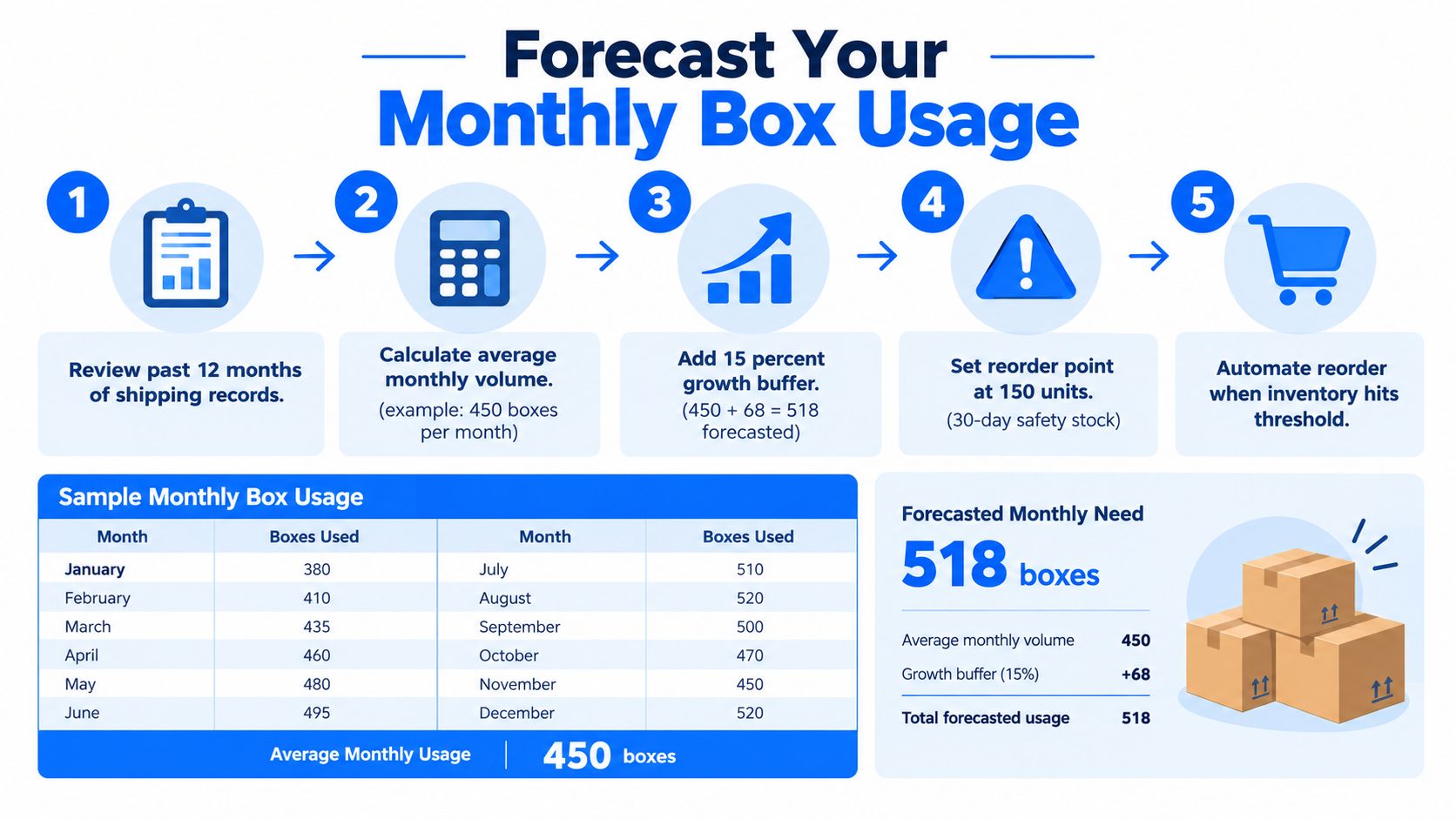
Use this simple worksheet for each size:
| Worksheet item | Your calculation |
|---|---|
| Orders using this box size per month | Enter your actual monthly count |
| Boxes per order | Enter the average cartons used per order |
| Base monthly usage | Orders per month × boxes per order |
| Damage and returns allowance | Add 10% to base usage |
| Forecast monthly usage | Base usage plus the allowance |
| Supplier lead time | Enter delivery days |
| Lead-time demand | Average daily usage × delivery days |
| Safety stock | Set a buffer for demand and delivery variation |
| Reorder point | Lead-time demand + safety stock |
The owner-supplied planning rule is straightforward: orders per month times boxes per order, plus 10% for damage and returns. If you use 20 boxes per day and the supplier lead time is five days, lead-time demand is 100 boxes. Add 20 boxes as safety stock, and the reorder point becomes 120 boxes. The QuickBooks reorder-point guidance uses the same structure, lead-time demand plus safety stock.
Turn the forecast into a buying trigger
- Record usage by size. Review weekly or monthly consumption, not just total shipments.
- Adjust known changes. Add expected holiday volume, promotions, new customers, production changes, or substitutions.
- Set safety stock. Cover demand swings and late deliveries rather than choosing an arbitrary extra quantity.
- Compare the trigger with the selling unit. If the product page sells bundles, calculate in bundles. If it sells pallets, calculate in pallets.
- Round up only at the end. If a pallet contains 20 bundles and your reorder point is 260 bundles, you must order 14 pallets, or 280 bundles, when full pallets are required. Verify the actual pallet build because it varies by box size and manufacturer.
A more advanced safety-stock method uses a service-level factor, demand variability, and lead-time variability. The commonly presented formula is safety stock = Z × standard deviation of demand × square root of lead time, as described in Amazon Business safety-stock guidance. You don't need that model for every small warehouse, but it helps when demand and delivery times change often.
The Oracle reorder-point documentation defines reorder point as safety stock plus forecast demand during lead time. Keep open orders, on-hand stock, average use, lead time, and bundle or pallet quantity in the same review.
Choosing Between Parcel Delivery and Freight Shipping
A bundle or case may arrive through parcel service. Several cases consolidated on a skid may require freight handling, a dock, pallet jack, appointment, or liftgate. Confirm the delivery setup before placing the order, especially if the address is a small storefront, job site, or facility without a receiving dock.
FedEx states that FedEx Express packages can weigh up to 150 pounds, while FedEx Express Freight supports individual skids weighing 150 pounds or more in its U.S. packaging guidelines. This is a planning threshold, not a promise that every shipment at that weight will use the same service.
Ask for these details before checkout:
- Packed weight: Include cartons, pallet, film, and protection.
- Dimensions: Record each piece and the total pallet footprint.
- Shipment count: Several cases may be handled differently from one consolidated skid.
- Receiving equipment: Confirm dock, pallet jack, forklift, appointment, or liftgate needs.
- Freight type: Request parcel, LTL, or truckload pricing as appropriate.
A pallet quote should state cartons per pallet, pallet dimensions, gross weight, stack limit, and quoted freight method. Call for a custom freight quote when the order serves a project, involves multiple pallets, or must arrive at a location with special delivery constraints.
Shop In Stock Shipping Boxes and Packaging Supplies
Start by matching the carton to the product and consumption pattern. If you're testing a new size or replenishing an irregular SKU, choose a bundle and confirm the product specification before scaling up. If one size moves steadily and your facility can receive a full load, ask for pallet quantity and volume pricing.
You can shop corrugated shipping boxes by size and quantity. For products that need separation or different shapes, browse shipping boxes, pads, and tubes. Consolidating boxes with related packaging can simplify purchase orders and reduce the number of separate replenishment decisions.
Material Handling USA operates from Salt Lake City, has served businesses since 1997, and lists 58,000+ in-stock SKUs with nationwide shipping and volume pricing. For pallet quantities, project-size orders, or a box size that needs closer review, use the product page specifications and ask a product specialist to confirm the load and delivery details.
Common Questions About Wholesale Box Orders
What is a bundle of shipping boxes?
A bundle is a group of flat, stock corrugated cartons packaged together for shipment and storage. At Material Handling USA, stock boxes ship in bundles of 25 for large sizes or 50 for small sizes. Check the individual product page because the selling unit can vary by item.
When does a pallet make sense?
A pallet makes sense when monthly use exceeds a few bundles of one size, demand is predictable, and your facility can receive and store a complete load. It can also make sense when freight on multiple bundles costs more than one pallet shipment. Confirm pallet dimensions and cartons per pallet before comparing totals.
Is the pallet always cheaper per box?
No. The pallet can receive a lower unit price, but the full decision includes freight, labor, space, equipment, damage, and held inventory. A smaller bundle may have the lower total cost when demand changes or storage is limited.
Do I need a forklift for a pallet?
Not always, but you need a safe way to unload and move the shipment. Depending on the packed weight, carrier, and destination, you may need a dock, pallet jack, forklift, appointment, or liftgate. Confirm those requirements before ordering.
How should I handle damaged cartons on arrival?
Inspect the shipment before putting it away. Separate crushed, wet, torn, or visibly compromised cartons, photograph the condition, and record the shipment details. Contact the supplier promptly and avoid mixing damaged stock with usable cartons.
Can I order a custom box size?
Custom sizes may be available, but the minimum quantity, production timing, material specification, and freight method can differ from stock boxes. Call 1-800-326-4403, Monday through Friday, 8am to 5pm MT, for pallet quantities, custom sizes, or a quote on project-size orders.
Should I buy one pallet for several box sizes?
Usually not. A mixed-size pallet can complicate stacking, counting, picking, and compression. Buy pallet quantities for stable, high-velocity sizes, and use bundles for long-tail sizes or new pack configurations.
How often should I update my reorder point?
Review it after seasonal peaks, promotions, changes in customer mix, or changes in supplier lead time. Keep a separate history for each carton size so a change in total shipments doesn't hide a shortage of one critical box.
Material Handling USA offers stock shipping boxes in bundle quantities, volume pricing tiers, and phone quotes for pallet and project-size orders. Visit Material Handling USA to shop the right box quantity, or call 1-800-326-4403, Monday through Friday, 8am to 5pm MT, for pallet quantities, custom sizes, or a quote.