Aurora Quik-Lok Shelving: Sizes, Capacities and Uses
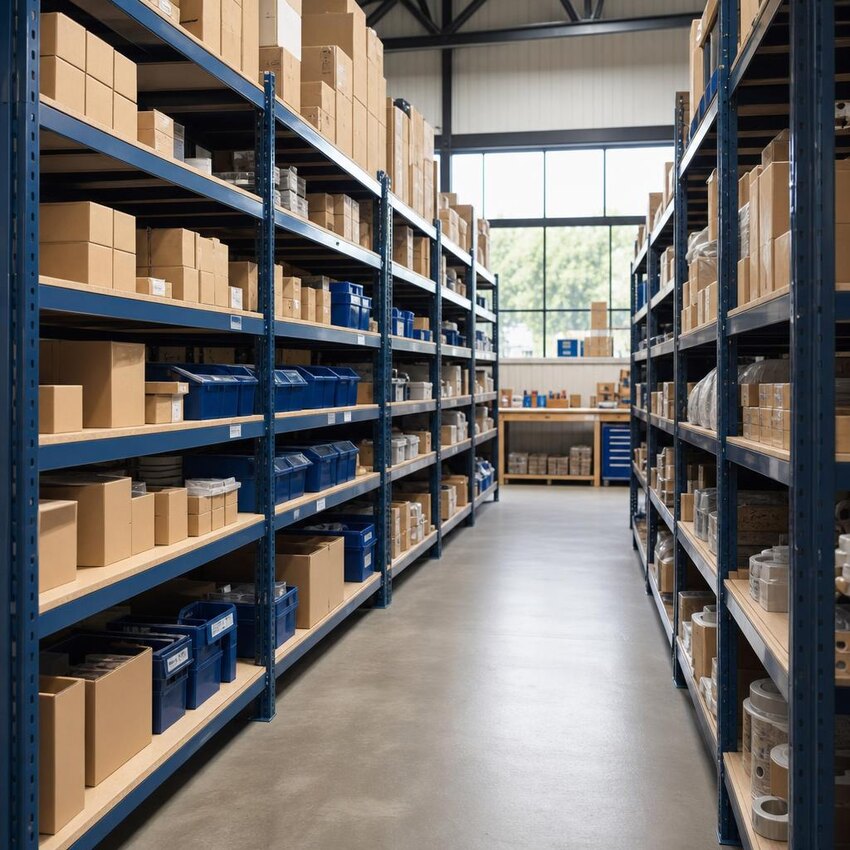
Your parts room has bins in the aisle, or your records room has cartons stacked wherever they fit. You need more usable storage, but a deeper shelf could narrow the walkway, and a taller unit could run into lights or sprinkler clearance.
Aurora Quik-Lok shelving is a four-post steel system available with open or closed sides. Choosing the right setup means matching its size, steel gauge, supports, and accessories to your stock, then checking the floor and installation conditions before you load it.
Table of Contents
- Quik-Lok Standard Sizes for Every Bay
- How the Keyhole Clip System Assembles Without Tools
- Shelf Gauges, Profiles and Load Ratings
- Closed or Open Sides for Your Storage Job
- Accessories That Solve Common Storage Problems
- How to Choose Your Quik-Lok Setup Step by Step
- When Quik-Lok Needs Engineering Review or Anchoring
- Quik-Lok Shelving FAQ
- Shop Aurora Quik-Lok Shelving in Stock
Quik-Lok Standard Sizes for Every Bay
A records bay under an 80-inch ceiling looks settled until the cartons are full. Overall height only tells you the frame clears the room. Shelf openings tell you whether a carton comes out straight.
Aurora's Quik-Lok specification sheet lists these standard dimensions and custom increments.
Quik-Lok standard sizes and custom increments
| Dimension | Standard sizes (inches) | Custom increment |
|---|---|---|
| Height | 40 1/4, 64 1/4, 76 1/4, 85 1/4, 88 1/4, 97 1/4, 100 1/4, 121 1/4 | 1 1/2 inch |
| Width | 24, 30, 36, 42, 48 | 1/2 inch |
| Depth | 9, 10, 12, 13, 15, 16, 18, 20, 24, 26, 30, 32, 36 | Confirm custom-depth availability |
Confirm the combination, not each number in isolation. Height can step in 1 1/2-inch increments and width in 1/2-inch increments when a column or aisle forces a nonstandard bay. The sheet does not publish a custom depth step, so stay with the listed depths unless availability is confirmed.
Planning a 76 1/4-Inch Bay
At a ceiling near 80 inches, 76 1/4 inches is the standard height with a little physical room left. Check the opening layout in the specification for the configuration you order. Do not assume a shelf count from the frame height alone.
I would not order a 97 1/4-inch frame or taller until the floor has been reviewed and anchoring is decided. Quik-Lok is a loaded steel structure. Reinforcement belongs in that same check when the bay will hold dense records or parts.
Our chrome wire shelving sizes guide is the comparison if wire shelving is still on the table. Display Guru's twin slot bracket sizing guide covers wall-bracket length, and those brackets are not Quik-Lok components.
Before browsing Aurora shelving configurations:
- Pick height inside overhead limits, and only after a floor and anchoring review on the taller frames.
- Select width that keeps the aisle walkable.
- Match depth to the containers so stock sits fully on the shelf.
How the Keyhole Clip System Assembles Without Tools
Quik-Lok uses upright posts, front and rear shelf supports, and shelves. Rivets on the supports engage keyholes in the inner wall of the double-wall uprights, then the shelves rest over those supports.
Think of a picture hanging from hooks on a rail. The connection carries the weight once it's seated. Aurora's shelving planning guide describes a design without conventional nuts, bolts, or sway braces.
Use this visual to understand the connection.
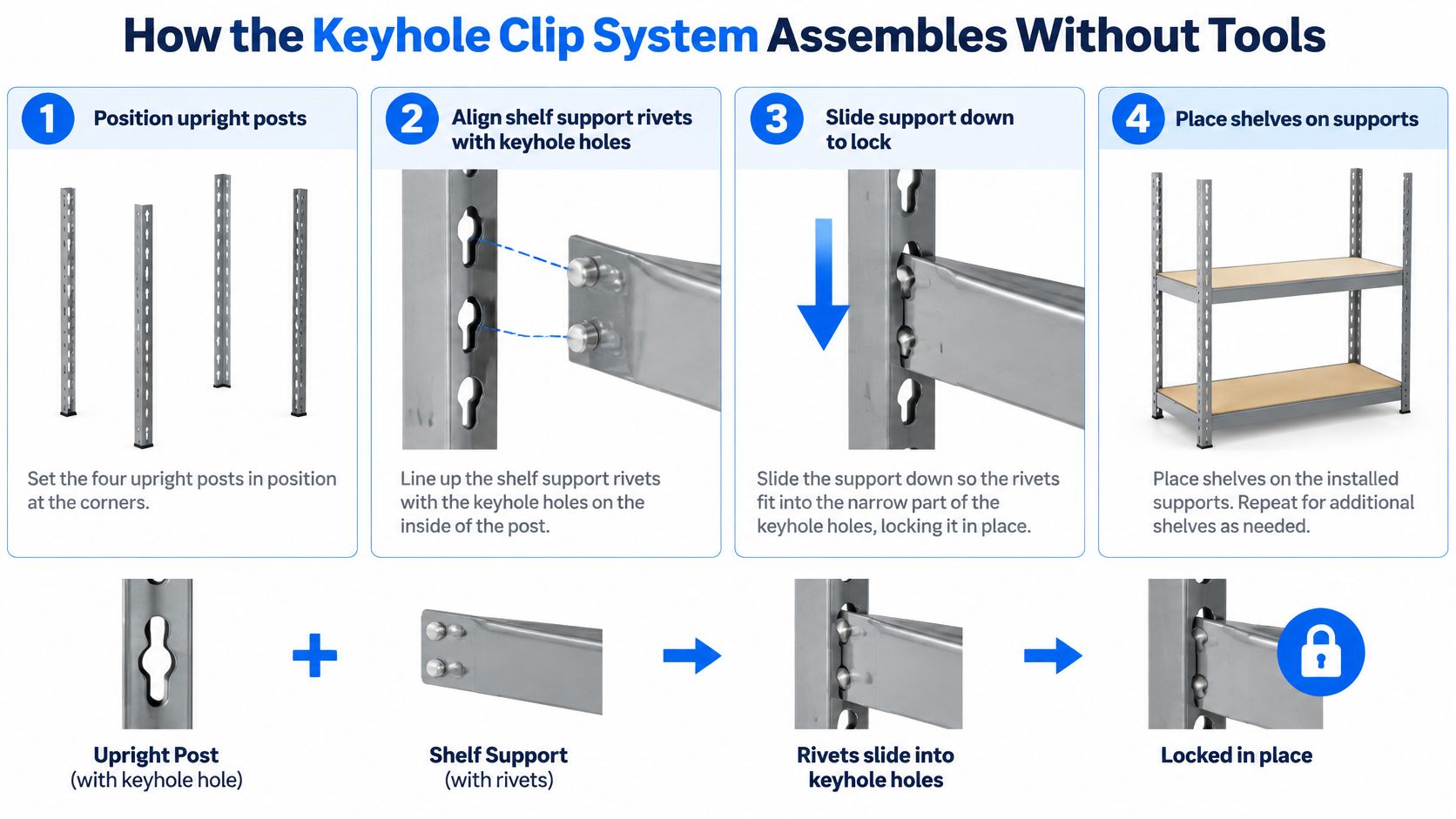
Follow the manufacturer's instructions for your configuration:
- Position the uprights. Start level and square on a suitable floor. Don't build around a lean.
- Align the supports. Use matching keyhole positions. Uneven heights can twist the frame.
- Seat every rivet. Check each connection before loading. Partial engagement isn't a locked connection.
- Place the shelves. Confirm they sit properly over both supports, not on an edge.
- Work upward. Complete each level before adding another. Don't leave loose supports behind.
- Check plumb and square. Use a level and inspect the corners. Don't assume straight-looking posts are aligned.
A finished bay should have level shelves, square corners, and no unexplained movement under a gentle hand check. That check doesn't replace required anchoring.
Shelf Gauges, Profiles and Load Ratings
Quik-Lok shelf profiles and steel gauges
| Component | Profile | Steel gauge | When to specify |
|---|---|---|---|
| Standard Quik-Lok shelf | 3/4 inch | 18 or 22 gauge | Lighter loads; confirm in the product spec |
| Heavy-duty support | 1 1/4 inch | 11 or 14 gauge | Moderate or heavy loading; reinforcement required |
| Per-shelf capacity | Configuration-specific | Match the complete assembly | Check the product spec for each configuration |
Aurora's Quik-Lok technical brochure specifies the profiles and gauges shown above and calls for additional reinforcement under moderate or heavy loading.
A lower gauge number means thicker steel. But a heavy-duty support isn't the same component as a shelf deck, and gauge alone doesn't establish the capacity of the complete bay.
Build the Load Specification
Before ordering:
- Define shelf width.
- Set shelf depth.
- Choose the steel gauge.
- Identify the reinforcement type.
- Estimate the uniformly distributed load per shelf.
For example, cartons spread across a shelf don't load it the same way as the same weight concentrated in one corner. Long spans and concentrated loads can increase bending even when the total weight appears acceptable.
Weigh your stocked cartons, not empty containers. Add their weights for each shelf, then compare that total with the rating for the exact shelf and support combination. The available summaries don't provide a universal per-shelf capacity.
Buying rule: If your load approaches the stated limit, or your inventory is dense, ask our product specialist about reinforcement before ordering the basic configuration.
Closed or Open Sides for Your Storage Job
Ask what matters most: dust exposure, quick stock checks, or controlled access. Side panels change visibility, but panels alone don't secure a bay.
Use this comparison to weigh access against enclosure.
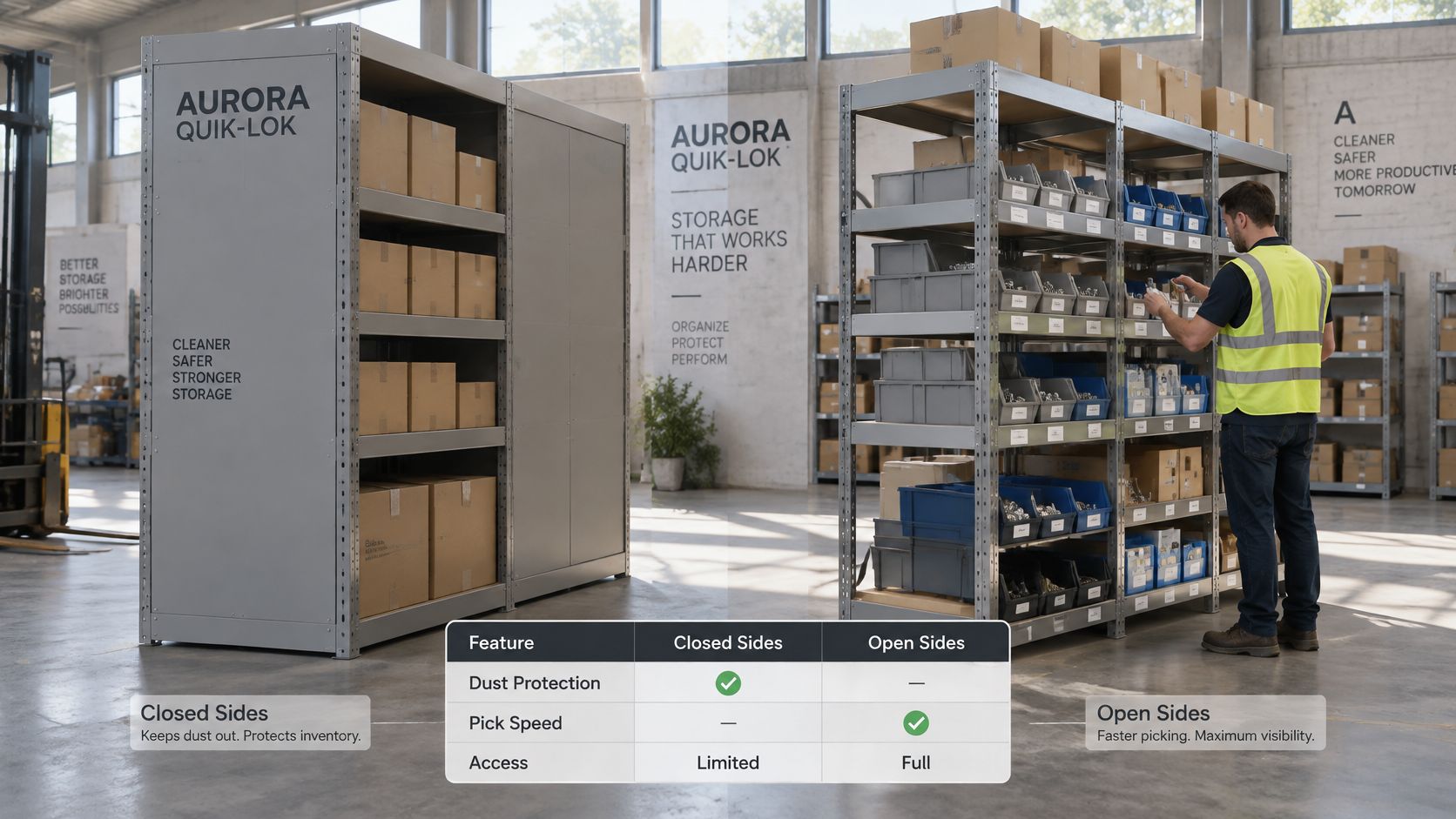
Open sides make bins easier to see and reach in a busy parts room. Closed sides help shield contents from surrounding activity, while records that need controlled access may also require suitable doors and locks. Neither style makes the system dust-tight.
- Open: Favor visibility and frequent picking.
- Closed: Favor enclosure, privacy, and reduced side exposure.
- Mixed: Use compatible enclosed and accessible bays for different stock.
Closed panels can reduce airflow and side visibility. Put clear labels along the front shelf edge so staff don't need to open or search every compartment.
For a larger building project, Heyaansh Industries Pvt Ltd's guide to specifying prefab sheds for warehousing projects addresses the enclosure around the storage area, not Quik-Lok compatibility.
The video provides another visual reference.
Accessories That Solve Common Storage Problems
Choose accessories for a clear task, not just because they fit the product family. Confirm availability and compatibility for your exact bay.
Quik-Lok accessories and the storage problem each solves
| Accessory | Storage problem it solves |
|---|---|
| Dividers | Split an open shelf into separate spaces for small parts or files |
| Bin fronts | Help retain loose contents and define the front edge of a compartment |
| Drawers | Keep small hardware enclosed and out of sight |
| Doors | Close a bay for reduced exposure and controlled access when suitably equipped |
| Back panels | Help prevent items from passing through the rear and block the rear view |
| Side panels | Enclose the exposed ends of a bay |
Dividers are useful when similar parts share a shelf. Drawers suit small hardware that would be awkward to pick from deep cartons. For parts rooms, records areas, pharmacies, or tool cribs, start with the handling task and verify any separate security or storage requirements.
Fit the Accessory to the Bay
- Divide first. Set compartment widths before choosing bin fronts.
- Use doors selectively. Enclosure adds an opening step during picking and restocking.
- Check rear exposure. Add compatible back panels where stock could slide through.
- Enclose walkway ends. Side panels can separate stored items from passing traffic.
Use our plastic shelf bin sizes chart to compare container dimensions before assigning compartments. When you browse Aurora accessories, match shelf width, post depth, attachment details, and door clearance to the product specification.
List the main problems in each bay, then assign an accessory to each problem. Leave out accessories that don't solve one.
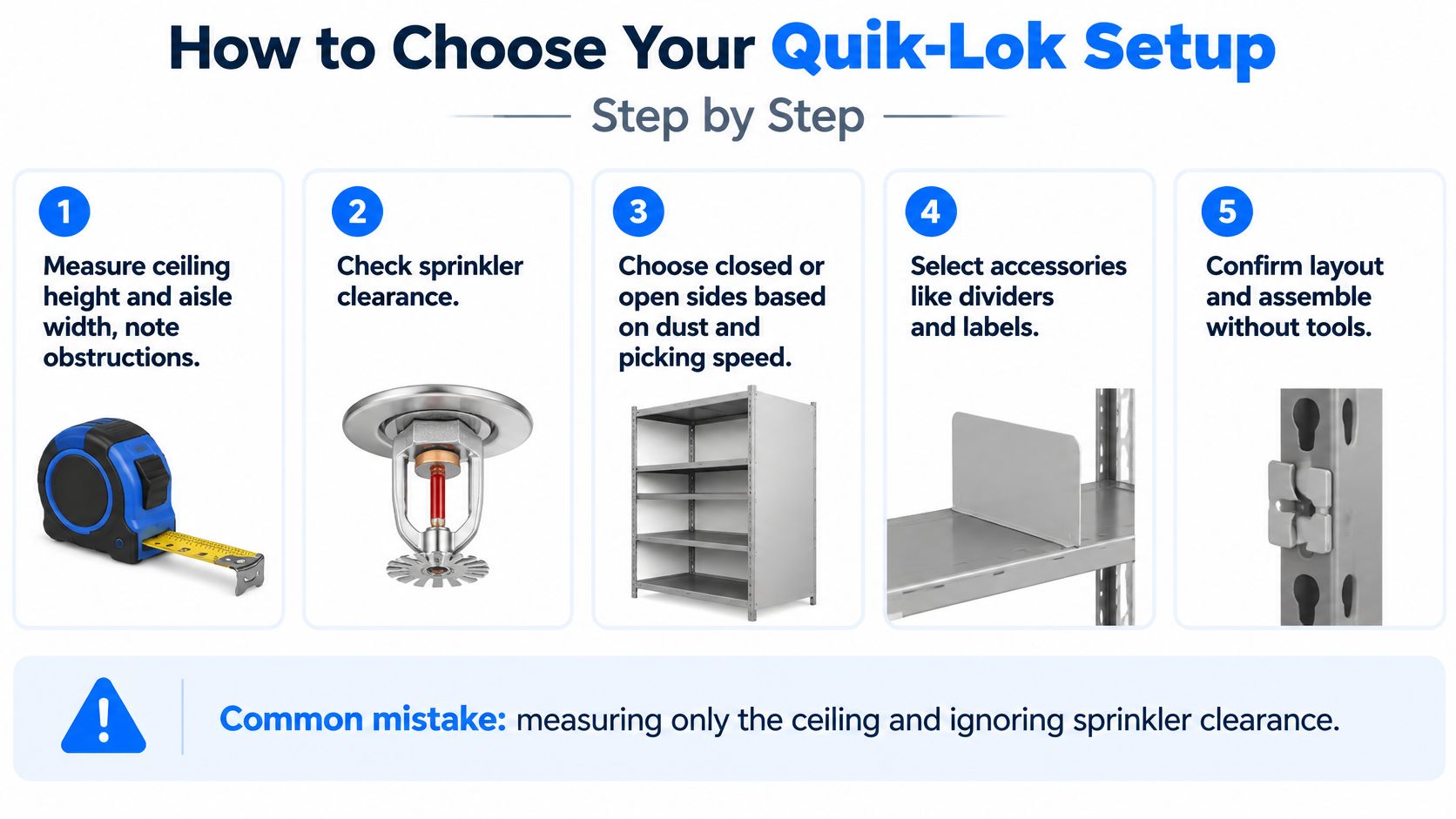
How to Choose Your Quik-Lok Setup Step by Step
Make the layout decisions before ordering components. Otherwise, a useful accessory can become an expensive mismatch.
- Measure the room. Record ceiling height, available footprint, and aisle width. Include columns, sprinkler heads, lights, and other obstructions, not just the ceiling.
- Choose height and width. Sketch the loaded bay in the room. Don't measure only the bare frame and overlook projecting containers.
- Set shelf depth. Use the largest container assigned to that bay. Don't oversize an entire row for an unusual carton that belongs elsewhere.
- Choose the side style. Balance access with enclosure. Closing every daily-pick compartment can slow replenishment.
- Match gauge and reinforcement to the load. Use stocked weights. Don't buy the lightest configuration without checking capacity.
- Confirm accessories. Check each part against the bay specification. Similar-looking doors and panels aren't proof of a match.
Material Handling USA provides buying guidance and planning tools. Our warehouse shelving guide can help you organize the room-level decisions before finalizing a component list.
Use this planning visual as a reminder, while keeping load verification and installation approval on your checklist.
When Quik-Lok Needs Engineering Review or Anchoring
A loaded bay is a storage structure, not tool-free furniture. Settle the floor, the stock, and the anchor plan before you order the frame. Aurora's Quik-Lok product guidance cautions that installations above the ground floor should have floor loads reviewed by a structural engineer.
I would pause the order when the layout shows an upper floor with thin load documentation, a tall shallow bay with heavy cartons on the top shelves, back-to-back rows concentrating weight on one slab area, or a site where seismic and code requirements are still unconfirmed with the responsible local professional. A short, deep bay loaded evenly still needs that same floor and anchor check. Lower height reduces the tipping concern. It does not replace the review. Reinforcement belongs in that same pre-order check whenever the shelf, support, and stock combination is moderate or heavy.
Separate Assembly From Structural Approval
The Quik-Base combines a shelf support, front base, and floor-anchoring device. Confirm the mandatory anchoring conditions, substrate requirements, and anchor selection for your floor in Aurora's installation documentation before you anchor the bay.
Ask Aurora and a local engineer to confirm the installation requirements. Use a qualified installer when anchoring or site conditions require work beyond basic assembly.
Assembly instructions explain how components connect. Site-specific approval determines whether the loaded installation suits the building.
After installation, inspect posts, supports, connections, and anchors on a documented schedule. Isolate damaged bays immediately and keep them out of service until assessed.
Quik-Lok Shelving FAQ
What Heights, Widths and Depths Are Standard?
Quik-Lok offers a broad set of standard dimensions, shown in the size table. Confirm the exact combination on the product specification, rather than assuming every height comes in every depth.
Can I Order Custom Sizes?
Yes, custom heights and widths are available in published increments. Ask for confirmation of the complete custom configuration, including compatible panels, doors, and supports.
Is Quik-Lok Tool-Free?
The core shelf assembly uses riveted supports seated in keyholes without conventional loose fastening hardware. Anchoring and other site work may still need tools and professional installation.
Should I Choose Open or Closed Sides?
Choose open sides when staff need clear views and frequent access. Choose closed sides for enclosure, then add appropriate doors if controlled access is part of the job.
When Do I Need Reinforcement?
Aurora calls for reinforcement under moderate or heavy loading. Have the shelf, support, and reinforcement combination checked against your actual inventory weight.
Do Upper Floors Need an Engineer Review?
Aurora advises structural review of floor loads above ground level. Include shelving weight, stored contents, and the proposed layout in that review.
Where Do I Confirm Capacity?
Use the specification for the exact configuration you're ordering. Don't apply a rating from a different shelf size, gauge, or support assembly.
Shop Aurora Quik-Lok Shelving in Stock
A buyer who treats Quik-Lok like tool-free furniture often orders shelves before the load path is settled. Start in shelving and storage racks. Open each listing and check current stock plus the specification for that exact bay.
Match the listing to the schedule you already wrote: height, width, depth, gauge, shelf openings, supports, reinforcement, and capacity. If the page does not answer a load or compatibility question, stop. Settle reinforcement, a floor review, or anchoring before you build the cart, not after freight is booked.
Material Handling USA, based in Salt Lake City, has supplied industrial products since 1997. Buyers shop 58,000+ in-stock SKUs, and the business serves customers nationwide. On a multi-bay job, confirm component availability and shipping arrangements. Do not assume every upright, shelf, and support will land on the same delivery.
Get a Project Quote
Volume pricing is available. Ask about quantity breaks by the case or pallet where the listing allows it, or use Request a Quote for a project-size order.
Confirm size and load first, then order. For pallet quantities, custom sizes, or a project quote, call a product specialist at 1-800-326-4403.
Material Handling USA sells shelving and storage racks and publishes buying guidance so you can match Quik-Lok components to the room and the inventory. Take your bay dimensions and load list to Material Handling USA, or call if the configuration still needs a check before you buy.