Borroughs Rivet Span Shelving: Sizes, Decks and Capacities

Does a shelf rated for 350 pounds support that load once you add decking? Not automatically. For standard units, the Borroughs Rivet-Span product specification applies that rating to the steel beam level under stated loading conditions, not automatically to the deck.
That distinction matters when you're buying Borroughs Rivet Span shelving for cartons, maintenance parts, or bulky inventory. You need the dimensions, beam arrangement, and deck capacity to match the goods, not just a capacity number that looks right.
Table of Contents
- What Borroughs Rivet Span Shelving Is
- Rivet Span Sizes From 36 to 96 Inches and Heights to 144 Inches
- Single and Double Rivet Beams Explained
- Particle Board, Wire and Steel Decks Compared
- How to Choose the Right Rivet Span Setup
- Rivet Span vs Box Edge and Flexi Bin
- Rivet Span Questions Buyers Ask Most
- Shop In-Stock Rivet Span Shelving Today
What Borroughs Rivet Span Shelving Is
Borroughs Rivet Span is boltless shelving assembled with a rubber mallet, without nuts, bolts, or clips. You can start with a starter unit and extend the run with compatible add-on units as your storage needs grow.
Say you're setting up a maintenance parts room. Vertical posts, side-to-side beams, and front-to-back beams form the frame. You select the combination that fits your cartons and parts rather than forcing everything into fixed shelf openings.
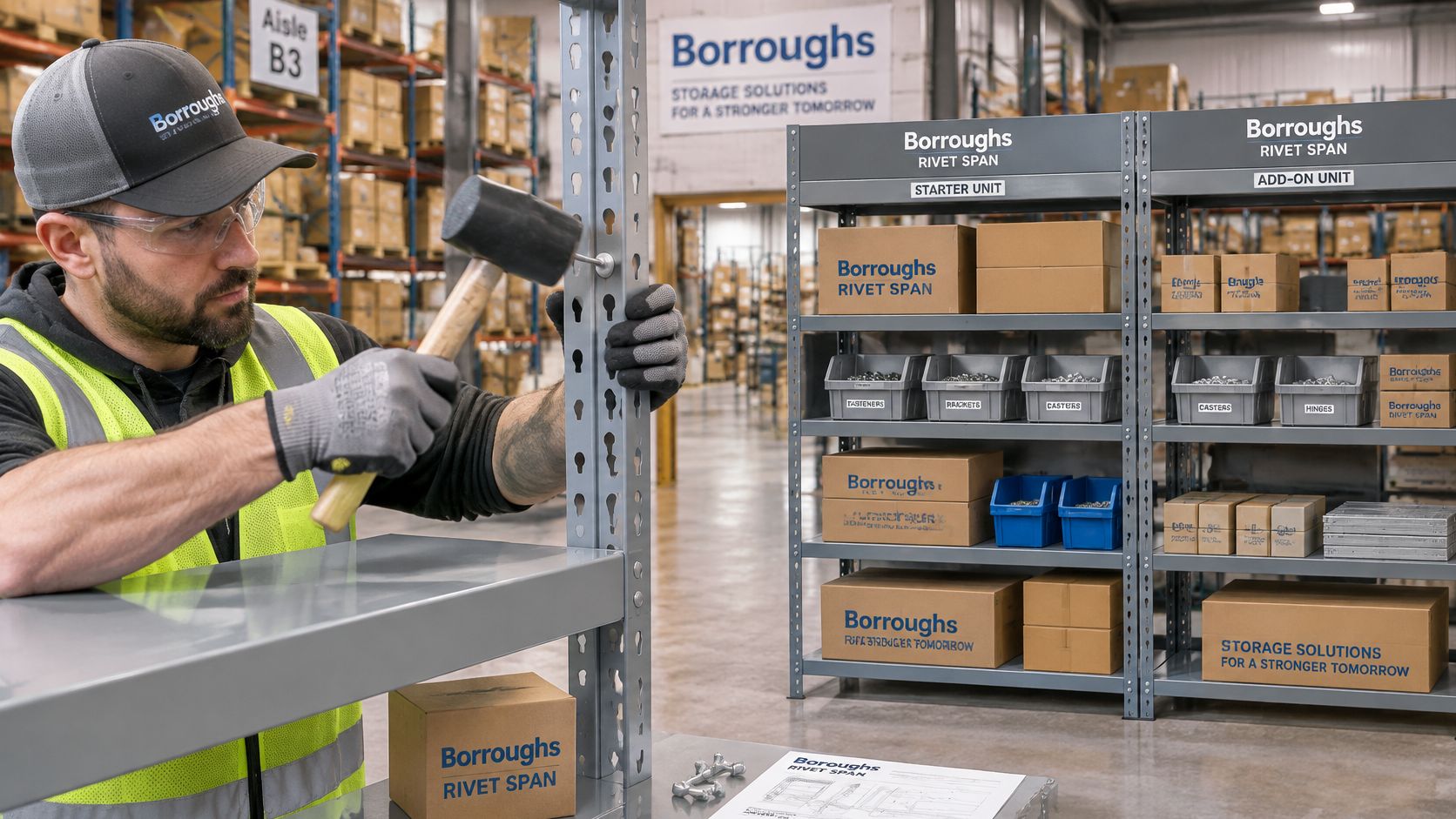
Borroughs' company history traces the manufacturer to Kalamazoo, Michigan, where Walter Borroughs founded it in 1938. Rivet Span belongs to that established industrial-storage product line.
The open layout supports access from several sides, making it useful for runs against a wall or double-entry parts storage. Open access doesn't mean you can omit required structural members.
Layout check: Mark which sides employees need to reach before choosing the run location.
You can shop Borroughs shelving by brand while checking how each configuration fits that access plan.
Rivet Span Sizes From 36 to 96 Inches and Heights to 144 Inches
Rivet Span dimensions and load ratings
The published dimensions and ratings below come from Borroughs' boltless shelving specifications, with the catalog span range identified separately.
| Specification | Published Value | What It Means for Your Setup |
|---|---|---|
| Nominal width | 36 to 96 inches | Match the run to your available wall or floor space |
| Nominal depth | 12 to 48 inches | Fit the carton or container footprint without overhang |
| Available heights | 84, 96, 120 and 144 inches | Check overhead clearance and safe picking access |
| Shelf adjustment | 1.5-inch centers | Keep openings close to the stored load |
| Standard load rating | 350 lb per beam level on four-level units | Confirm the exact configuration and loading conditions |
| Span range | 48 to 96 inches in the catalog | Check beam type and support requirements for the selected span |
| Example beam pair capacity | Selected 48-inch spans reach 1,600 lb; selected 60-inch configurations reach 2,250 lb | These are configuration-specific examples, not universal span ratings |
| Post and beam steel | 14-gauge steel on standard units | Match replacement components to the specified frame |
| Common decking | 5/8-inch particle board | Check its capacity separately from the beams |
Read capacity by configuration
The higher beam-pair examples aren't upgrades you can assume apply to a standard unit. They refer to selected beam types and arrangements. A longer shelf doesn't automatically hold more, and a shorter shelf isn't automatically rated for the highest figure shown.
The longest beam pair at a level controls that level's beam capacity. Published beam ratings also exclude the decking, so the beam table alone doesn't establish the usable load for your completed shelf.
Measure the goods before the space
Measure the widest carton and its front-to-back footprint. Then check the handling clearance needed to lift it out without scraping the shelf above.
Choose height around your picking method, not just available ceiling space. Tall storage needs a workable way to reach the upper levels and the structural members required for that configuration.
Write down width, depth, height, and heaviest load per level before you browse shelving and storage racks. Check the individual product specification for dimensions or combinations not shown here.
Single and Double Rivet Beams Explained
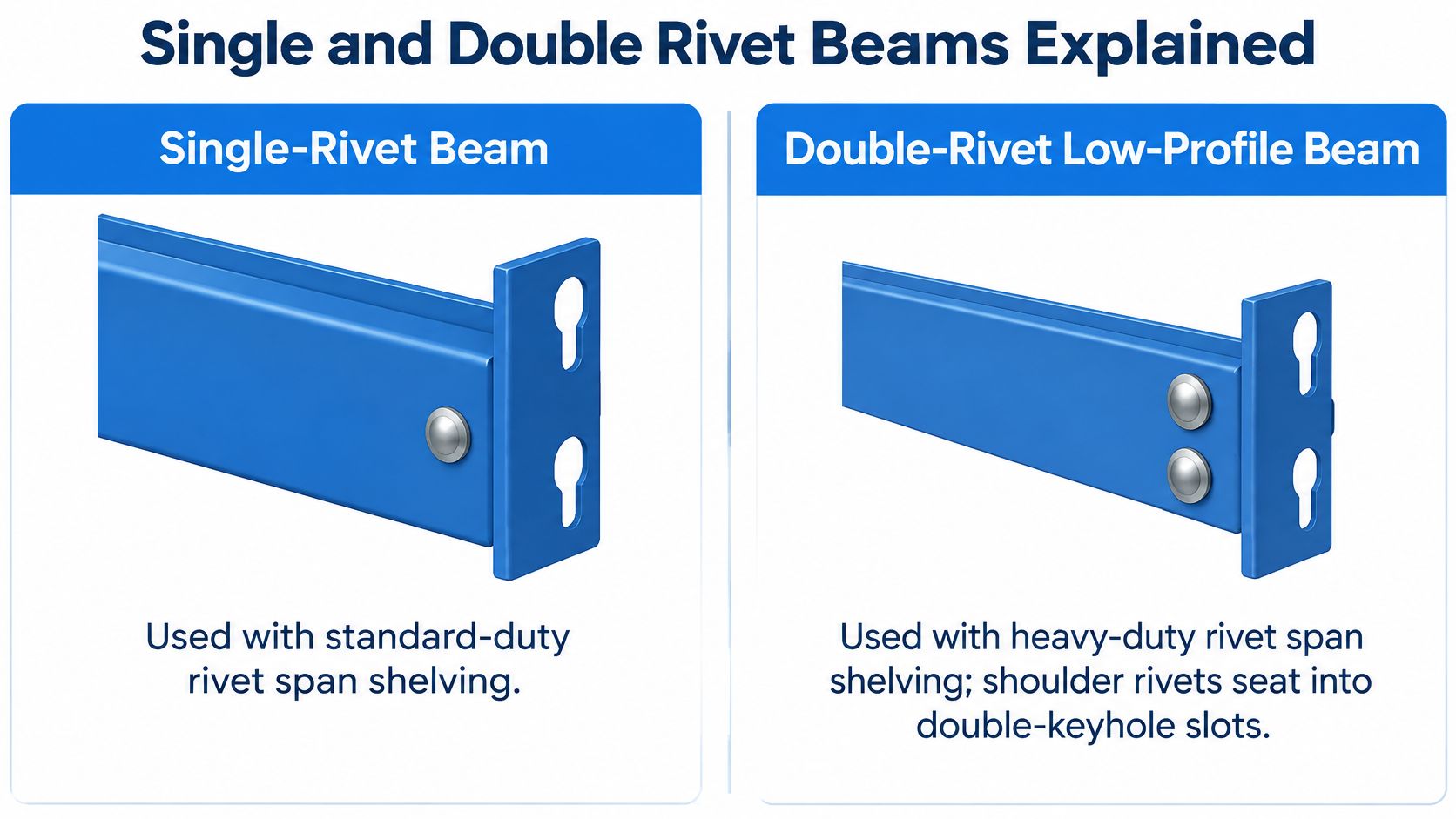
Single-rivet beams serve standard-duty shelving. Double-rivet low-profile beams serve heavy-duty shelving. The Borroughs Rivet-Span brochure identifies those uses and explains how shoulder rivets engage double-keyhole slots in the posts.
Think of the beams as the load-carrying rungs of the frame. Their section and connection matter, but you still need the correct arrangement around the whole unit.
The perimeter isn't optional
The brochure requires a complete double-rivet beam perimeter at both the top and bottom of every unit. Each perimeter includes two side-to-side beams and two front-to-back beams.
That requirement applies even when intermediate shelf levels use a different beam arrangement. Don't treat the bottom perimeter as spare parts because your lowest stored item sits higher up.
- Wrong substitution: Putting single-rivet beams into a required double-rivet perimeter.
- Missing member: Removing a perimeter beam to slide a large item through the opening.
- Incomplete connection: Leaving a rivet partly seated instead of checking engagement before loading.
A basic unit provides access from all sides without cross braces or face braces. Required perimeter members still belong in place, and taller configurations may need additional ties.
Shelf adjustment lets you place levels close to the goods, but it doesn't change which beam belongs in a required structural position. Before assembly, compare the packing list with the installation drawing, then separate the perimeter beams from the intermediate shelf components.
Particle Board, Wire and Steel Decks Compared
Steel beam capacity and deck capacity are separate checks. The Borroughs Rivet-Span catalog excludes decking from its published beam ratings and requires the frame, beams, and support arrangement to work together.
Particle board is a common choice for boxed goods. Wire and steel offer different storage surfaces, but neither should be selected on appearance alone.
| Deck Type | Best Use | Load Note | Where to Verify |
|---|---|---|---|
| Particle board, 5/8-inch | Cartons and light to medium bulk goods, subject to rating | Separate capacity from the steel beams | Rated deck load per level on the product spec |
| Wire deck | Bins and mixed parts where airflow and visibility matter | No deck rating established here | Rated load and support requirements on the product spec |
| Steel deck | Items needing a solid surface, including irregular parts after load review | A solid surface doesn't establish capacity | Rated load per level on the product spec |
Even loads and concentrated loads
A row of cartons spreads weight differently from a casting resting on narrow feet. Machinery feet, dense parts, and stacked drums can concentrate weight in a small area, causing local deck damage even when total weight appears acceptable.
Don't divide a heavy item's weight by the shelf area and call it a uniformly distributed load. The actual contact points still matter.
For heavier or irregular items, confirm both the deck rating and any required supports. Tall units also need the prescribed intermediate ties, so don't remove them to make loading easier.
List each item type, mark its load as distributed or concentrated, and assign a suitable deck to each level.
How to Choose the Right Rivet Span Setup
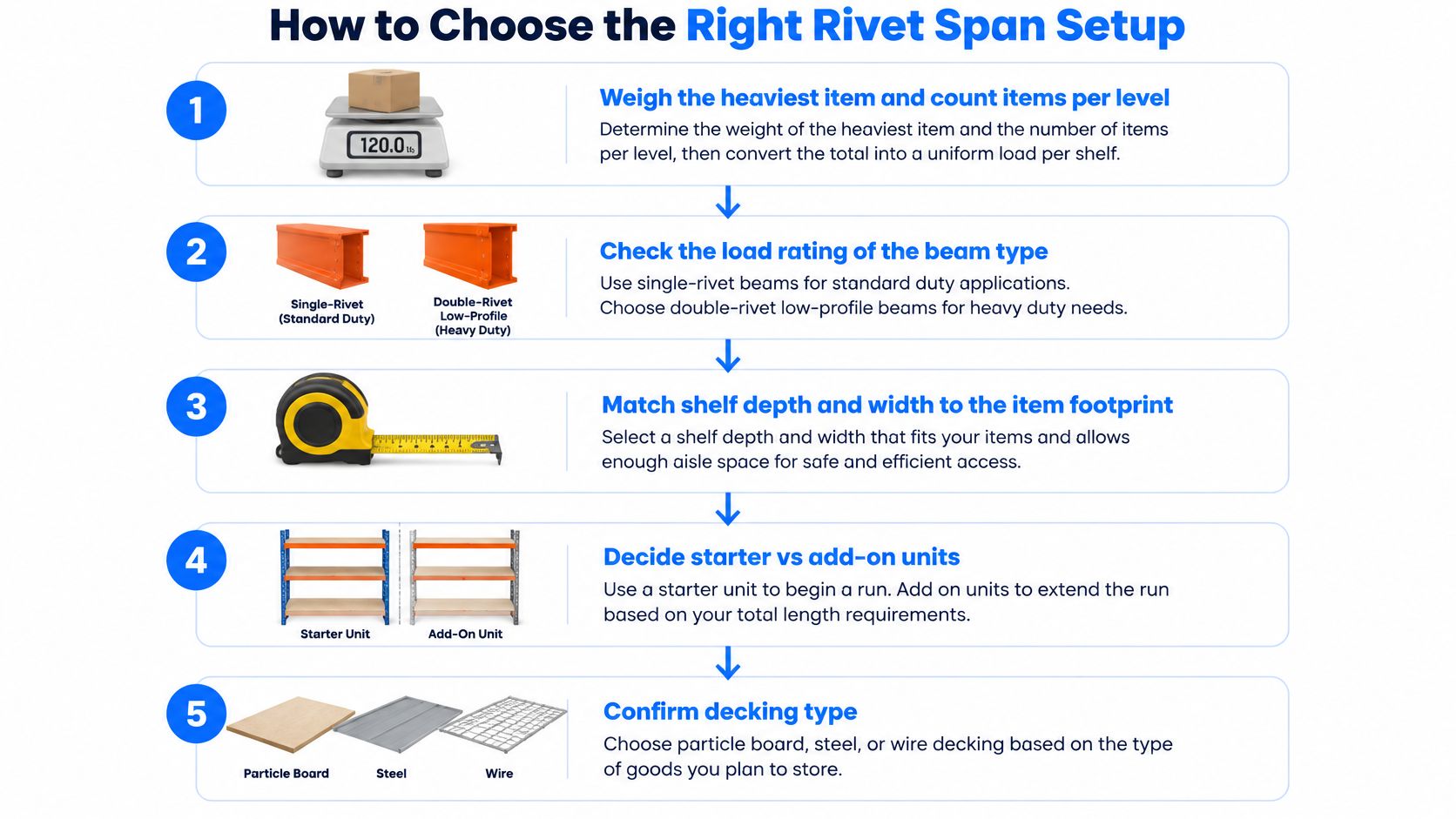
Use a notepad, tape measure, and scale to build a complete specification. Our warehouse shelving buying guide can help you organize the layout before you select individual components.
-
Record the load. Weigh the heaviest item and count how many items will occupy each level. Total the weight, then describe how it contacts the deck, evenly spread cartons and narrow machinery feet need different reviews.
-
Choose the footprint. Match shelf width and depth to the goods and the available aisle space. Avoid carton overhang, especially where employees walk or move carts.
-
Set usable shelf openings. Allow enough hand clearance to grip and remove the load. Use the available adjustment positions rather than leaving large empty gaps above short cartons.
-
Select the beam arrangement. Choose the duty level that matches the intended load. Keep the required double-rivet perimeter intact regardless of the intermediate shelf arrangement.
-
Check span and height together. Read the capacity table for the actual beam pair, not a similar-looking unit. Include all intermediate ties required for the chosen height.
-
Assign each deck. Match in-stock shelving decks to the goods, then confirm the selected deck's rating and fit. Include concentrated-load details in the quote request instead of describing every load as evenly distributed.
-
Lock the complete parts list. Identify starters, compatible add-ons, beams, posts, decks, and supports as one assembly. Matching nominal dimensions alone doesn't establish component compatibility.
Send one complete quote request
Save your measurements, load descriptions, and component choices together. Add a simple floor sketch showing the wall, aisle, and required access sides.
That gives a product specialist enough detail to check the assembly instead of quoting disconnected parts. If you expect different goods later, describe those too, without assuming unused beam capacity guarantees a suitable deck.
Rivet Span vs Box Edge and Flexi Bin
Rivet Span is open bulk storage. Box Edge is clip-style steel shelving with closed sides for small-parts storage. Start with that difference before comparing individual capacities.
Closed sides help contain parts, but they don't replace bins or dividers for sorting. Open shelving gives you more loading access, but loose small items still need suitable containers.
| Feature | Rivet Span | Box Edge |
|---|---|---|
| Construction | Boltless rivet connections with steel posts and beams | Clip-style steel shelving |
| Sides | Open, with access from all sides on a basic unit | Closed sides |
| Best use | Bulk goods, cartons, and larger parts | Small parts needing enclosure |
| Assembly | Rubber mallet, without nuts or bolts | Check the model's assembly instructions |
| Shelf adjustment | Slotted-post adjustment | Confirm spacing on the product spec |
| Standard load rating | Check the selected beam-level configuration | Confirm the selected model's rating |
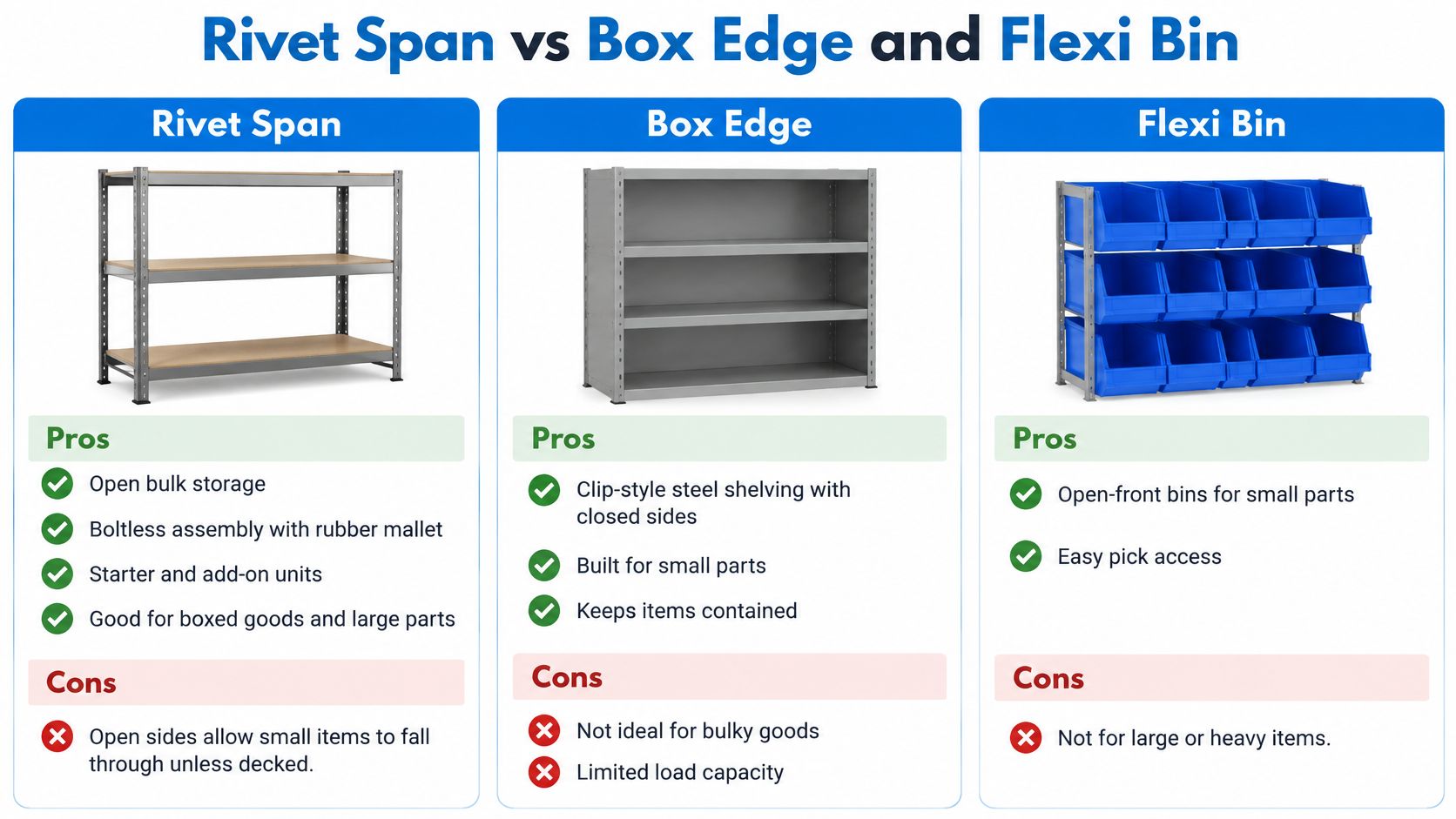
Choose by the stored item
For bulky cartons or parts loaded from several sides, Rivet Span is a practical starting point. For small parts needing side enclosure, consider Box Edge.
Flexi Bin is a separate product family. Confirm its construction, access, and load ratings on the exact product specification before treating it as an alternative. The graphic is a selection aid, not evidence of comparative load capacity.
Use these questions to sort your inventory:
- Packaging: Is the item loose, boxed, or already stored in a bin?
- Containment: Does it need closed sides or separate compartments?
- Change: How often will employees need to reset the storage openings?
If you're also considering wire shelving, use the chrome wire shelving sizes guide to check that different system's footprint. Don't transfer its ratings or component assumptions to Rivet Span.
Rivet Span Questions Buyers Ask Most
Does Rivet Span need tools?
A rubber mallet seats the rivet connections, and there are no nuts or bolts to torque. That is the full tool list for a standard build. Follow the model's assembly instructions for bracing order, since a frame assembled out of sequence can end up out of square even when every beam clicks into place.
Can I add units later?
Yes. Compatible add-on units extend an existing run rather than standing alone. Confirm the connection arrangement and parts list before ordering, because an add-on kit depends on the starter frame it attaches to.
Can every shelf hold the advertised beam load?
No. Where a 350-pound rating is listed, it covers the steel beam level under stated loading. The decking carries its own limit, and the longest beam pair at a level sets what that level can hold. A beam rating alone is not permission to load the finished shelf.
Can I remove a brace for access?
Not without reassessing stability. Perimeter members and intermediate ties keep the frame square, and removing one changes how the load travels through the unit. Keep them in place unless the manufacturer approves a revised configuration.
Does Rivet Span suit irregular parts?
Yes, when the deck and frame match the goods. Parts with feet, narrow edges, or small contact areas concentrate weight in a small footprint, so check the load against the deck spec, not just the beam number.
Can shelf height change after setup?
Yes, levels reposition in the post slots. Unload the affected level first, reseat the beams fully, and recheck the configuration whenever the goods or loading pattern changes.
What if I need a size not listed?
Check the exact product specification or call 1-800-326-4403. Have your dimensions and load details ready.
Shop In-Stock Rivet Span Shelving Today
Material Handling USA sells shelving and storage racks with volume pricing, including price breaks by the case or pallet where listed. You can shop Borroughs shelving by brand or browse shelving and storage racks to check current in-stock options.
Based in Salt Lake City and serving businesses since 1997, we ship nationwide. Check the selected product page for the actual configuration and availability rather than assuming every catalog combination is stocked.
Bring a complete specification
For pallet quantities, custom sizes, or a project-size quote, call 1-800-326-4403, Monday to Friday, 8 AM to 5 PM MT.
Have these details ready:
- Dimensions: Width, depth, overall height, and level count.
- Components: Beam type, deck type, starters, and add-ons.
- Loading: Heaviest load per level and any concentrated contact points.
Choose the level count, beam type, and decking before placing the order so the assembly can be checked as a whole.
Material Handling USA offers shelving and storage racks, volume pricing, and phone support to help you match a Rivet Span configuration to your inventory. Visit Material Handling USA to shop matching items, or call with your dimensions and load details for a project-size quote.