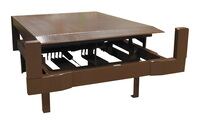
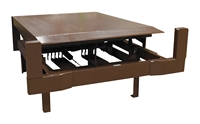
Dock Plates vs. Dock Boards: Which Do You Need?
This is the most important distinction in loading dock equipment. Both bridge the gap between a loading dock and a truck bed, but they're designed for very different load types:
| Feature | Dock Plate | Dock Board |
|---|---|---|
| Side curbs/legs | None (flat plate) | Yes — raised flanges |
| Best for | Hand trucks, pallet jacks, carts, foot traffic | Forklifts, heavy power equipment |
| Typical capacity | 5,000 – 15,000 lb | 15,000 – 40,000 lb |
| Material | Aluminum (most common) or steel | Steel (most common) or aluminum |
| Weight | Light — repositionable by hand | Heavy — often moved with forklift |
| Price range | $ | $$–$$$ |
Simple rule: If a forklift crosses it, use a dock board. If only hand equipment and foot traffic cross it, a dock plate is sufficient.
Dock Plate Materials: Aluminum vs. Steel
Aluminum dock plates are the standard for most facilities. They're lightweight (easy to reposition by one or two workers), rust-resistant, and work well for pallet jack and hand truck use. A standard 60×60" aluminum plate weighs 60–90 lbs and can handle 10,000–15,000 lb capacity.
Steel dock plates and boards are heavier but stronger — required for forklift traffic. They can handle the dynamic loads a forklift generates (sudden starts, turning, heavy concentrated loads) that would permanently bend an aluminum plate. Steel dock boards range from 30,000 to 60,000 lb capacity.
Sizing Your Dock Plate or Board
Two measurements matter: width and length.
- Width: At minimum, match the widest load you'll move. For full-width pallet access, use the trailer's interior width (~94–96") plus 6–12" clearance on each side. Common widths are 60", 72", 84", and 96".
- Length: Longer plates = shallower grade = safer, easier travel. The standard is a maximum 7% grade (1" rise per 14" of length). To calculate: divide your height differential by 0.07. A 6" height difference = minimum 86" plate length. A 12" difference = minimum 170" — at which point a dock leveler becomes the better solution.
Dock Levelers: When to Upgrade from a Portable Plate
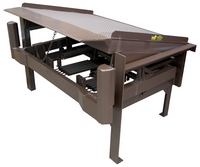
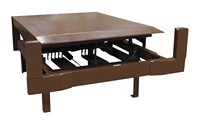
A dock leveler is a permanent, pit-mounted platform built into the dock face that hydraulically adjusts to meet any truck bed height. Levelers make sense when:
- You process 10+ trucks per day
- Height differentials vary widely (different truck types)
- Forklifts are crossing continuously
- Worker safety and ergonomics are a priority
Mechanical levelers use a spring-loaded lip that is manually activated — lower cost but requires the worker to engage the lip for each truck. Hydraulic levelers raise and lower at the push of a button — safer, faster, and standard for high-volume operations.
Dock leveler capacity is typically rated at 25,000–80,000 lbs; width options include 6', 7', and 8'. Contact our team for dock leveler installation quotes.
Dock Bumpers: Protecting Your Building and Equipment
Dock bumpers absorb the impact when a truck backs into the dock face. Without bumpers, trucks damage the building structure, and buildings damage truck bodies. The main types:
- Laminated dock bumpers: Stacked rubber layers bonded together — the most common type. Available in various thicknesses (4.5"–10") and sizes. Good balance of cost and performance.
- Molded rubber bumpers: One-piece construction, more durable in high-impact environments, less likely to delaminate under repeated heavy impact.
- Steel-reinforced bumpers: For very high-impact applications or facilities with truck traffic that isn't well-controlled.
Bumper projection (how far they extend from the dock face) should match or slightly exceed the lip of your dock seal or shelter to prevent seal damage.
Dock Lights and Safety Equipment
OSHA requires adequate lighting at loading docks. Proper dock lighting reduces accidents during night or early-morning operations. Dock-mounted LED work lights on articulating arms (which extend into the trailer) allow workers and forklift operators to see into the trailer without relying on the trailer's interior lighting (which is often absent).
Additional safety equipment to consider:
- Wheel chocks: Prevent truck movement while loading — required by OSHA in most applications.
- Dock seals and shelters: Provide weather protection and improve energy efficiency by sealing the gap between building and truck.
- Vehicle restraints: Mechanical hooks that lock onto the truck's ICC bar — more reliable than wheel chocks alone for heavy forklift use.